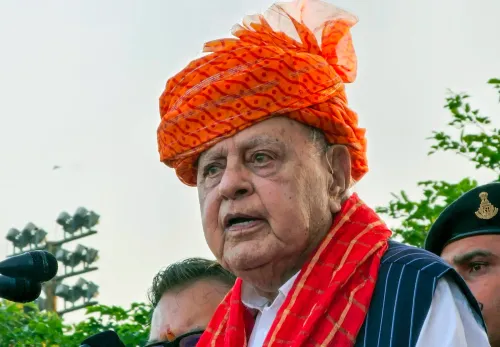
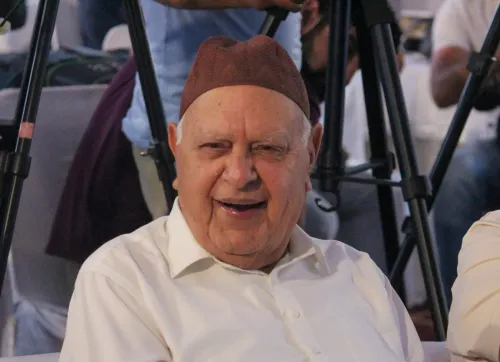
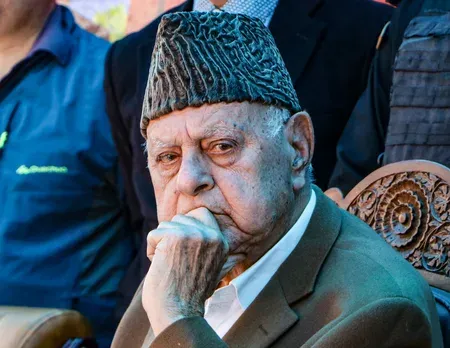
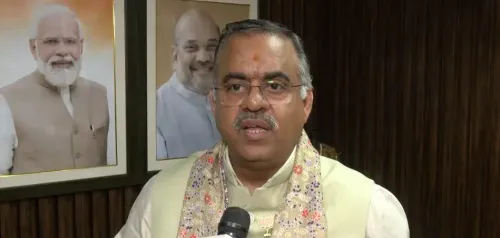
Pralhad Joshi slams Farooq Abdullah over pro-Pakistan remarks
Synopsis
Union Minister Pralhad Joshi has sharply attacked National Conference leader Farooq Abdullah for allegedly praising Pakistan, calling it an insult to Indian soldiers and a betrayal of the Ambedkar-crafted Constitution that gave the Abdullah family their political power.
Key Takeaways
Union Minister Pralhad Joshi publicly accused Farooq Abdullah of insulting Indian soldiers by praising Pakistan, on October 25, 2026 .
Joshi argued the Abdullah family's political power derived entirely from Dr.
Ambedkar's Indian Constitution, which they were now allegedly disrespecting.
The BJP minister invoked the post-2019 Article 370 revocation as evidence of peace and progress in Jammu and Kashmir under PM Modi .
Joshi dismissed Pakistan's moral authority on Kashmir, stating it 'cannot even save its own people.' The specific Farooq Abdullah remarks cited in the post could not be independently verified at the time of publication.
The statement continues the BJP's broader pattern of targeting National Conference leaders over perceived sympathy toward Pakistan on the Kashmir question.
A sharp political volley flew across the J&K narrative on Sunday, October 25, 2026, as Union Consumer Affairs and New and Renewable Energy Minister Pralhad Joshi publicly accused National Conference leader Farooq Abdullah of insulting Indian soldiers by praising Pakistan — remarks Joshi called a betrayal of the very Constitution that put the Abdullah family in power.
Joshi's post pulled no punches: 'By praising Pakistan, he has insulted our brave soldiers who protect Jammu and Kashmir every single day.' He invoked Dr. B.R. Ambedkar, framing the Indian Constitution as the foundational source of the Abdullah family's political fortunes — and, in the same breath, the document they were now allegedly disrespecting.
The Ambedkar card and the constitutional argument
B.R. Ambedkar, chairman of India's Constituent Assembly, is widely regarded as the principal architect of the Indian Constitution. By anchoring his critique in Ambedkar's legacy, Joshi cast the Abdullah family's stance not merely as a foreign-policy disagreement but as ingratitude toward the democratic framework that enabled their decades in power as Chief Ministers and MPs in Jammu and Kashmir. It is a framing the BJP has deployed with increasing frequency to place constitutional loyalty at the centre of the J&K political debate.
Post-2019 J&K and the BJP's integration narrative
Joshi's broadside arrives in the context of a transformation the central government has pointed to repeatedly. In August 2019, the Modi government revoked Article 370, ended Jammu and Kashmir's special constitutional status, and reorganised it as a Union Territory. Since then, New Delhi has consistently framed the change as the gateway to peace, development, and administrative normalcy in a region long scarred by insurgency. 'Under Prime Minister Modi, Jammu and Kashmir has left behind years of violence to enjoy peace, schools, and real progress,' Joshi wrote, condensing that narrative into a single sentence.
The National Conference, led by the Abdullah family — Farooq Abdullah and his son Omar Abdullah — has historically advocated for regional autonomy and has been a central target of BJP criticism for what the party characterises as soft or ambiguous positions on Pakistan's role in Kashmir. The specific remarks by Farooq Abdullah that triggered Joshi's post could not be independently verified at the time of publication.
Pakistan in Joshi's crosshairs
Joshi's sharpest rhetorical line may have been his dismissal of Pakistan's standing as a protector: 'Pakistan cannot even save its own people, let alone protect anyone else.' It is a pointed reference to Pakistan's persistent domestic instability — economic crises, political upheaval, and security challenges that have dominated its internal landscape in recent years. The argument reframes any Pakistani claim over Kashmiri welfare as hollow on its face.
Joshi closed with a direct demand: the Abdullah family must 'stop their pro-Pakistan talk and start respecting the Indian constitution that gave them their power.' The language is designed to put National Conference leaders on the defensive, forcing a choice between defending the remarks or distancing themselves from them.
With J&K politics never far from the national spotlight, Joshi's intervention ensures this particular exchange will reverberate well beyond a single post — and puts the National Conference on notice that every statement touching Pakistan will be treated as a defining political test.
Point of View
And frame any sympathy for Pakistan's position as a disqualification from Indian democratic life. By invoking Ambedkar, the BJP widens the argument beyond foreign policy into a question of foundational values — making it harder for the National Conference to respond on narrow political terms. The intervention also signals that the central government intends to keep the J&K integration narrative front and centre heading into any electoral or administrative cycle in the Union Territory. Whether Farooq Abdullah responds, and how, will determine whether this becomes a sustained controversy or a one-day skirmish.
NationPress
25 Oct 2026
Frequently Asked Questions
What did Pralhad Joshi say about Farooq Abdullah?
Union Minister Pralhad Joshi accused Farooq Abdullah of insulting Indian soldiers by praising Pakistan, saying the National Conference leader was acting as a 'megaphone' for a neighbour that 'only spreads trouble,' and demanded he stop pro-Pakistan talk.
Why did Pralhad Joshi mention Ambedkar in his post?
Joshi invoked Dr. B.R. Ambedkar, the principal architect of the Indian Constitution, to argue that the Abdullah family's political power was built on Indian democracy and the Constitution — implying their alleged pro-Pakistan stance was a betrayal of that foundation.
What happened to Jammu and Kashmir's special status?
In August 2019 the Government of India revoked Article 370, ending Jammu and Kashmir's special constitutional status and reorganising it as a Union Territory under direct central administration.
Has BJP criticised National Conference over Pakistan before?
Yes. Criticism of National Conference leaders — including Farooq and Omar Abdullah — over positions seen as sympathetic to Pakistan on the Kashmir issue has been a recurring theme in BJP political messaging, particularly since the 2019 reorganisation of J&K.
What were Farooq Abdullah's exact remarks about Pakistan?
The specific remarks by Farooq Abdullah that prompted Joshi's post could not be independently verified at the time of publication; Joshi characterised them as 'praising Pakistan' without quoting them verbatim.