President Murmu at Bastar Dussehra: 'I Am a Maanjhi's Daughter'
Synopsis
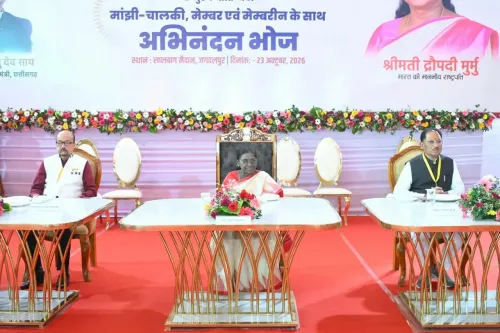
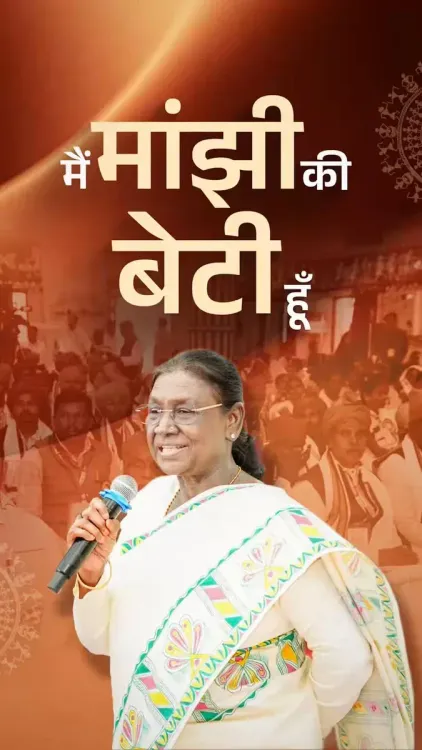
President Droupadi Murmu addressed Bastar Dussehra at Jagdalpur's Lalbagh Maidan on October 23, 2026, identifying herself as 'a Maanjhi's daughter' and urging tribal communities to preserve their culture even as they embrace development.
Key Takeaways
President Droupadi Murmu attended the Bastar Dussehra 2026 celebrations at Lalbagh Maidan, Jagdalpur on October 23, 2026 .
She identified herself as belonging to tribal culture, saying 'I am a Maanjhi's daughter' — invoking the Santhal village-headman tradition of her Odisha heritage.
Her message paired a call for development with an 'urge' to always preserve tribal tradition.
Bastar Dussehra is one of India's longest indigenous cultural festivals, rooted in goddess Danteshwari worship rather than mainstream Ramayana narratives.
President Murmu is the first person from a tribal community to hold the office of President of India, elected in 2022 .
The Ministry of Tribal Affairs instituted Janjatiya Gaurav Divas in 2021 to honour tribal heroes alongside development policy.
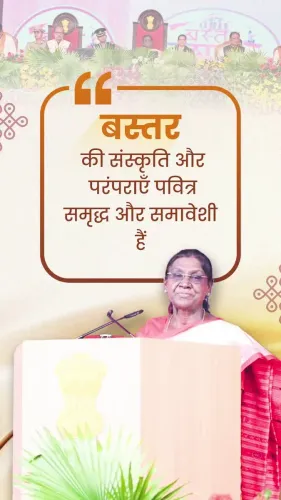
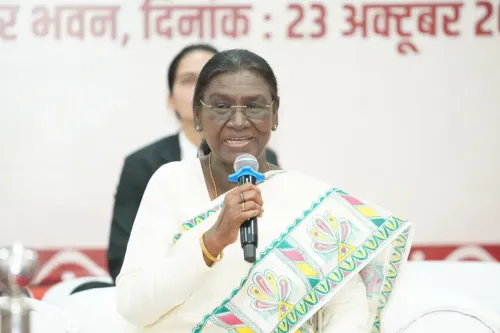
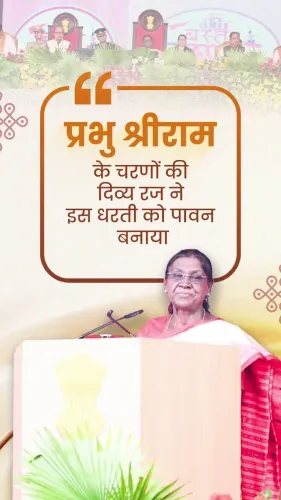
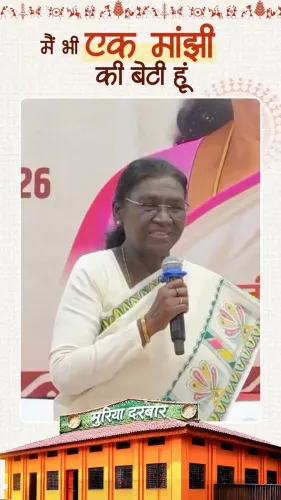
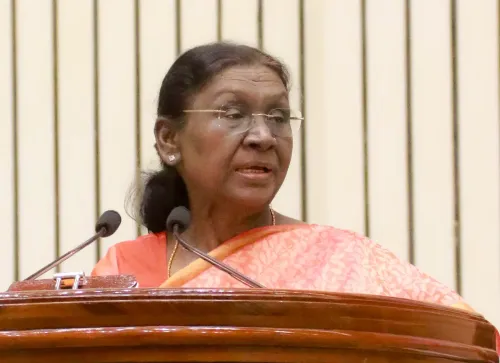
At Lalbagh Maidan in Jagdalpur on Friday, October 23, 2026, President Droupadi Murmu did something no prepared speech could replicate — she placed herself inside the story. 'I too come from this tribal culture and tradition,' she told the crowd gathered for the Bastar Dussehra festival. 'I am a Maanjhi's daughter.' Six words, and the distance between the highest constitutional office in India and a forest village in central Chhattisgarh collapsed.
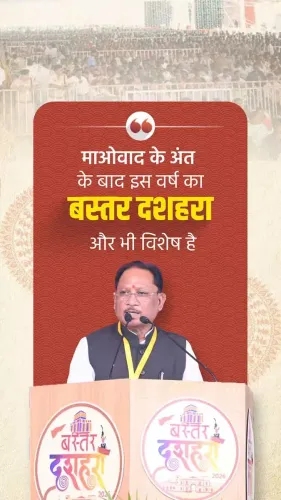
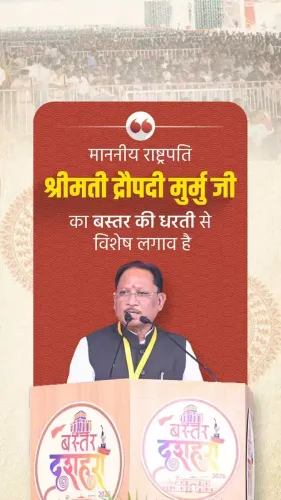
The Chief Minister's Office of Chhattisgarh shared the President's remarks on X, quoting her in full: 'मैं भी इसी आदिवासी संस्कृति और परंपरा से आती हूं' — 'I also come from this very tribal culture and tradition.' Her appeal was direct: pursue development, yes, but never let go of this heritage.The Weight Behind 'Maanjhi's Daughter'
President Murmu belongs to the Santhal tribe of Odisha — a community where the 'Maanjhi' is the village headman, a figure of both governance and spiritual authority. By invoking that identity at Bastar Dussehra, she was not delivering a courtesy address. She was asserting a lineage. The Santhal Maanjhi system is among the oldest forms of customary self-governance in the subcontinent, and naming it here — in the heartland of a different but equally ancient tribal civilisation — sent a signal of solidarity that cut across regional boundaries. Bastar Dussehra is itself unlike any other festival in India. Spanning roughly 75 days, it pre-dates the mainstream Hindu calendar version and is rooted in the propitiation of the goddess Danteshwari, the presiding deity of the Bastar region. The festival is not a re-enactment of the Ramayana's conclusion — it is the living ritual calendar of the tribal confederacy that once constituted the Bastar kingdom. Royal rites, forest deity worship, and the participation of dozens of tribal clans make it one of the longest-running indigenous cultural festivals anywhere in the world.Development and Tradition — Murmu's Dual Imperative
The President's framing was deliberate: 'Move forward with the idea of development, but I urge you to always preserve this tradition.' That pairing — vikas alongside cultural continuity — is not accidental. It reflects a tension that Chhattisgarh, with one of India's highest proportions of Scheduled Tribe population, navigates constantly. Mining, infrastructure, and welfare delivery in Scheduled Areas under the Fifth Schedule of the Constitution demand economic integration; tribal communities simultaneously assert the right to define the terms of that integration. The central government formalised this balancing act in 2021, when the Ministry of Tribal Affairs instituted Janjatiya Gaurav Divas to honour tribal heroes and ensure cultural preservation runs parallel to development policy. Presidential participation in events like Bastar Dussehra reinforces precisely that constitutional commitment — symbolic recognition with policy weight behind it.Why Jagdalpur, Why Now
Jagdalpur, the headquarters of Bastar district, sits at the cultural and administrative centre of a region that has historically seen both deep state investment and acute development challenges. The Lalbagh Maidan venue, where the President spoke, is the festival's ceremonial heart — the ground where tribal processions converge and the state's acknowledgement of that culture is made visible. A sitting President appearing here is not routine; it is a statement that the tribal identity she represents is not peripheral to the Indian republic but foundational to it. For the communities in attendance, her words offered something rarer than a welfare announcement — a mirror, held up by the country's first citizen, in which they could see themselves reflected without apology.Point of View
Hosting the President at this festival reinforces the state's positioning on the Viksit Chhattisgarh development agenda while simultaneously signalling cultural sensitivity — a dual message aimed at both voters and policymakers in New Delhi. The tension she named — development versus heritage — is the central unresolved debate in every Scheduled Area across central India, and her framing suggests the constitutional position is that neither can be sacrificed for the other.
NationPress
24 Oct 2026
Frequently Asked Questions
What is Bastar Dussehra and how is it different from regular Dussehra?
Bastar Dussehra is a roughly 75-day tribal festival centred in Jagdalpur, Chhattisgarh, rooted in the worship of goddess Danteshwari and the rituals of the ancient Bastar tribal confederacy. Unlike the mainstream Dussehra that marks Rama's victory over Ravana, Bastar Dussehra is an indigenous ceremony predating that narrative and involving dozens of tribal clans.
Why did President Murmu call herself a 'Maanjhi's daughter' at Bastar Dussehra?
President Droupadi Murmu belongs to the Santhal tribe of Odisha, where the 'Maanjhi' is the customary village headman. By invoking this identity at Bastar Dussehra, she was asserting solidarity with tribal communities and signalling that her roots in indigenous governance structures remain central to her public identity even as President.
Who is Droupadi Murmu and what is her tribal background?
Droupadi Murmu is the President of India since 2022 and the first person from a tribal community to hold the office. She belongs to the Santhal tribe of Odisha, one of the largest tribal groups in India.
What is Janjatiya Gaurav Divas and when was it started?
Janjatiya Gaurav Divas was instituted by the Ministry of Tribal Affairs in 2021 to honour tribal heroes and promote the preservation of tribal culture alongside national development programmes.
Where is Bastar Dussehra 2026 being held?
Bastar Dussehra 2026 is being held at Lalbagh Maidan in Jagdalpur, the headquarters of Bastar district in Chhattisgarh.