President Murmu to attend Jagdalpur's Muria Darbar on Oct 23 at Bastar Dussehra
Synopsis
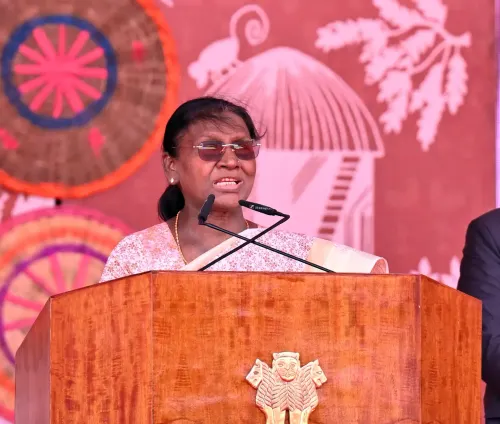
President Droupadi Murmu — India's first tribal woman Head of State — is set to attend the centuries-old Muria Darbar in Jagdalpur on 23 October, participating in Bastar Dussehra's most significant tribal assembly. Her presence carries rare symbolic weight in a region that has historically been one of India's most conflict-affected, and underscores the Centre's tribal outreach agenda at the highest constitutional level.
Key Takeaways
President Droupadi Murmu will visit Jagdalpur, Chhattisgarh on 23 October as part of a two-day state tour on 22–23 October .
She will participate in the historic Muria Darbar held annually as part of Bastar Dussehra .
A special interaction with Manjhi-Chalki tribal community leaders and a public address at Lalbagh Maidan are also on the agenda.
The visit follows a formal invitation from Bastar MP Mahesh Kashyap and a separate request from Manjhi-Chalki representatives.
District Collector Akash Chhikara and SP Shalabh Sinha have reviewed security, traffic, and logistics at Lalbagh Maidan .
The Muria Darbar dates to the Bastar princely state era, when rulers held open courts post-Dussehra to hear public grievances.
President Droupadi Murmu will travel to Jagdalpur in Chhattisgarh's Bastar district on 23 October to participate in the historic Muria Darbar, a centuries-old tribal assembly held as part of the Bastar Dussehra festival. The President will also hold a special interaction with members of the Manjhi-Chalki community and address a large public gathering at Lalbagh Maidan, marking one of the highest-profile official visits to the region in recent memory.
How the Visit Came About
Bastar Member of Parliament and Dussehra Committee Chairman Mahesh Kashyap formally invited President Murmu to attend Bastar Dussehra. Separately, representatives of the Manjhi-Chalki — the traditional tribal community leaders of Bastar — also requested her presence during an earlier meeting, which she accepted. Chhattisgarh Chief Minister Vishnu Deo Sai, speaking to reporters, confirmed that the President's Chhattisgarh tour is scheduled across 22 and 23 October, with the Jagdalpur leg on the second day.
'The President's arrival in Bastar is a moment of great joy and pride for all of us,' Chief Minister Sai said. He has directed officials to ensure all facilities are in place for the general public attending the programme.
Security and Logistics in Full Swing
In preparation for the high-profile visit, District Collector Akash Chhikara and Superintendent of Police Shalabh Sinha convened a detailed review meeting of senior officials covering security arrangements, traffic management, protocol, seating plans, and logistics. Both officers subsequently conducted a personal inspection of the venue at Lalbagh Maidan, reviewing stage construction, separate entry and exit routes for dignitaries and the public, drinking water supply, emergency medical facilities, and vehicle parking.
The Historical Significance of Muria Darbar
The Muria Darbar traces its roots to the era of the Bastar princely state, when the king would convene a public court — or Darbar — after the successful close of Dussehra to hear the grievances of his subjects. Village Manjhis and Mukhiyas would present the needs and problems of their communities before the ruler, making it a foundational institution of participatory governance in the region.
With the transition to democracy, the assembly has evolved in character. Today, administrative and political representatives participate in detailed discussions on regional demands and local issues, while members of the erstwhile royal family continue to attend, preserving the traditional continuity of the gathering.
What President Murmu's Presence Signals
This comes amid the government's sustained emphasis on tribal outreach — President Murmu herself is the first tribal woman to hold India's highest constitutional office, lending her attendance at the Muria Darbar particular symbolic weight. Notably, Bastar, once one of the most conflict-affected districts in the country, has seen improved security conditions in recent years, and high-profile official visits have grown more frequent. Large crowds are expected at Lalbagh Maidan, and the visit is set to spotlight both the cultural heritage and the democratic evolution of the Bastar tribal belt.
Point of View
Stable, and capable of hosting sovereign-level events. The real test, however, is whether such high-profile attention translates into sustained administrative responsiveness to the Manjhi-Chalki community's concerns — or remains a symbolic milestone.
NationPress
16 Oct 2026
Frequently Asked Questions
What is the Muria Darbar and why is it significant?
The Muria Darbar is a historic tribal assembly held at the conclusion of Bastar Dussehra, originating in the Bastar princely state era when the king would hear public grievances from village Manjhis and Mukhiyas. Today it serves as a democratic forum for discussing regional problems and demands, with members of the erstwhile royal family still in attendance to preserve its traditional character.
When will President Murmu visit Jagdalpur?
President Droupadi Murmu is scheduled to visit Jagdalpur on 23 October, the second day of her two-day Chhattisgarh tour spanning 22 and 23 October. She will participate in the Muria Darbar and address a public gathering at Lalbagh Maidan.
Who invited President Murmu to attend Bastar Dussehra?
Bastar MP and Dussehra Committee Chairman Mahesh Kashyap formally invited the President to attend Bastar Dussehra. Representatives of the Manjhi-Chalki tribal community also separately requested her visit, which she accepted.
What security arrangements are in place for the President's Jagdalpur visit?
District Collector Akash Chhikara and Superintendent of Police Shalabh Sinha have conducted a full review of security, traffic management, seating, and logistics, and personally inspected Lalbagh Maidan. Arrangements cover separate entry and exit routes, emergency medical facilities, drinking water supply, and vehicle parking.
Why is President Murmu's attendance at the Muria Darbar particularly notable?
President Murmu is India's first tribal woman to hold the country's highest constitutional office, making her participation in a centuries-old tribal assembly carry distinct symbolic and cultural weight. It also underscores the Centre's broader tribal outreach agenda and marks one of the most high-profile official visits to Bastar in recent years.