How Does India's Growth Story Shine with President Murmu's Focus on 'Nari Shakti'?
Synopsis
In a compelling address, President Droupadi Murmu champions women's empowerment as essential to India's progress. She highlights significant milestones in various sectors, emphasizing the government's commitment to equality and social justice, while celebrating the achievements that empower women and uplift the nation.
Key Takeaways
Women's empowerment is central to India's growth narrative.
Significant milestones in sports and military achievements for women.
Rural infrastructure development with 18,000 kilometers of new roads.
Record food grain production establishing India as a leader in agriculture.
Commitment to public health with various successful initiatives.
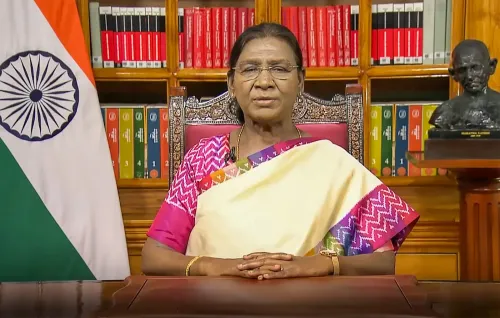
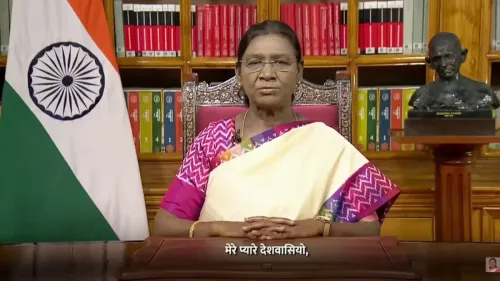
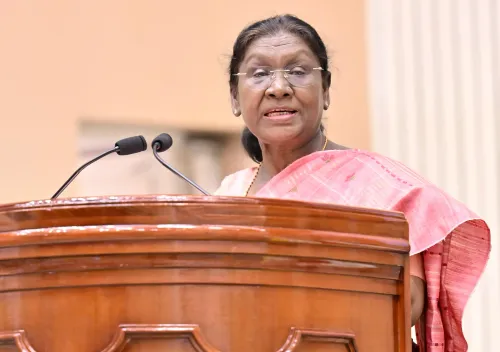
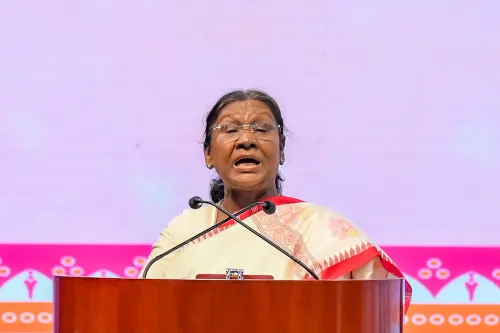
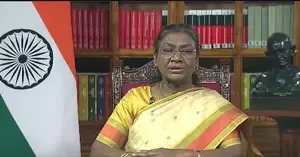
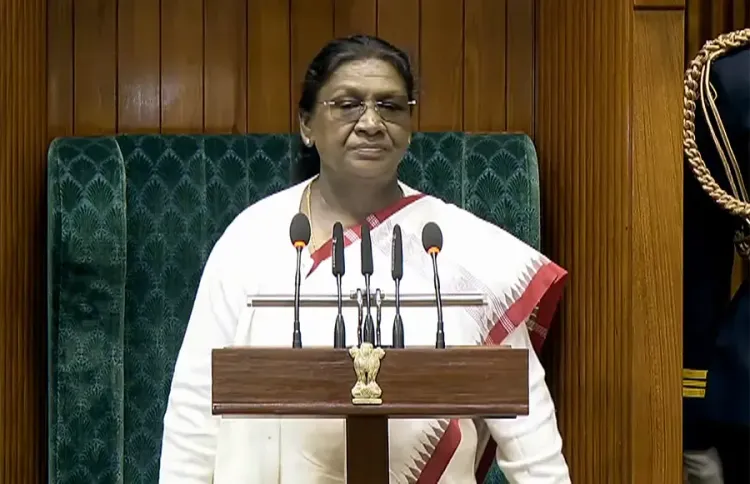
New Delhi, Jan 28 (NationPress) In her address to the joint session of Parliament on Wednesday, President Droupadi Murmu encapsulated a compelling narrative regarding India's achievements and future aspirations, with a strong emphasis on women's empowerment as a pivotal element in the country’s development journey.
She proclaimed that in the context of India's advancement, “nari shakti (women empowerment)” is paramount. This sentiment echoed throughout her remarks as she celebrated the remarkable milestones women have reached across various sectors.
Recalling a historic achievement, she noted the graduation of the first cohort of women cadets from the National Defence Academy, marking a significant turning point in India's military history.
Additionally, she extended congratulations to the Indian women’s cricket team for their victory in the ICC ODI World Cup and to the blind women’s cricket team for winning the T20 World Cup, describing these accomplishments as emblematic of women’s increasing strength and visibility in sports.
President Murmu's address was not solely a celebration of women’s successes but also a reaffirmation of India’s dedication to equality and justice.
Reflecting on the vision of Baba Saheb Ambedkar, she stated that the Constitution continues to guide the nation with a spirit of social justice. True justice, she stressed, means that every citizen is entitled to their fair share without discrimination.
Over the last decade, she observed that India has fortified its foundations in all sectors, creating a system devoid of corruption and ensuring that every rupee is directed towards development.
According to her, this framework allows progress to be evaluated not merely by statistics but by the actual experiences of citizens throughout the nation.
Infrastructure and rural development were also central themes in her speech.
She highlighted the Pradhan Mantri Gram Sadak Yojana, initiated by former Prime Minister Atal Bihari Vajpayee, which has successfully added nearly 18,000 kilometers of new rural roads in just the past year. This expansion, she noted, has revolutionized connectivity in villages, unlocking economic opportunities and enhancing social integration.
Furthermore, she emphasized the establishment of 1.8 lakh Ayushman Arogya Mandirs, which have broadened healthcare access, and the issuance of Vay Vandana cards to approximately one crore senior citizens, enabling around eight lakh elderly individuals to receive complimentary hospital treatment.
These initiatives, she argued, are reflective of the government’s pledge to inclusive growth and the care for its most vulnerable populations.
Agriculture and food security were also key aspects of her address.
President Murmu celebrated India's record food grain production of over 350 million tonnes, establishing the country as the world's largest rice producer.
She acknowledged India's position as the second-largest fish producer, showcasing success in the blue economy, and reaffirmed India's leadership in milk production through the robust cooperative movement.
These accomplishments signify a commitment not only to numbers but also to ensuring that the voices of farmers and rural communities resonate at the core of the nation’s progress.
Regarding energy and sustainability, the President underscored India’s swift advancements in clean energy.
In addition to nuclear energy, she spotlighted the installation of two million rooftop solar systems, marking a significant advancement in the solar energy sector. This reflects India’s commitment to sustainable growth and climate responsibility, ensuring that development goes hand in hand with environmental stewardship.
President Murmu also addressed India’s strides in public health. She praised the Sickle Cell Anaemia Elimination Mission, under which six crore citizens have been screened, aiding in the control of the disease in tribal regions. She highlighted mission-mode campaigns that have successfully curtailed Japanese Encephalitis in rural Uttar Pradesh and celebrated the World Health Organisation’s announcement of India being declared trachoma-free, a significant public health achievement that emphasizes the nation’s capacity to confront enduring challenges.
The President reiterated the government’s vision of Sabka Saath, Sabka Vikas, noting its positive impact on Dalits, backward classes, and tribal communities. She revealed that 95 crore Indians now have access to social security schemes, a remarkable increase from 25 crore in 2014, which she described as a historic transformation in scale and impact.
Point of View
It is imperative to recognize that President Murmu's address not only celebrates the strides made in women's empowerment but also underscores the government's unwavering commitment to inclusive growth. With a focus on social justice and equality, her speech resonates deeply with the aspirations of millions of Indians, reinforcing the belief that progress must be collective and equitable.
NationPress
22 Sept 2026
Frequently Asked Questions
What was the main focus of President Murmu's address?
President Murmu emphasized women's empowerment as a crucial element of India's growth story, highlighting significant achievements and the government's commitment to equality and justice.
What milestones in women's achievements did President Murmu mention?
She mentioned the graduation of the first batch of women cadets from the National Defence Academy and the victories of the Indian women's cricket teams in international tournaments.
How has the government contributed to rural development?
The government has launched the Pradhan Mantri Gram Sadak Yojana, which added nearly 18,000 kilometers of rural roads, enhancing connectivity and economic opportunities in villages.
What is India's position in food production?
India has achieved a record food grain production of over 350 million tonnes, making it the world's largest rice producer and the second-largest fish producer.
What initiatives were highlighted for public health?
President Murmu praised initiatives like the Sickle Cell Anaemia Elimination Mission, which screened six crore citizens, and celebrated India's declaration as trachoma-free by the World Health Organisation.