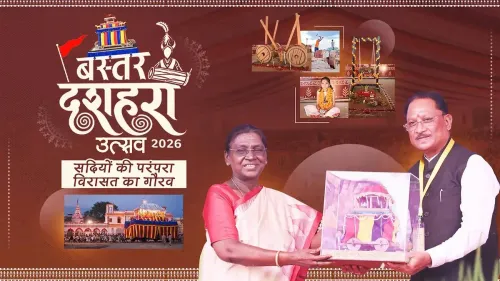
President Murmu joins Bastar Dussehra, hails tribal democracy
Synopsis
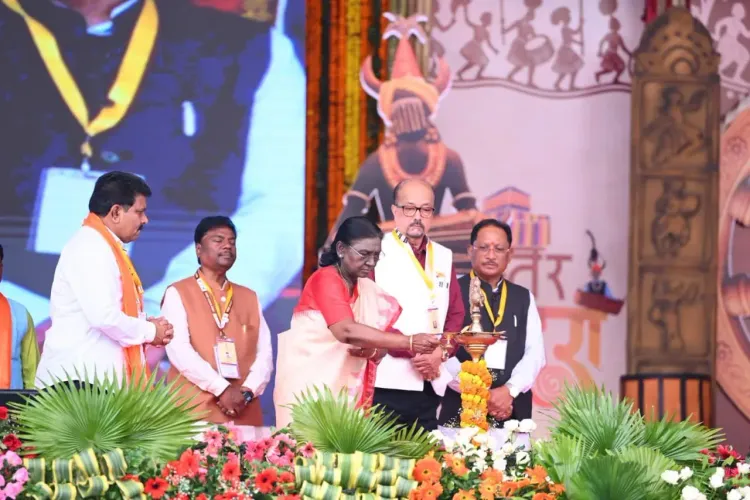
President Droupadi Murmu joined the world-renowned Bastar Dussehra on October 23, honouring Goddess Danteshwari's sacred land. She called the Muria Darbar a living symbol of democracy. CM Vishnu Deo Sai declared a Maoist-free Bastar now marching towards reconstruction and development.
Key Takeaways
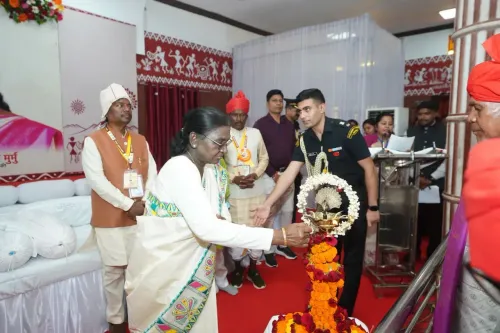
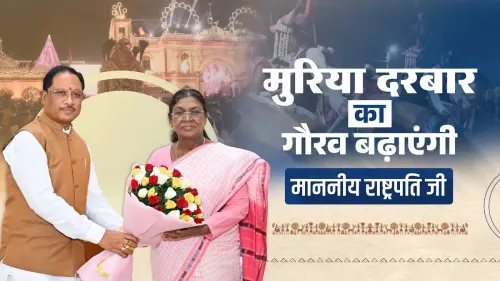
President Droupadi Murmu attended the world-famous Bastar Dussehra on October 23, 2026 , in the sacred land of Goddess Maa Danteshwari .
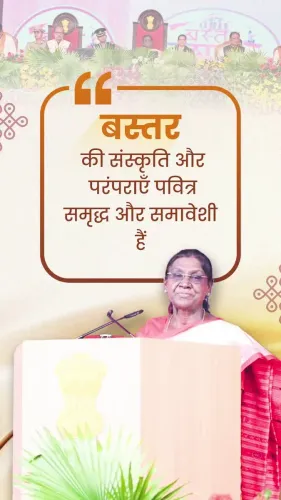
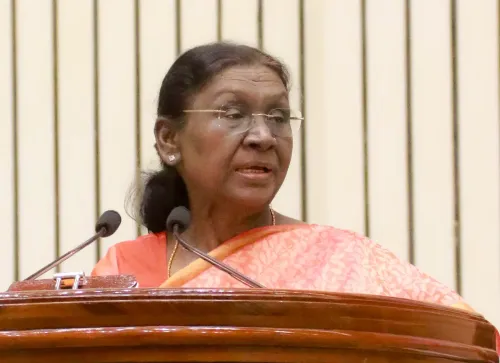
She described the Muria Darbar — Bastar's ancient tribal assembly — as a 'living symbol of democratic values,' praising tribal culture and social harmony.
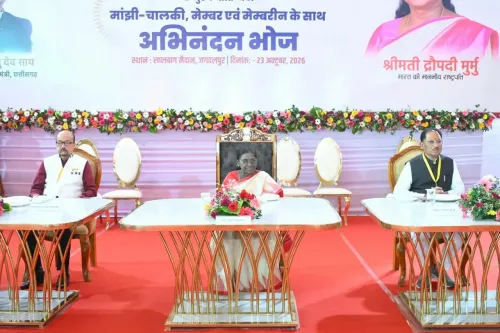
Chief Minister Vishnu Deo Sai and Governor Ramen Deka were both present at the celebration.
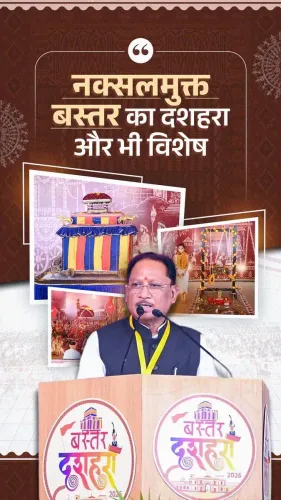
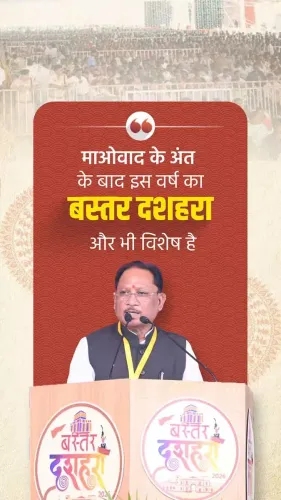
CM Sai declared that a 'Maoist-free Bastar' is now moving towards reconstruction and development while preserving its cultural heritage.
President Murmu is India's first tribal head of state, making her participation in a landmark tribal festival symbolically significant at the national level.
The visit reflects a decade of security gains in the Bastar region reducing Maoist violence and enabling large-scale public cultural events.
India's first tribal President stepped onto the sacred soil of Bastar on Friday, October 23, 2026, joining the world-renowned Bastar Dussehra — a festival rooted in centuries of tribal tradition centred on the worship of presiding deity Maa Danteshwari. The Chief Minister's Office of Chhattisgarh confirmed that President Droupadi Murmu participated in the celebrations and praised the iconic Muria Darbar — the region's ancient tribal assembly — as a 'living symbol of democratic values.'
Muria Darbar and the weight of a President's words
The Muria Darbar is no ceremonial relic. It is a functioning community council in which tribal representatives from across the Bastar division converge to deliberate and decide — a form of grassroots governance that predates modern Indian democracy by centuries. When President Murmu, herself from the Santali tribal community and the first person of tribal origin to hold the nation's highest constitutional office, described it as a democratic beacon, the symbolism landed with unmistakable force. She also praised tribal culture, ancient traditions, and social harmony — values the festival embodies across its weeks-long ritual calendar.
CM Sai's Maoist-free Bastar declaration
Chief Minister Vishnu Deo Sai, who attended alongside Governor Ramen Deka, used the occasion to frame Bastar's transformation in explicit terms. 'Maovad se mukt Bastar apni sanskritik virasat ko sanjoe rakhte hue ab navnirman aur vikas ki or agrassar hai' — 'A Maoist-free Bastar, while preserving its cultural heritage, is now moving towards reconstruction and development,' he said. It is a declaration that carries political weight: for decades, large swathes of Bastar were effectively governed by Maoist insurgents, and major public gatherings — let alone a presidential visit — were unthinkable in several of its districts.
A decade of security gains, now on cultural display
The Chhattisgarh government has pursued a dual strategy in Bastar since the early 2010s: sustained security operations to roll back Left Wing Extremism (LWE), paired with development and cultural outreach programs to rebuild civilian life. Progressive reduction in Maoist-related violence across the preceding decade has enabled exactly this kind of moment — a sitting President participating openly in a mass tribal festival in a region once synonymous with conflict. The visit signals, more visibly than any government report could, how far conditions have shifted.
President Murmu's tribal identity adds a layer that no policy announcement can replicate. Her presence at Bastar Dussehra sends a message to indigenous communities across the country: that the Republic's highest office recognises their traditions not as folklore to be archived, but as living, democratic institutions worthy of the presidency itself.
Bastar's ancient drums and the constitutional seal of India's first tribal President — rarely do cultural heritage and national symbolism align this cleanly. The next question is whether this visibility translates into concrete development announcements for a region that has waited long enough.
Point of View
Potentially softening critiques of top-down development in forest regions. CM Sai's 'Maoist-free Bastar' declaration, made on this platform, doubles as a political milestone claim ahead of future electoral cycles. The broader pattern — presidential and prime ministerial engagement with tribal cultural events — reflects a national push to mainstream tribal identity within the constitutional framework rather than treat it as peripheral.
NationPress
24 Oct 2026
Frequently Asked Questions
What is Bastar Dussehra and why is it famous?
Bastar Dussehra is an ancient tribal festival held in the Bastar region of Chhattisgarh, centred on the worship of presiding deity Goddess Danteshwari. Unlike mainstream Dussehra, it is a weeks-long celebration rooted in tribal customs, featuring the iconic Muria Darbar community assembly, and is considered one of the longest-running folk festivals in the world.
Why did President Droupadi Murmu attend Bastar Dussehra 2026?
President Droupadi Murmu attended the Bastar Dussehra celebrations on October 23, 2026, participating in the tribal festival and lauding the Muria Darbar as a living symbol of democratic values. As India's first tribal head of state, her participation carries strong cultural and symbolic significance for indigenous communities.
What is the Muria Darbar?
The Muria Darbar is a traditional tribal assembly in Bastar where community representatives gather to deliberate on local governance matters. It predates modern democratic institutions and is considered a form of indigenous grassroots democracy. President Murmu described it as a living symbol of democratic values at the 2026 Bastar Dussehra.
What did CM Vishnu Deo Sai say at Bastar Dussehra 2026?
Chief Minister Vishnu Deo Sai declared at the event that a 'Maoist-free Bastar' is now moving towards reconstruction and development while preserving its rich cultural heritage — signalling a shift in the state government's narrative from conflict management to growth and cultural revival.
Is Bastar safe from Maoist violence now?
The Chhattisgarh government has reported progressive reduction in Maoist-related violence in the Bastar region over the preceding decade, following sustained security operations and development outreach. CM Sai's declaration of a 'Maoist-free Bastar' at the 2026 Dussehra reinforces this official position, though specific current figures were not disclosed at the event.