Tamil Nadu private dairies urge CM Vijay to end Aavin subsidy advantage
Synopsis
Tamil Nadu's private dairy operators — who handle nearly 75% of the State's milk procurement — have formally asked CM C. Joseph Vijay to level the playing field after Aavin received two procurement price hikes to ₹44 per litre in under two weeks, costing the State ₹60 crore a month and forcing unsubsidised rivals to choose between losses and higher consumer prices.
Key Takeaways
The Tamil Nadu Dairies Association submitted a representation to Chief Minister C.
Joseph Vijay on 15 September 2026 seeking subsidy parity for private dairy operators.
The private sector handles nearly 75 per cent of Tamil Nadu's milk procurement and sales, yet receives no State subsidy support.
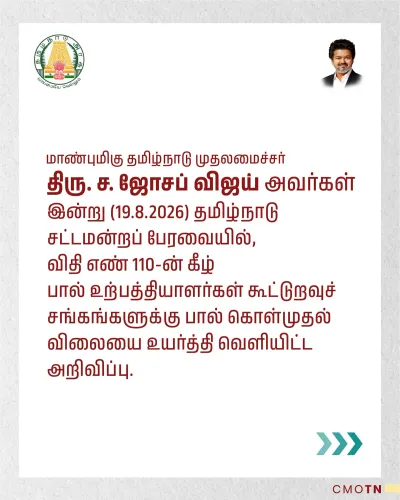
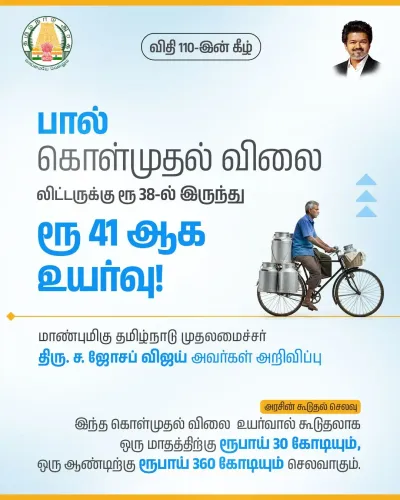
Aavin's cow-milk procurement price was raised twice — from ₹38 to ₹41 per litre on 19 August , then to ₹44 per litre on 31 August .
The latest price revision is projected to cost the State approximately ₹60 crore per month .
The association recommended studying Amul's cooperative profit-sharing model as an alternative to recurring government subsidies.
Private dairies warn that without subsidy access, higher procurement costs will be passed on to consumers through elevated retail milk prices.
Private dairy operators in Tamil Nadu have formally appealed to Chief Minister C. Joseph Vijay to introduce an equitable support framework for the entire dairy sector, arguing that subsidies exclusively channelled to the State-owned cooperative Aavin are distorting competition and hurting thousands of farmers aligned with private companies.
The Industry's Core Complaint
The Tamil Nadu Dairies Association submitted a representation to Chief Minister Vijay on Tuesday, 15 September 2026, highlighting that private operators have built out milk procurement, processing, and distribution networks across the State over the past three decades. According to the association, the private sector currently handles nearly 75 per cent of Tamil Nadu's milk procurement and sales — a majority share that, it argues, warrants policy parity.
The association welcomed measures aimed at shielding dairy farmers from rising input costs but maintained that limiting financial assistance to the State cooperative creates a serious market imbalance. Private dairies, it said, are unable to access comparable subsidies despite procuring milk from a significant share of the State's producers.
What Triggered the Appeal
The representation followed two back-to-back increases in Aavin's cow-milk procurement price within a short window. The rate was raised from ₹38 to ₹41 per litre on 19 August, and subsequently to ₹44 per litre on 31 August. The government attributed both revisions to rising expenditure on cattle feed, fodder, and farm maintenance. The latest revision alone is expected to cost the State approximately ₹60 crore every month.
With Aavin now offering ₹44 per litre, private dairies face pressure to match or exceed that rate to retain their farmer base — without any subsidy buffer to absorb the difference. The association noted that private operators were already paying more than Aavin in several parts of Tamil Nadu to secure milk supplies, making their position increasingly untenable.
Impact on Farmers and Consumers
Because private dairies do not receive government subsidies, the association warned that companies would be compelled to transfer the additional procurement cost to consumers through higher retail milk prices. Farmers supplying private buyers, it added, are caught in a squeeze between subsidised cooperative milk and competition from dairies operating in neighbouring States — leaving both producers and end consumers exposed.
What the Association Is Asking For
The Tamil Nadu Dairies Association has put forward several proposals. It has asked the government to reconsider consumer subsidies and allow retail milk prices to reflect actual procurement and operational costs, while protecting farmers dependent on private buyers. It also recommended examining the cooperative model of Gujarat-based Amul, under which a portion of organisational profits is returned directly to milk producers — an arrangement it said could reduce the need for recurring government expenditure.
Calling for multi-stakeholder consultations involving dairy farmers, private operators, and cooperative representatives, the association urged the Chief Minister to formulate a comprehensive dairy policy that protects producers without distorting the market. A balanced approach, it argued, is essential to maintain fair competition, control consumer prices, and ensure the long-term sustainability of Tamil Nadu's dairy industry.
Broader Context
This is not the first time Tamil Nadu's dual-track dairy structure — a large State cooperative alongside a dominant private sector — has sparked policy friction. With the private sector accounting for roughly three-quarters of procurement, any subsidy asymmetry has outsized market consequences. The appeal underscores a structural tension visible across several Indian States where cooperative pricing, backed by government support, sets de facto price floors that private players must match without equivalent relief.
Point of View
Then lets private players absorb the cost shock unaided. With the private sector controlling 75% of procurement, the subsidy asymmetry is not a minor distortion — it is a market-shaping intervention in disguise. The Amul reference is pointed; Gujarat's model works precisely because profits flow back to producers without chronic State bailouts. If Tamil Nadu is serious about long-term dairy sustainability, it must choose between genuinely cooperative economics and a subsidy-dependent public enterprise — it cannot sustain both indefinitely without either inflating the fiscal bill or squeezing out private operators who carry the majority of the State's milk supply chain.
NationPress
15 Sept 2026
Frequently Asked Questions
Why are Tamil Nadu private dairies upset with Aavin subsidies?
Private dairy operators argue that government subsidies available exclusively to the State cooperative Aavin give it an unfair pricing advantage. Since the private sector handles nearly 75% of Tamil Nadu's milk procurement without any comparable subsidy, operators say they are unable to compete fairly and may be forced to raise consumer prices.
How much has Aavin's milk procurement price increased recently?
Aavin's cow-milk procurement price was raised from ₹38 to ₹41 per litre on 19 August 2026 and further to ₹44 per litre on 31 August 2026 — two hikes within roughly two weeks. The government cited higher cattle feed, fodder, and farm maintenance costs as the reason, with the latest revision costing the State around ₹60 crore per month.
What has the Tamil Nadu Dairies Association asked the government to do?
The association has asked Chief Minister C. Joseph Vijay to introduce an equitable support system covering all dairy operators, reconsider consumer subsidies, allow retail prices to reflect actual procurement costs, and convene multi-stakeholder consultations. It also recommended studying Amul's cooperative profit-sharing model as a sustainable alternative to recurring government subsidies.
How does the Amul model differ from Tamil Nadu's current approach?
Under Amul's Gujarat-based cooperative structure, a portion of the organisation's profits is returned directly to milk producers, reducing dependence on recurring State subsidies. The Tamil Nadu Dairies Association says adopting a similar model could directly benefit farmers while easing the fiscal burden on the government.
What is the risk for consumers if private dairies do not get subsidy relief?
Without access to subsidies, private dairies facing higher procurement costs say they will have no option but to pass the additional expense to consumers through higher retail milk prices. This could add to household inflation pressures, particularly in areas where private brands dominate retail milk supply.