What are the Implications of the New Rural Employment Bill in Lok Sabha?
Click to start listening
Synopsis
The Lok Sabha was charged with debates as the government introduced the VB-G RAM G Bill, aiming to replace MGNREGA. Opposition leaders raised concerns over potential disrespect towards Mahatma Gandhi's legacy, while the government defended the Bill's intent to modernize rural employment frameworks.
Key Takeaways
- The VB-G RAM G Bill aims to replace MGNREGA.
- Opposition argues it disrespects Mahatma Gandhi's legacy.
- Bill proposes to increase guaranteed rural employment days.
- Financial burden shifts to state governments.
- Modernization of rural employment framework is the goal.
New Delhi, Dec 16 (NationPress) The Lok Sabha experienced intense debates on Tuesday as the Viksit Bharat Guarantee for Rozgar and Ajeevika Mission (Gramin) -- or VB-G RAM G -- Bill, 2025 was introduced. This legislation aims to supersede the Mahatma Gandhi National Rural Employment Guarantee Act (MGNREGA) of 2005.
Opposition members, including Priyanka Gandhi Vadra and K.C. Venugopal from Congress, Harendra Malik of the Samajwadi Party, and Mahua Moitra from the Trinamool Congress, criticized the Bill, claiming it seeks to erase Mahatma Gandhi's legacy from MGNREGA.
Priyanka Gandhi urged for the Bill to be sent to the Parliament's Standing Committee for thorough examination and debate.
Harendra Malik accused the government of attempting to substitute Mahatma Gandhi's name with that of Nathuram Godse.
Mahua Moitra echoed these sentiments, emphasizing, “We will not accept any disrespect towards Gandhi—the Father of the Nation.”
Congress MP Shashi Tharoor criticized the Union government, asserting that the new Bill represents a “deeply regrettable and retrogressive move” for the nation.
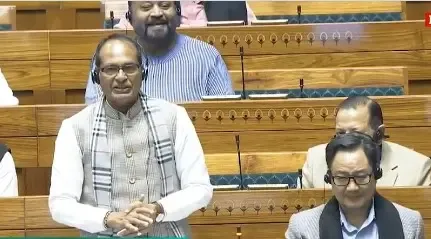
Union Rural Development Minister Shivraj Singh Chouhan challenged the Opposition's claims, questioning whether Congress’s previous renaming of the Jawahar Rozgar Yojana was an affront to the late Prime Minister Jawaharlal Nehru.
Chouhan affirmed that the Central government not only respects Mahatma Gandhi but also adheres to his principles. “Mahatma Gandhi ji resides in our hearts,” he stated, adding, “Both Gandhi ji and Pandit Deendayal Upadhyaya prioritized the welfare of the most vulnerable. We believe in their philosophies and are implementing numerous poverty alleviation schemes inspired by their thoughts.”
BJP MP Kangana Ranaut countered the Opposition’s assertion that the new name disrespects Mahatma Gandhi, who unified the nation with his rendition of ‘Raghupati Raghav Raja Ram.’ “This renaming was designed to fulfill his vision,” she remarked.
The VB-G RAM G Bill aims to modernize the rural employment framework in India by replacing MGNREGA.
It reflects the Union government's objective to adapt rural employment to current economic conditions, pledging enhanced livelihood support through an increase in guaranteed workdays and an improved administrative approach.
The Bill proposes to increase guaranteed rural employment from 100 days under MGNREGA to 125 days annually for adult household members willing to engage in unskilled manual labor.
Opposition members also expressed concerns about the increased financial burden on states, contrasting it with MGNREGA, where the Central government covered most expenses.
The new legislation shifts a considerable share of wage and implementation costs to state governments.
Additionally, the Bill allows work interruptions during peak agricultural seasons, which aims to mitigate disruptions in farming activities but also introduces complexities in delivery.
Furthermore, it proposes stricter digital oversight and technological integration to improve transparency, accountability, and efficiency.
In summary, the VB-G RAM G Bill, 2025 represents a significant update to rural employment policy in India, aiming to respond to contemporary rural socio-economic conditions by expanding work guarantees and enhancing governance.
Nonetheless, the implications of heightened state financial responsibilities, political disputes, and administrative obstacles pose considerable challenges that may affect the practicality of protecting rural livelihoods.
Point of View
It is vital to acknowledge the significance of the VB-G RAM G Bill, 2025. This proposed legislation aims to modernize rural employment but faces criticism for its potential implications on Mahatma Gandhi's legacy. Navigating these complexities is essential to ensure that rural livelihoods are protected while adapting to modern economic realities.
NationPress
17/12/2025
Frequently Asked Questions
What is the VB-G RAM G Bill?
The VB-G RAM G Bill is a proposed legislation aimed at replacing the MGNREGA, expanding rural employment guarantees and enhancing livelihood support.
Why is the Bill controversial?
The Bill has sparked controversy as opposition leaders claim it undermines Mahatma Gandhi's legacy, with allegations that it attempts to erase his name from rural employment initiatives.
What changes does the Bill propose?
The Bill proposes to increase guaranteed rural employment days from 100 to 125 annually and aims to modernize the administrative framework for better efficiency.
How does the Bill affect state governments?
The new legislation shifts a significant portion of wage and implementation costs to state governments, increasing their financial burden compared to MGNREGA.
What is the significance of Mahatma Gandhi in this context?
Mahatma Gandhi's legacy is central to the debate, with opposition leaders arguing that the Bill's changes disrespects his contributions to rural employment and welfare.