How Did PU Scientists Create a Paint Additive to Combat Hospital Infections?

Synopsis
Panjab University scientists have unveiled a revolutionary paint additive designed to significantly reduce hospital infections. Patented in December 2025, this non-toxic solution promises to enhance safety in healthcare settings, a crucial advancement in the wake of the Covid-19 pandemic. Discover the innovative minds behind this breakthrough and its potential impact on patient safety.
Key Takeaways
Panjab University developed an innovative paint additive.
The additive reduces hospital infections by eliminating bacteria.
It is non-toxic and safe for indoor environments.
Patented on December 31, 2025, it holds promise for healthcare applications.
The development was inspired by the challenges posed during the Covid-19 pandemic .
Chandigarh, Jan 2 (NationPress) Researchers at Panjab University (PU) have created a groundbreaking paint additive aimed at minimizing hospital infections, a concern that has gained urgency following the Covid-19 pandemic.
This innovative solution received an Indian patent on December 31, 2025.
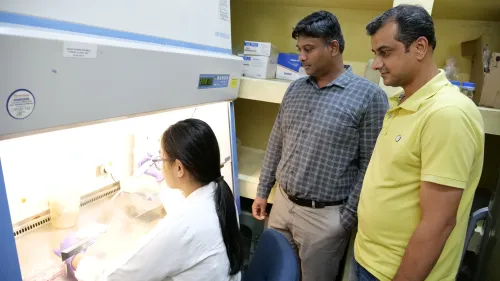
The project, spearheaded by Gaurav Verma from the Department of Chemical Engineering and Nanotechnology, was a product of collaborative research during the pandemic.
Other team members include Avneet Saini from the Department of Biophysics, Shubhi Joshi, and MSc student Deeksha Sharma.
This paint additive functions by eliminating dangerous bacteria on surfaces, thereby enhancing the safety of hospital walls, beds, and furniture.
Significantly, the material is non-toxic and does not disperse into the air or surroundings, ensuring it is safe for indoor applications.
The patented technology holds promise for widespread use in hospitals and clinics to combat infections and enhance patient safety.
The idea was conceived during the Covid-19 crisis when hospital-acquired infections took a heavy toll, particularly during the delta wave of 2021-22.
Such infections often spread through frequently touched surfaces like walls and furniture, leading to serious complications such as black fungus.
The origins of this development trace back to 2018 when Shubhi Joshi, a food microbiologist, approached Gaurav Verma for her PhD.
Despite excelling in the PU PhD entrance exam, she was unable to secure admission in her field.
Verma welcomed her into his laboratory, presenting her with a formidable research challenge regarding tiny materials known as nanomaterials.
Throughout the pandemic, the team persisted in their laboratory efforts while adhering to physical distancing and safety regulations.
Their dedication culminated in the successful creation of the antibacterial paint additive, completed in 2022.
Currently, Shubhi Joshi serves as an ICMR Woman Scientist and continues her collaboration with the PU research team.
Verma emphasized that this innovation embodies his belief that every student possesses the potential to contribute to meaningful science, which should have a direct positive impact on society.
He remarked that paint should not only enhance aesthetics but also play a crucial role in saving lives.
Point of View
I believe the innovative work coming from Panjab University showcases the transformative power of research in addressing real-world challenges. This development in paint technology highlights the importance of scientific advancements in enhancing public health and safety, especially in the wake of the Covid-19 pandemic.
NationPress
1 Oct 2026
Frequently Asked Questions
What is the main purpose of the paint additive developed by PU scientists?
The paint additive is designed to reduce hospital infections by killing harmful bacteria on surfaces.
Is the paint additive safe for indoor use?
Yes, the material is non-toxic and does not mix into the air or surroundings, making it safe for indoor applications.
When was the paint technology patented?
The paint technology received an Indian patent on December 31, 2025.
Who led the research for this innovation?
The research was led by Gaurav Verma from the Department of Chemical Engineering and Nanotechnology at Panjab University.
What inspired the development of this paint additive?
The idea was conceived during the Covid-19 pandemic when hospital-acquired infections became a significant concern.