Punjab CM Mann pays tribute on Guru Arjan Dev Ji's 420th martyrdom day
Synopsis
The Chief Minister's Office of Punjab, led by CM Bhagwant Mann, paid official tribute to Sri Guru Arjan Dev Sahib Ji — the Fifth Sikh Guru and 'Crown of Martyrs' — on his 420th martyrdom day on 18 June 2026, continuing a decades-long tradition of state commemoration.
Key Takeaways
The Chief Minister's Office of Punjab issued an official tribute to Sri Guru Arjan Dev Sahib Ji on 18 June 2026 .
The commemoration marks the 420th martyrdom anniversary of the Fifth Sikh Guru.
Guru Arjan Dev Sahib Ji compiled the Adi Granth and was martyred in Lahore in 1606 under Mughal Emperor Jahangir .
He is honoured with the title 'Shaheedan De Sartaj' , meaning 'Crown of Martyrs' in Punjabi.
Chief Minister Bhagwant Mann has led the Punjab government since March 2022 , representing the Aam Aadmi Party .
Punjab governments have formally observed this martyrdom anniversary every June since the state's reorganisation in 1966 .
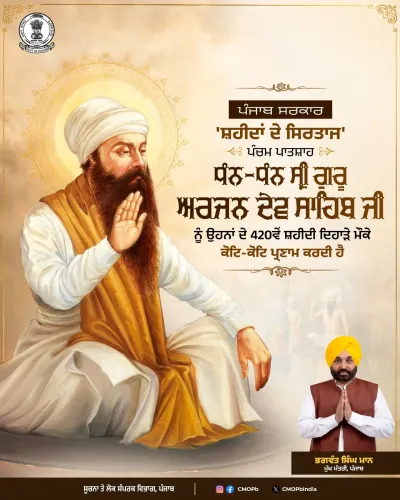
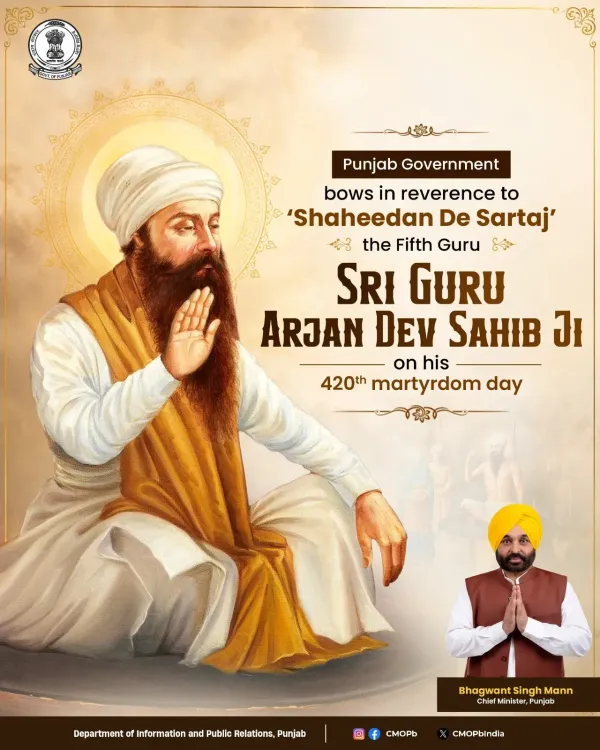
The Chief Minister's Office of Punjab, on behalf of Chief Minister Bhagwant Mann and the state government, offered official reverence to Sri Guru Arjan Dev Sahib Ji — revered as 'Shaheedan De Sartaj' (Crown of Martyrs) — on Thursday, 18 June 2026, marking the 420th martyrdom day of the Fifth Sikh Guru.
Context
The post, shared by the official CMO Punjab handle, described the tribute as the Punjab Government 'bowing in reverence' to the Fifth Guru, using the Punjabi honorific 'Shaheedan De Sartaj' — meaning 'Crown of Martyrs' — a title that encapsulates Guru Arjan Dev Sahib Ji's singular place in Sikh history. The tribute was accompanied by Punjabi-script hashtags reinforcing the occasion's religious and cultural weight.
Policy Backdrop
Sri Guru Arjan Dev Sahib Ji, the Fifth Guru of the Sikhs, compiled the Adi Granth — the foundational scripture of Sikhism — and was martyred in 1606 in Lahore under the orders of Mughal Emperor Jahangir. He is widely regarded as the first great martyr of the Sikh faith, and his sacrifice forms a cornerstone of Sikh religious identity and collective memory. Punjab state governments have issued formal commemorations of this martyrdom anniversary each June since the state's reorganisation in 1966, making it a durable feature of official governance ritual, irrespective of the party in power.
Stakeholders and Impact
The tribute carries direct resonance for Punjab's Sikh community, which constitutes the religious majority of the state, as well as for Sikh communities across India and the global diaspora. Official statements of this nature from the Chief Minister's Office serve to reaffirm the state administration's alignment with the values of Sikh history and martyrdom — a consistent element of political communication in Punjab. For Chief Minister Bhagwant Mann, who has led the Aam Aadmi Party government in Punjab since March 2022, such commemorations are part of a broader pattern of engaging with the state's religious calendar at the highest executive level.
What's Next
The Punjab government is expected to continue marking subsequent anniversaries associated with the Sikh Gurus through the remainder of 2026 and into 2027, with official events at historic gurdwaras likely accompanying future commemorations. The consistency of these tributes across administrations underscores their role not merely as ceremonial gestures but as institutionalised expressions of the state's public identity — one that successive governments have found politically and culturally indispensable to maintain.
Point of View
Cutting across party lines and election cycles. For the Aam Aadmi Party government under Bhagwant Mann, maintaining this tradition is as much a governance obligation as a political signal — one that reinforces the administration's connection with Punjab's Sikh majority. The 420th martyrdom day of Guru Arjan Dev Ji, a figure who represents both spiritual authority and resistance to state oppression, carries particular symbolic weight in a state where historical martyrdom narratives remain deeply embedded in public consciousness. How the government translates such commemorations into substantive policy engagement with Sikh heritage sites and institutions will be the more telling measure of its commitment.
NationPress
18 Sept 2026
Frequently Asked Questions
Who was Sri Guru Arjan Dev Sahib Ji?
Sri Guru Arjan Dev Sahib Ji was the Fifth Guru of the Sikhs. He compiled the Adi Granth, the foundational scripture of Sikhism, and was martyred in Lahore in 1606 under Mughal Emperor Jahangir, making him the first great martyr of the Sikh faith.
What does 'Shaheedan De Sartaj' mean?
'Shaheedan De Sartaj' is a Punjabi honorific meaning 'Crown of Martyrs.' It is the title given to Sri Guru Arjan Dev Sahib Ji in recognition of his martyrdom, which holds a foundational place in Sikh religious history.
Why is the Punjab government commemorating this day in 2026?
The Punjab government, led by Chief Minister Bhagwant Mann, observed the 420th martyrdom anniversary of Sri Guru Arjan Dev Sahib Ji on 18 June 2026. Punjab governments have formally marked this occasion every June since the state's reorganisation in 1966.
Who is Bhagwant Mann?
Bhagwant Mann is the Chief Minister of Punjab, representing the Aam Aadmi Party. He has led the Punjab state government since March 2022.
When was Guru Arjan Dev Ji martyred?
Guru Arjan Dev Ji was martyred in 1606 in Lahore, under the orders of Mughal Emperor Jahangir. The 2026 commemoration marks 420 years since his martyrdom.