Punjab Govt Targets 3,763 SC-Majority Villages for Model Development

Synopsis
Punjab's AAP government under CM Bhagwant Mann has launched a flagship 'Adarsh Pind' initiative, releasing needs-based development funds for 3,763 Scheduled Caste-majority villages across the state to transform them into model villages.
Key Takeaways
3,763 villages with majority Scheduled Caste populations have been selected for development as 'Adarsh Pind' (model villages) by the Punjab government.
Funds have been released for the complete development of all selected villages, calibrated to each village's specific needs.
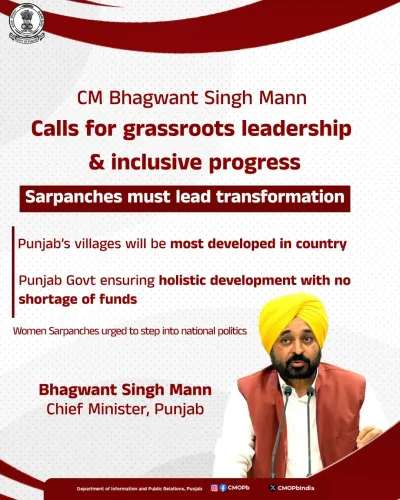
The initiative is being driven under the direct guidance of Chief Minister Bhagwant Singh Mann of the Aam Aadmi Party.
Punjab has one of India's highest Scheduled Caste population shares , making SC-focused rural policy a long-standing governance priority in the state.
The announcement was made on 27 September 2026 via the official Chief Minister's Office of Punjab account.
More than 3,763 villages with a dominant Scheduled Caste population are set for a sweeping transformation — and the Punjab government has already released funds for every single one. The Chief Minister's Office of Punjab announced on Sunday, 27 September 2026 that the administration led by Chief Minister Bhagwant Singh Mann has launched a major initiative to develop these villages as 'Adarsh Pind' — model villages — with needs-based funding unlocked for all selected settlements across the state.
What 'Adarsh Pind' means for rural Punjab's SC communities
Punjab carries one of India's highest Scheduled Caste population shares — a demographic reality that has made SC-targeted rural policy a recurring electoral and governance priority for successive governments in Chandigarh. The current Aam Aadmi Party administration, which came to power in the March 2022 assembly elections, deepened this emphasis soon after taking office. The 'Adarsh Pind' scheme is the most expansive articulation of that commitment yet: not a handful of pilot villages, but a state-wide sweep covering 3,763 habitations identified as SC-majority settlements.
The CMO's post states that funds have been released 'as required' (ਲੋੜ ਅਨੁਸਾਰ) for the complete development of all selected villages — signalling that the rollout is calibrated to each village's actual infrastructure gaps rather than a flat per-village allocation. That distinction matters: it suggests an assessment-driven approach rather than a symbolic one-size-fits-all disbursement.
Why the scale of this rollout draws attention
Nearly four thousand villages receiving simultaneous development funding is an administrative undertaking of genuine scale. The critical test, as watchers of Punjab's rural programs will note, lies in execution: how quickly physical works translate from fund releases to finished roads, drainage, clean drinking water, and community infrastructure on the ground. Progress reports, utilisation certificates, and any independent evaluations of completed works will determine whether 'Adarsh Pind' becomes a lasting benchmark — or another scheme whose promise outpaces its delivery.
For CM Bhagwant Mann, the announcement also carries political weight ahead of future electoral cycles — the AAP government has consistently positioned SC welfare and village-level infrastructure as core to its governance identity in Punjab.
Point of View
And its real test is whether decentralised, needs-based fund release actually accelerates physical works at the village level — a challenge that has historically tripped up even well-intentioned rural schemes in India. Politically, the move reinforces AAP Punjab's strategy of anchoring its governance identity in dalit-inclusive development, a voter bloc that proved decisive in the 2022 sweep. The breadth of coverage — nearly four thousand villages simultaneously — raises both its electoral visibility and the implementation risk. Independent monitoring of fund utilisation will be the true measure of whether this initiative sets a replicable model or fades into the long list of announced-but-incomplete state rural programs.
NationPress
28 Sept 2026
Frequently Asked Questions
What is the Adarsh Pind scheme in Punjab?
'Adarsh Pind' means 'model village' in Punjabi. Under this initiative, the Punjab government of CM Bhagwant Mann is developing 3,763 Scheduled Caste-majority villages with targeted, needs-based infrastructure funding to bring them up to a benchmark standard of rural development.
How many villages are covered under Punjab's Adarsh Pind initiative?
A total of 3,763 villages with dominant Scheduled Caste populations across Punjab have been selected for development under the Adarsh Pind scheme.
Who announced the Adarsh Pind scheme for SC villages?
The announcement was made by the Chief Minister's Office of Punjab on 27 September 2026, citing directions from Chief Minister Bhagwant Singh Mann .
What kind of funding has been released for Adarsh Pind villages?
The Punjab government has released needs-based funds — meaning the allocation for each village is determined by its specific development requirements — for the complete development of all 3,763 selected villages.
Why does Punjab focus so much on Scheduled Caste village development?
Punjab has one of the highest proportions of Scheduled Caste population among all Indian states, making SC-focused welfare and rural infrastructure a central priority for successive state governments and a major factor in Punjab's political landscape.