Punjab CMO: 526 raids on Day 134 of 'Gangsteran Te Vaar' drive
Synopsis
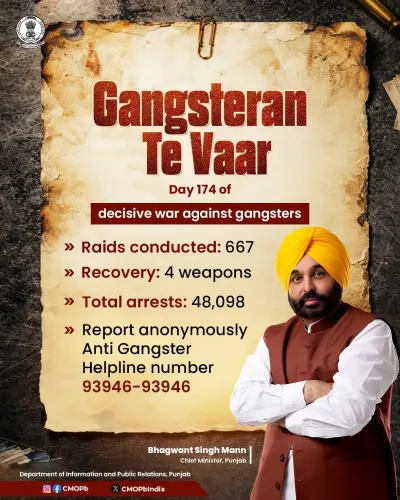
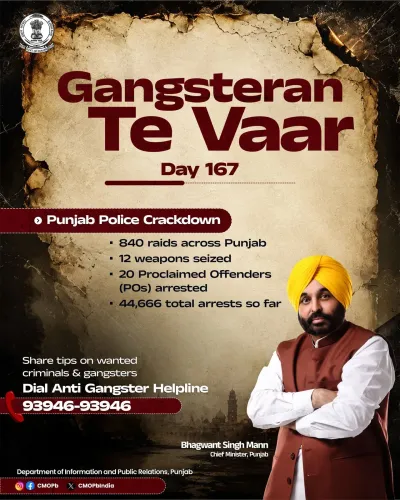
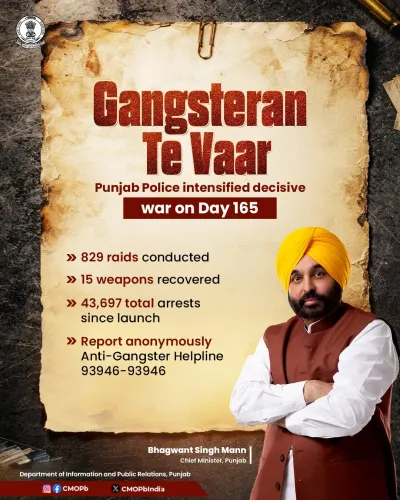
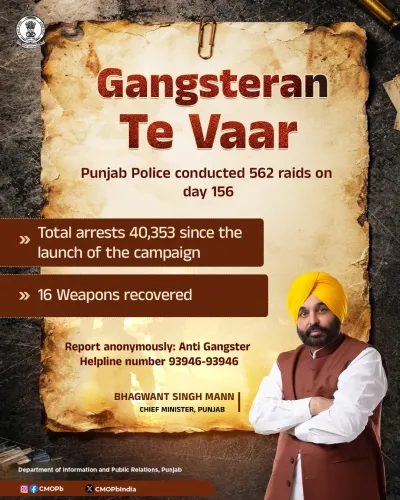
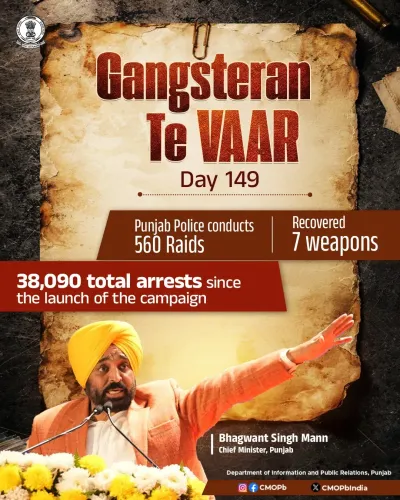
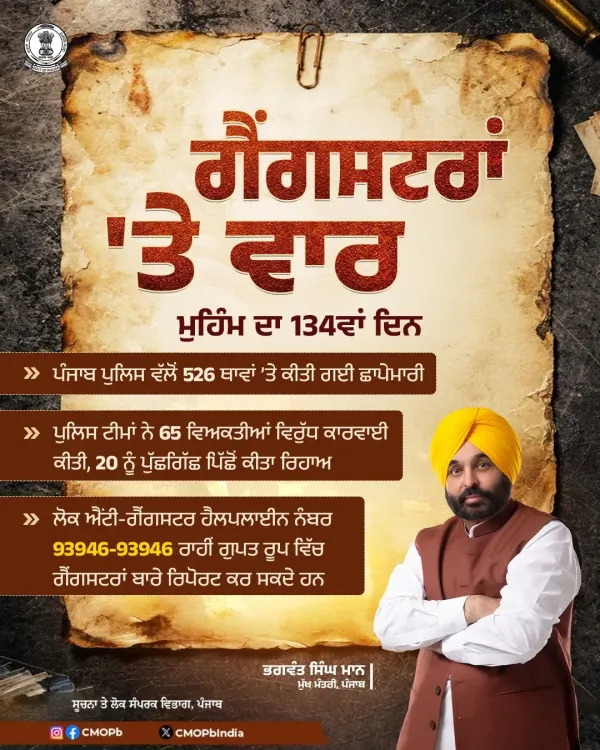
The Chief Minister's Office of Punjab reported 526 raids on the 134th day of the 'Gangsteran Te Vaar' campaign, with seven weapons seized and cumulative arrests reaching 33,612. The state-wide drive, led by Punjab Police under Chief Minister Bhagwant Mann, targets mapped associates of gangsters as part of a sustained anti-organised-crime push.
Key Takeaways
Punjab Police conducted 526 raids on Day 134 of the 'Gangsteran Te Vaar' campaign.
Seven weapons were recovered during the day's operations.
Cumulative arrests since the campaign's launch stand at 33,612 .
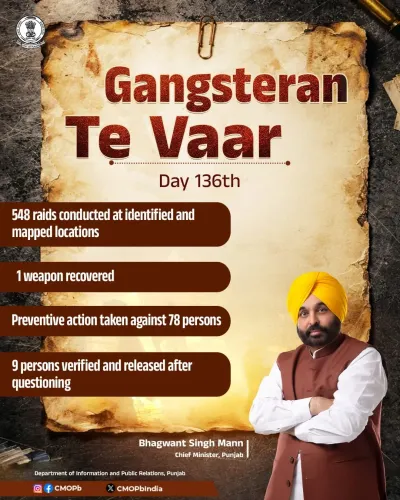
Raids targeted identified and mapped locations linked to gangsters' associates.
The drive is a flagship internal-security initiative of the Bhagwant Mann government.
Daily updates from the CMO underscore the operation's sustained, state-wide nature.
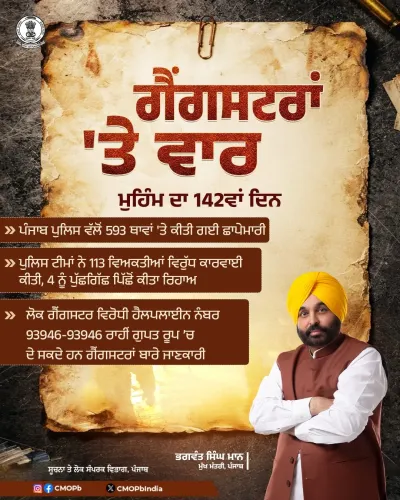
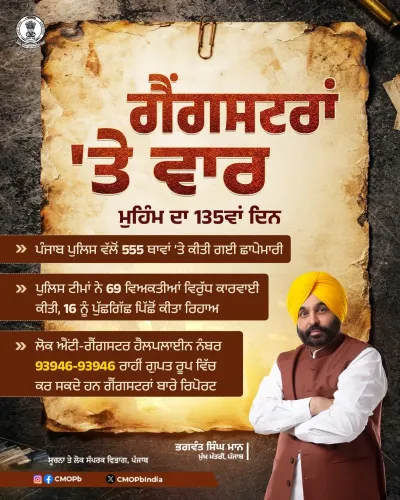
The Chief Minister's Office of Punjab on 4 June 2026 said the state police carried out 526 raids on the 134th day of the ongoing 'Gangsteran Te Vaar' (War on Gangsters) campaign, targeting locations across Punjab that had been identified and mapped as linked to associates of known gangsters. The operation led to the arrest of several individuals and the recovery of seven weapons, taking the cumulative arrest tally since the campaign's launch to 33,612.
Context
In its post, the CMO stated that as the 'decisive Gangsteran Te Vaar campaign enters its 134th day, Punjab Police conducted 526 raids at identified and mapped locations linked to associates of gangsters across the state.' The original Punjabi text used the phrase ਫ਼ੈਸਲਾਕੁੰਨ ਮੁਹਿੰਮ ('decisive campaign') to describe the drive.
The announcement underscores the day-by-day reporting format that the Punjab Police and the Chief Minister's Office have adopted for the operation, with daily updates on raids, arrests and arms recoveries. The 134-day continuum signals a sustained, rather than episodic, enforcement push.
Policy backdrop
The Aam Aadmi Party government, led by Chief Minister Bhagwant Mann since March 2022, has placed dismantling the drug-and-gangster nexus at the centre of its internal-security agenda. 'Gangsteran Te Vaar' is the most visible expression of that commitment, mobilising district police units in coordinated, intelligence-led sweeps.
Anti-gangster drives are not new to Punjab. Previous state administrations also ran large-scale operations against organised crime and narcotics trafficking, often involving multi-district raids and arms recoveries. The current campaign builds on that template but emphasises the 'mapping' of associate networks — a shift from targeting individual fugitives to disrupting the wider support ecosystem of gangs.
Stakeholders and impact
The immediate stakeholders are Punjab's residents, particularly in districts where gang violence and extortion have surfaced in recent years, and the rank-and-file of the Punjab Police, who execute the daily raids. Organised crime networks — several with reported overseas links in Canada, Europe and elsewhere — are the principal targets.
The recovery of seven weapons in a single day, while modest in absolute terms, feeds into a larger seizure ledger that the state cites as evidence of degraded gang firepower. The cumulative figure of 33,612 arrests over 134 days averages out to roughly 250 arrests per day, a pace that places significant demands on policing, prosecution and prison infrastructure.
For residents, the visible enforcement tempo is intended to deter extortion calls and gang-linked violence that have periodically rattled commercial hubs in the state. For civil-society observers, the scale also raises questions about due process, bail outcomes and the conversion of arrests into convictions.
What's next
Attention will turn to whether the state shares disaggregated data on the nature of charges, conviction rates and assets attached under the campaign. Any debate in the Punjab Vidhan Sabha on the operation's outcomes, along with periodic consolidated briefings from the Director General of Police, will be key markers of how the drive evolves beyond its current arrest-and-raid metrics.
If sustained, 'Gangsteran Te Vaar' could become a defining law-and-order plank of the Mann government as it approaches the second half of its term, with electoral implications tied to perceptions of safety and the credibility of follow-through in court.
Point of View
Signalling visible action on a law-and-order plank central to the Aam Aadmi Party's Punjab pitch. The shift from chasing named gangsters to mapping their wider associate networks reflects a maturing approach to organised crime, but the true test lies downstream — in conviction rates, asset attachments and the durability of the deterrent. With over 33,000 arrests logged, the operation's scale will inevitably invite scrutiny of judicial bandwidth and due-process safeguards. How the Mann government balances enforcement optics with measurable outcomes will shape its security record heading into the latter half of its term.
NationPress
24 Sept 2026
Frequently Asked Questions
What is the Gangsteran Te Vaar campaign in Punjab?
'Gangsteran Te Vaar' (War on Gangsters) is a state-wide Punjab Police campaign involving coordinated raids on locations linked to gangsters and their associates. It is a flagship internal-security initiative of the Bhagwant Mann government aimed at dismantling organised crime networks.
How many arrests have been made under Gangsteran Te Vaar so far?
As of Day 134, cumulative arrests under the campaign have reached 33,612, according to the Chief Minister's Office of Punjab. On the latest day alone, police conducted 526 raids and recovered seven weapons.
Who launched the Gangsteran Te Vaar drive in Punjab?
The drive is being run by the Punjab Police under the Aam Aadmi Party state government led by Chief Minister Bhagwant Mann, which has made action against the drug-and-gangster nexus a stated priority since taking office in March 2022.
What was recovered in the latest Punjab Police raids?
Punjab Police recovered seven weapons during the 526 raids conducted on Day 134 of the campaign. Several individuals linked to gangster associates were also arrested in the operations across the state.
Why is Punjab focused on cracking down on gangsters?
Punjab has long grappled with organised criminal gangs often linked to the narcotics trade and with overseas connections. Successive state governments have launched large-scale anti-gangster operations to disrupt these networks, recover arms and address public-safety concerns.