Punjab Police Hits 46,774 Arrests on Day 172 of Gangsteran Te Vaar
Synopsis
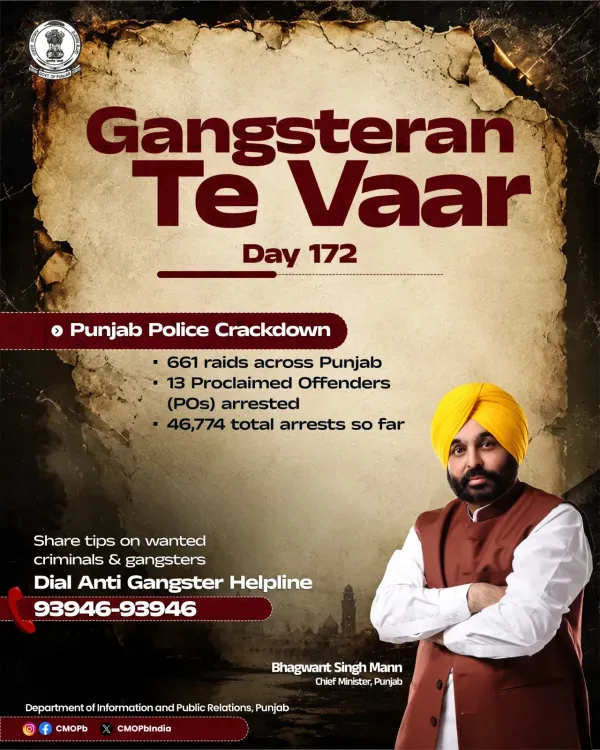
Punjab Police conducted 661 raids on Day 172 of the 'Gangsteran Te Vaar' campaign, taking cumulative arrests to 46,774. Preventive action was taken against 348 persons and 13 Proclaimed Offenders were detained during the operation, the Chief Minister's Office of Punjab announced.
Key Takeaways
661 raids were conducted at mapped locations linked to gangster associates on Day 172 of the campaign.
Cumulative arrests under 'Gangsteran Te Vaar' have reached 46,774 since the campaign's launch.
Preventive action was taken against 348 persons on the day of the operation.
13 Proclaimed Offenders (POs) — individuals who had evaded court appearances — were arrested during the operation.
The campaign uses an intelligence-mapped, network-disruption model , targeting pre-identified premises linked to gangster associates across Punjab .
The operation has now run continuously for over five months , making it one of the longer sustained anti-organised-crime drives in recent Indian state policing.
The Chief Minister's Office of Punjab announced on Sunday, 13 July 2026 that the state's decisive 'Gangsteran Te Vaar' anti-gangster campaign has entered its 172nd day, with Punjab Police conducting 661 raids at identified and mapped locations linked to associates of gangsters across the state.
What Happened on Day 172
On Day 172 of the campaign, police teams arrested multiple individuals, pushing the cumulative arrest count to 46,774 since the launch of the operation. In addition to arrests, preventive action was taken against 348 persons during the day's operations. Police teams also detained 13 Proclaimed Offenders (POs) during the operation — individuals who had previously evaded court appearances and been declared absconders by the judiciary.
The raids were conducted at locations that had been pre-identified and mapped as part of the campaign's intelligence-led approach, targeting premises linked to gangster associates spread across Punjab.
Context: A Metrics-Driven Crackdown
The 'Gangsteran Te Vaar' — translating broadly to 'Strike Against Gangsters' — is a statewide Punjab Police campaign targeting organised crime networks through sustained raids, arrests, and preventive detentions at systematically mapped locations. The campaign has been characterised by daily public reporting of operational metrics, a transparency measure designed to signal sustained institutional commitment.
Punjab has a documented history of organised crime, drug trafficking networks, and gang-related violence. The campaign's scale — spanning well over five months of continuous operations — places it among the more prolonged state-level anti-organised-crime drives in recent Indian policing history.
Policy Backdrop
The escalation of targeted operations against gangster syndicates in Punjab gained significant momentum following the high-profile 2022 murder of singer Sidhu Moose Wala, which drew national attention to the penetration of organised crime in the state. Since then, Punjab Police has pursued an intelligence-mapped, network-disruption model rather than reactive case-by-case policing.
Similar sustained anti-mafia drives have been deployed by other Indian states — including Uttar Pradesh and Maharashtra — to dismantle localised syndicate structures. The common thread is a combination of raids, preventive detentions under relevant statutes, and the tracking of proclaimed offenders to collapse operational networks over time.
Stakeholders and Impact
The primary stakeholders affected are gangster associates and their support networks, whose mapped locations have become the focus of daily police action. For ordinary Punjab residents — particularly in districts historically linked to organised crime activity — the campaign represents a sustained effort to reduce extortion, contract violence, and drug supply chains that feed into gang ecosystems.
The detention of 13 Proclaimed Offenders on a single operational day is notable, as POs represent individuals who have already evaded the legal process and whose capture has direct bearing on pending criminal cases in courts across the state.
What's Next
Observers will watch for the release of updated comprehensive crime statistics from Punjab that contextualise the campaign's impact on ground-level violence and organised crime indices. The possibility of a formal extension, phase-two restructuring, or legislative proposals targeting organised crime financing in the state remains on the policy horizon as the campaign crosses the six-month mark.
Point of View
Measurable state function rather than episodic law enforcement. At 172 days and counting, 'Gangsteran Te Vaar' has become a defining law-and-order marker for the current Punjab government, one it is visibly invested in sustaining in the public eye. The consistent detention of Proclaimed Offenders alongside mass raids suggests a two-track strategy: dismantling active networks while simultaneously clearing judicial backlogs created by absconders. How the state converts operational metrics into verifiable reductions in organised crime indices will determine whether the campaign is remembered as transformative policing or a prolonged show of force.
NationPress
11 Oct 2026
Frequently Asked Questions
What is the Gangsteran Te Vaar campaign in Punjab?
'Gangsteran Te Vaar' is a statewide Punjab Police operation targeting gangster networks through intelligence-mapped raids, mass arrests, preventive detentions, and the capture of Proclaimed Offenders across the state.
How many arrests have been made under Gangsteran Te Vaar?
As of Day 172 of the campaign, cumulative arrests under 'Gangsteran Te Vaar' have reached 46,774 , according to the Chief Minister's Office of Punjab.
What is a Proclaimed Offender (PO) in India?
A Proclaimed Offender is a person declared by a court as an absconder after failing to appear in legal proceedings. Punjab Police arrested 13 such individuals on Day 172 of the campaign.
Why did Punjab launch a major anti-gangster campaign?
The campaign gained momentum following the high-profile 2022 murder of singer Sidhu Moose Wala , which highlighted the deep penetration of organised crime in Punjab and prompted a sustained, intelligence-led police response.
How many raids did Punjab Police conduct on Day 172?
Punjab Police conducted 661 raids at pre-identified and mapped locations linked to gangster associates across the state on Day 172 of the 'Gangsteran Te Vaar' campaign.