Punjab Police Conducts 512 Raids on Day 152 of Gangsteran Te Vaar

Synopsis
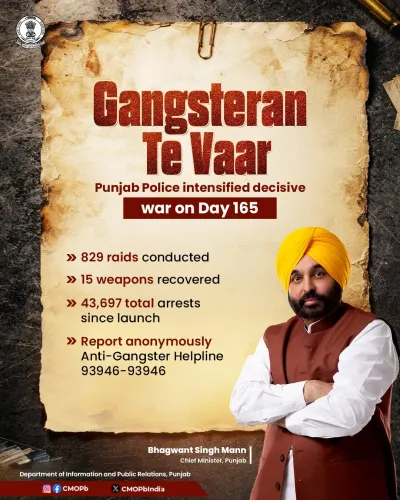
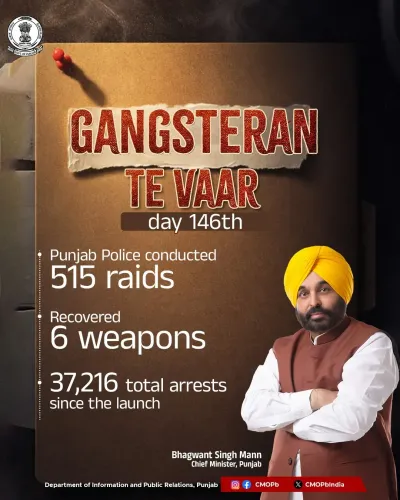
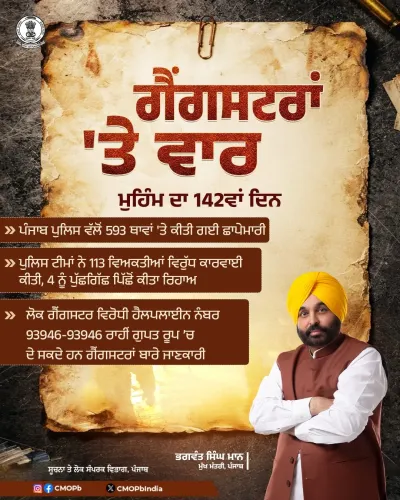
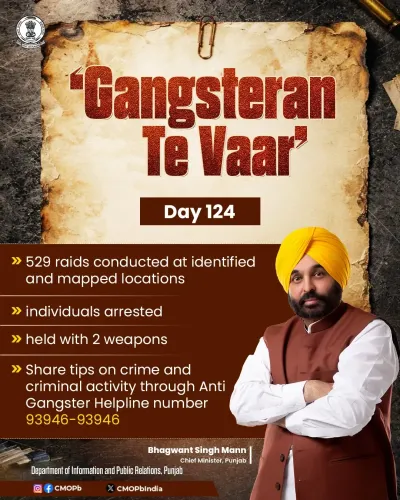
Punjab Police conducted 512 raids on Day 152 of the 'Gangsteran Te Vaar' anti-gangster campaign, seizing five weapons and pushing total arrests to 39,083 since the drive launched. The CMO of Punjab made the announcement on 22 June 2026, highlighting the campaign's sustained daily operational tempo.
Key Takeaways
512 raids were conducted across Punjab on Day 152 of the 'Gangsteran Te Vaar' campaign on 22 June 2026 .
Police arrested individuals carrying five weapons during the Day 152 operations.
Cumulative arrests since the campaign's launch have reached 39,083 .
Raids targeted identified and mapped locations linked to associates of gangsters , not only principal accused.
The campaign was launched by the AAP government under CM Bhagwant Mann , which has made anti-organised crime a governance priority since March 2022 .
No fixed end date for the campaign has been announced, suggesting it may continue as a sustained operational posture.
The Chief Minister's Office of Punjab announced on Monday, 22 June 2026 that Punjab Police conducted 512 raids across the state as the anti-gangster drive 'Gangsteran Te Vaar' entered its 152nd consecutive day, with cumulative arrests reaching 39,083 since the campaign's launch.
What the Latest Operation Covered
On Day 152, police teams targeted identified and mapped locations linked to associates of gangsters across Punjab. The raids resulted in arrests of individuals along with the seizure of five weapons, adding to a growing tally of arms recovered under the campaign. The CMO described the drive as 'decisive' — Gangsteran Te Vaar (meaning 'Strike Against Gangsters') — underscoring the government's framing of it as an ongoing offensive rather than a routine policing measure.
Context
Punjab has faced persistent challenges from organised crime, inter-gang violence, and drug trafficking networks that intensified following the decline of militancy in the mid-1990s. Successive state governments have launched periodic crackdowns combining raids, asset seizures, and arrests to disrupt these networks, but the scale and sustained daily cadence of 'Gangsteran Te Vaar' marks a distinct escalation in operational tempo.
Since the Aam Aadmi Party (AAP) government under Chief Minister Bhagwant Mann assumed office in March 2022, tackling organised crime and drug syndicates has been a stated priority. The campaign targets not only active gangsters but also their broader associate networks — logistics suppliers, financiers, and shelter providers — through systematic mapping of linked locations before raids are conducted.
Policy Backdrop
The AAP administration announced a comprehensive crackdown on drug syndicates and organised crime networks soon after taking office, positioning law-and-order reform as central to its governance agenda in the state. 'Gangsteran Te Vaar' operationalises that commitment through a structured, day-counted campaign that generates daily accountability metrics — arrests, raids, weapons seized — reported publicly through official channels.
Punjab Police has historically conducted multi-phase operations against criminal elements, particularly in the post-militancy period of the 1990s and 2000s. The current campaign continues this established pattern but distinguishes itself through its sustained daily reporting cadence and the use of intelligence-led mapping of associate networks before field operations are mounted.
Stakeholders and Impact
Residents across Punjab — particularly in districts with historically high gang activity — stand to benefit most directly from the disruption of organised crime networks. For gangster syndicates, the sustained pressure on associates and support infrastructure is designed to erode operational capacity even when principal accused remain at large or abroad.
The cumulative arrest figure of 39,083 over 152 days averages to roughly 257 arrests per day, a pace that reflects the breadth of the net being cast — encompassing associates, not only gang leaders. Civil liberties observers and legal aid bodies are among the stakeholders who will watch whether due process standards are maintained at this operational scale.
What's Next
The government has not indicated a fixed end date for 'Gangsteran Te Vaar', suggesting the campaign may continue indefinitely or transition into a permanent operational posture within routine policing. Official crime statistics for Punjab in the coming quarters will provide an independent measure of whether the sustained raids and arrests are translating into durable reductions in gang-related violence and drug trafficking across the state.
Point of View
Arrests, weapons — is as much a political communication strategy as an operational one, signalling continuous government action on law and order to a Punjab electorate that has historically punished administrations seen as soft on crime and drugs. The cumulative arrest figure of 39,083 over 152 days is striking in scale, but the critical question is whether these numbers reflect deep dismantling of gang infrastructure or a broader dragnet that sweeps in peripheral associates. For the Bhagwant Mann government, sustaining this campaign's visibility reinforces AAP's core governance-delivery narrative ahead of future electoral cycles. Independent verification of outcomes — particularly reductions in gang violence and drug trafficking — will determine whether 'Gangsteran Te Vaar' is remembered as a structural shift in Punjab's security landscape or as an extended show of force.
NationPress
20 Sept 2026
Frequently Asked Questions
What is the Gangsteran Te Vaar campaign in Punjab?
'Gangsteran Te Vaar' — meaning 'Strike Against Gangsters' — is a sustained Punjab Police campaign targeting gangster networks, their associates, and related criminal infrastructure through coordinated daily raids and arrests. It was launched by the AAP government under Chief Minister Bhagwant Mann after the party took office in March 2022.
How many arrests have been made under Gangsteran Te Vaar?
As of Day 152 of the campaign on 22 June 2026, total arrests since the launch of 'Gangsteran Te Vaar' have reached 39,083 , according to the Chief Minister's Office of Punjab.
How many raids did Punjab Police conduct on Day 152?
Punjab Police conducted 512 raids at identified and mapped locations linked to gangster associates across the state on Day 152 of the campaign, 22 June 2026.
What weapons were seized during the Day 152 operations?
Police teams arrested individuals found in possession of five weapons during the Day 152 operations of 'Gangsteran Te Vaar' on 22 June 2026.
Is the Gangsteran Te Vaar campaign still ongoing?
Yes, the campaign was in its 152nd consecutive day as of 22 June 2026. The government has not announced a fixed end date, suggesting operations are continuing with no immediate closure planned.