Punjab Police Marks 466 Days of 'Yudh Nashian Virudh' Drive
Synopsis
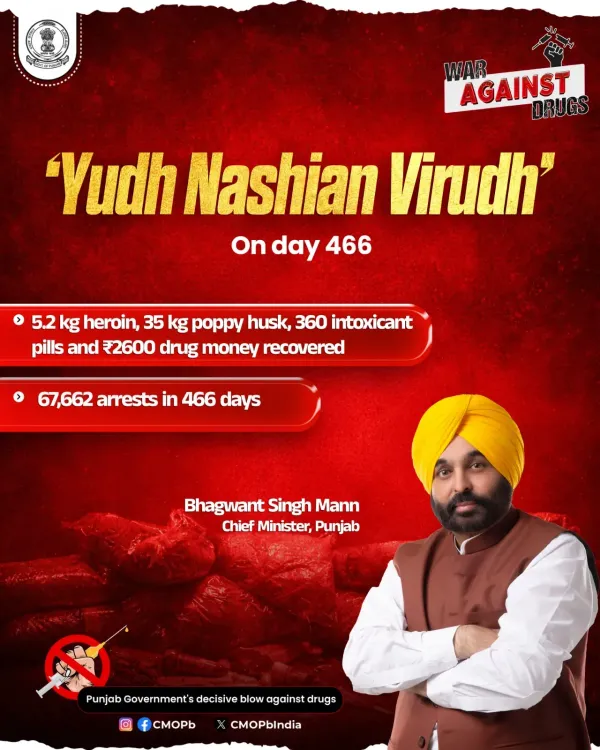
Punjab Police has logged 67,662 drug smuggler arrests over 466 days of the 'Yudh Nashian Virudh' campaign, seizing 5.2 kg heroin and 35 kg poppy husk on day 466 alone, while referring 12 persons to de-addiction treatment.
Key Takeaways
466 consecutive days of the 'Yudh Nashian Virudh' anti-narcotics drive have been completed as of June 11, 2026.
Cumulative arrests have reached 67,662 drug smugglers since the campaign began.
Day 466 seizures include 5.2 kg heroin , 35 kg poppy husk , 360 intoxicant pills , and ₹2,600 in drug money .
12 persons were convinced to undergo de-addiction and rehabilitation treatment on the same day.
The campaign combines hard enforcement with a parallel rehabilitation referral track targeting addiction recovery.
Daily public reporting of metrics is a core feature of the drive's transparency framework.
The Chief Minister's Office of Punjab on Thursday, June 11, 2026, announced that Punjab Police has completed 466 consecutive days of its anti-narcotics campaign 'Yudh Nashian Virudh' (Yudh Nashian Virudh — 'War Against Drugs'), reporting fresh seizures and a cumulative arrest count of 67,662 drug smugglers since the drive began.
What the Day's Operation Yielded
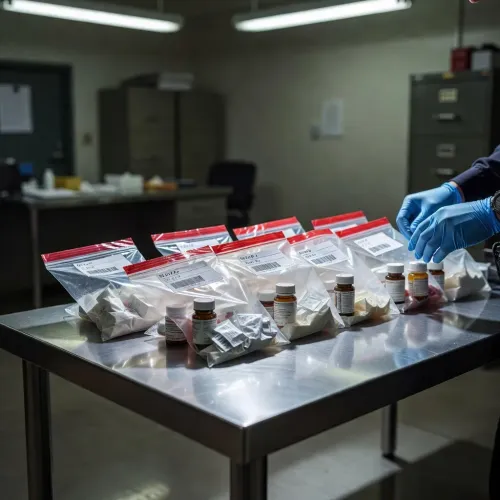
On day 466, police teams seized 5.2 kg of heroin, 35 kg of poppy husk, and 360 intoxicant pills, along with ₹2,600 in drug money from the possession of arrested smugglers. The daily update, shared by the CMO's official handle, reflects the state government's practice of publicly tracking enforcement outputs in near-real time. Alongside enforcement action, police also convinced 12 persons to voluntarily undergo de-addiction and rehabilitation treatment on the same day.Context: A Campaign Built on Daily Accountability
Punjab has long grappled with cross-border drug trafficking, a challenge amplified by the state's proximity to international boundaries. The 'Yudh Nashian Virudh' campaign was designed to combine hard enforcement — arrests and seizures — with a parallel rehabilitation track aimed at breaking the cycle of addiction at the community level. The daily public reporting of metrics is a deliberate transparency measure, meant to sustain pressure on enforcement agencies and signal political commitment to the electorate.Policy Backdrop: Successive Governments, Persistent Problem
Anti-narcotics operations in Punjab have been a recurring policy priority across administrations since at least the mid-2010s. The current campaign's structure — pairing police seizures with de-addiction referrals — reflects a dual-track approach that state governments have refined over successive terms. The cumulative figure of 67,662 arrests in 466 days averages to roughly 145 arrests per day, underscoring the scale at which the drive is being conducted. Poppy husk and heroin remain the most commonly reported narcotics in Punjab's trafficking corridors, consistent with the substances flagged in day 466's haul.Stakeholders and Impact
The campaign's primary beneficiaries are Punjab's youth, border communities, and families affected by addiction. The de-addiction component — 12 persons referred on a single day — is a relatively small number against the scale of the enforcement operation, but officials have consistently framed rehabilitation referrals as a qualitative indicator of community outreach alongside quantitative arrest tallies. Civil society groups working on addiction in the state have previously noted that sustained rehabilitation infrastructure, not just police action, is critical to long-term impact.What's Next
The CMO's office is expected to continue daily updates as the campaign extends beyond its 466-day milestone. Observers will watch whether the rehabilitation referral numbers scale up alongside enforcement figures, and whether the state announces any structural expansion of de-addiction centre capacity to absorb individuals being referred by police teams across districts.Point of View
The relatively modest daily rehabilitation referral numbers — 12 persons on day 466 — suggest the campaign's rehabilitation infrastructure has not yet scaled proportionally to its enforcement footprint, a gap that critics and civil society are likely to flag as the drive matures.
NationPress
20 Sept 2026
Frequently Asked Questions
What is 'Yudh Nashian Virudh' in Punjab?
'Yudh Nashian Virudh' translates to 'War Against Drugs' and is an ongoing Punjab Police campaign that combines daily narcotics enforcement — arrests and seizures — with de-addiction and rehabilitation referrals. It has been running continuously for over 466 days as of June 2026.
How many drug smugglers have been arrested in Punjab's anti-drug drive?
As of day 466 of the campaign on June 11, 2026, a cumulative total of 67,662 drug smugglers have been arrested under the 'Yudh Nashian Virudh' drive.
What drugs were seized by Punjab Police on June 11, 2026?
On the 466th day of the campaign, Punjab Police seized 5.2 kg of heroin , 35 kg of poppy husk , and 360 intoxicant pills , along with ₹2,600 in drug money.
Does Punjab Police also help drug addicts get treatment?
Yes. As part of the campaign's de-addiction component, police teams work to convince individuals to voluntarily undergo treatment. On June 11, 2026, 12 persons were referred to de-addiction and rehabilitation centres.
Why is Punjab particularly affected by drug trafficking?
Punjab's geographic location near international borders makes it a transit and consumption zone for narcotics, particularly heroin and poppy-derived substances. Successive state governments have treated anti-drug enforcement as a priority policy area for over a decade.