Punjab Police Marks 475 Days of 'Yudh Nashian Virudh' Drive
Synopsis
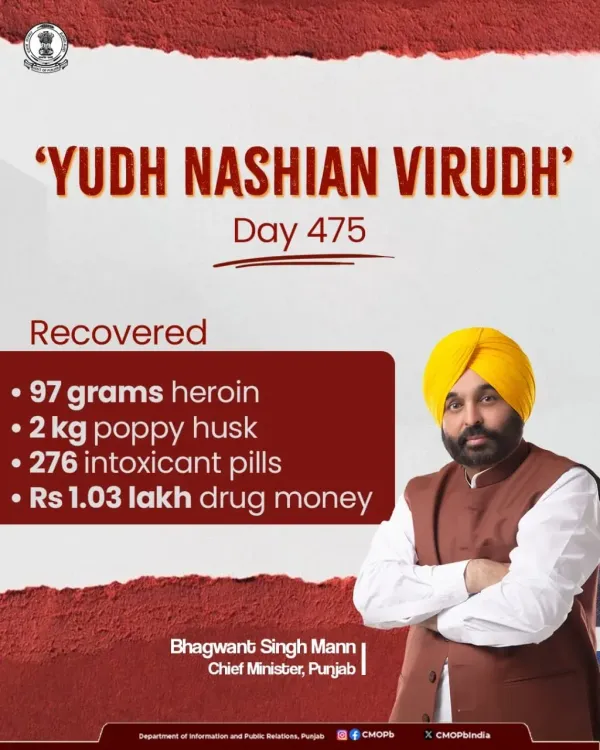
Punjab's 'Yudh Nashian Virudh' anti-drug drive has completed 475 days with total arrests reaching 68,981. The latest operation recovered 97g heroin, 2kg poppy husk, 276 intoxicant pills and Rs 1.03 lakh in drug money, the Chief Minister's Office reported on June 20, 2026.
Key Takeaways
475 consecutive days of the Yudh Nashian Virudh campaign have been completed as of June 20, 2026 .
Cumulative drug smuggler arrests under the drive have reached 68,981 .
The latest operation yielded 97 grams of heroin , 2 kg of poppy husk , and 276 intoxicant pills .
Rs 1.03 lakh in drug money was also recovered from arrested smugglers.
The campaign is led by Punjab Police under the Bhagwant Mann -led AAP government and targets narcotics supply networks across the state.
Drug trafficking across the India-Pakistan border remains a core challenge the drive seeks to address.
The Chief Minister's Office of Punjab announced on Saturday, June 20, 2026, that state police teams have completed 475 consecutive days of the anti-drug campaign Yudh Nashian Virudh (War Against Drugs), with fresh recoveries and arrests reported in the latest operational update.
What Was Recovered
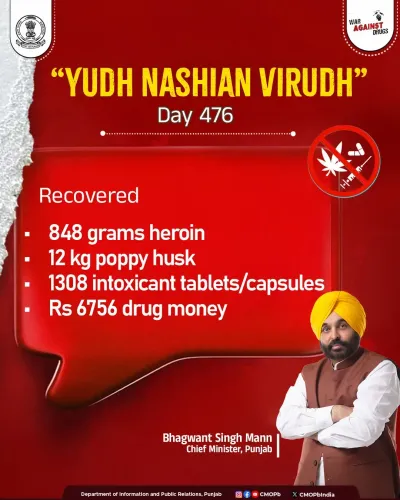
In the most recent drive under the campaign, police teams seized 97 grams of heroin, 2 kg of poppy husk, and 276 intoxicant pills from arrested drug smugglers. Authorities also recovered Rs 1.03 lakh in drug money from the suspects' possession. The recoveries span multiple narcotic categories, reflecting the mixed nature of drug supply networks active in the state.Context: A Campaign Now in Its Second Year
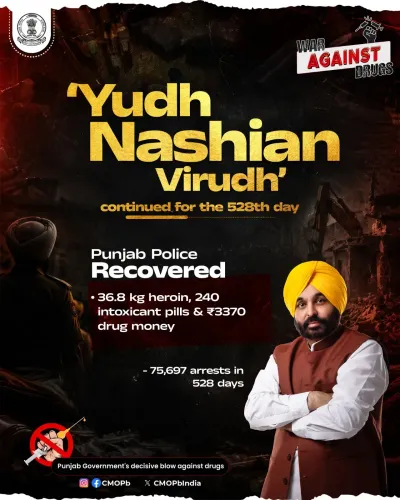
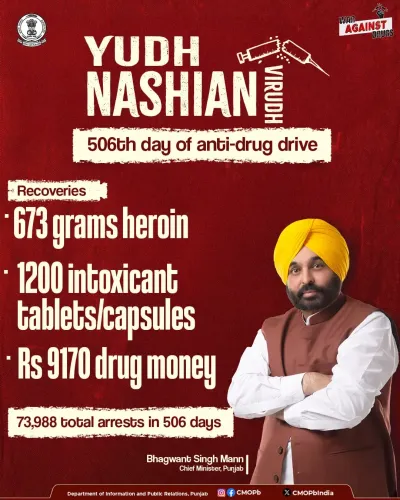
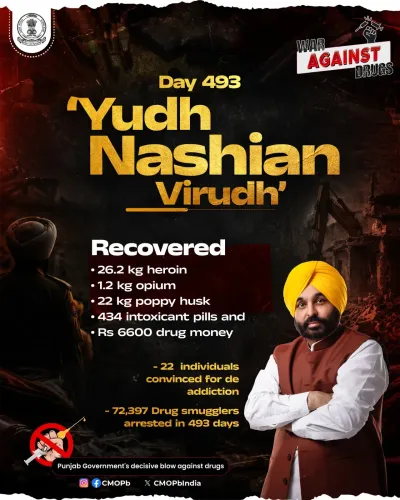
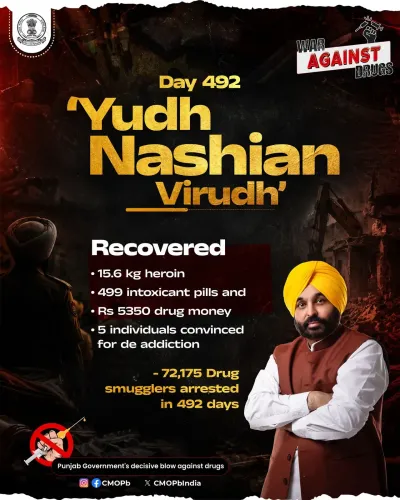
The Yudh Nashian Virudh campaign — translating to 'War Against Drugs' — is a statewide enforcement drive initiated by the Bhagwant Mann-led Aam Aadmi Party government in Punjab. With the 475-day milestone, the cumulative count of drug smugglers arrested under the campaign has reached 68,981, according to the CMO's update. The drive combines arrests, seizures, and sustained public messaging to disrupt narcotics supply chains across the state.Policy Backdrop: Punjab's Persistent Drug Challenge
Punjab has faced documented high prevalence of opioid and synthetic drug use for over a decade, with successive state governments launching enforcement operations since at least 2017. Drug trafficking across the India-Pakistan border has remained a persistent challenge for administrations of different parties. The current campaign continues a pattern of sustained enforcement, with Punjab Police serving as the primary operational agency. Periodic cumulative reporting — of the kind seen in this update — is a deliberate public-communication strategy to signal continuity and accountability.Stakeholders and Impact
The campaign's stated beneficiaries are Punjab's youth, families affected by addiction, and communities in border districts that have historically been most exposed to narcotics trafficking routes. Seizures of drug money alongside narcotics suggest efforts to disrupt financial flows that sustain trafficking networks. Anti-drug advocates and de-addiction organisations in the state have broadly welcomed sustained enforcement, while also calling for parallel investment in rehabilitation infrastructure.What to Watch
As the campaign crosses the 475-day mark, attention will turn to whether the government supplements enforcement data with announcements on de-addiction centre funding or supplementary budget allocations for rehabilitation. The pace of arrests and seizure volumes in coming weeks will indicate whether operational intensity is being maintained or modulated. Any arrest of a major trafficking network or cross-border operator would likely prompt a higher-profile announcement from the Chief Minister's Office. The sustained daily cadence of the Yudh Nashian Virudh drive signals that the Mann government intends to keep anti-drug enforcement a central plank of its governance narrative through its term, with cumulative milestones serving as periodic accountability markers for the public.Point of View
Converting enforcement data into a rolling accountability narrative. Reaching 68,981 arrests over 475 days signals operational consistency, but the figure also invites scrutiny of conviction rates and whether supply chains are genuinely disrupted or merely stressed. Punjab's drug problem has outlasted multiple enforcement campaigns by previous governments, suggesting that arrest volumes alone are insufficient without parallel rehabilitation investment. The Mann government's political credibility on this issue — one it campaigned hard on — will ultimately be tested by outcomes data, not just operational tallies.
NationPress
19 Sept 2026
Frequently Asked Questions
What is Yudh Nashian Virudh?
'Yudh Nashian Virudh' is a Punjabi phrase meaning 'War Against Drugs' and refers to an ongoing statewide anti-narcotics enforcement campaign run by Punjab Police under the Bhagwant Mann government, targeting drug smugglers, trafficking networks, and narcotics seizures across Punjab.
How many drug smugglers have been arrested in Punjab's anti-drug drive?
As of day 475 of the campaign on June 20, 2026, a total of 68,981 drug smugglers have been arrested under the 'Yudh Nashian Virudh' drive, according to the Chief Minister's Office of Punjab.
What drugs were seized in the latest Punjab anti-drug operation?
In the latest operation reported on June 20, 2026, Punjab Police recovered 97 grams of heroin, 2 kg of poppy husk, 276 intoxicant pills, and Rs 1.03 lakh in drug money from arrested smugglers.
Why is Punjab particularly affected by drug trafficking?
Punjab's geographic position along the India-Pakistan border has made it a transit and destination point for narcotics smuggling for decades. High opioid and synthetic drug prevalence has been documented in the state since at least 2017, prompting successive governments to launch enforcement drives.
Who is leading the Yudh Nashian Virudh campaign in Punjab?
The campaign is conducted by Punjab Police and overseen by the state government led by Chief Minister Bhagwant Mann of the Aam Aadmi Party, which has made anti-drug enforcement a central governance priority since taking office in March 2022.