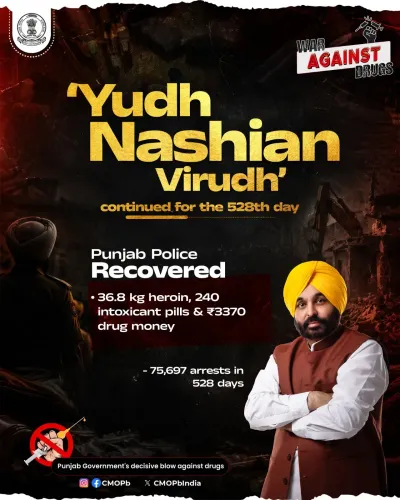
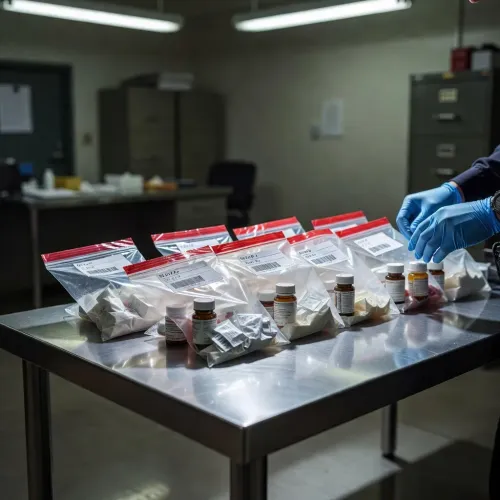
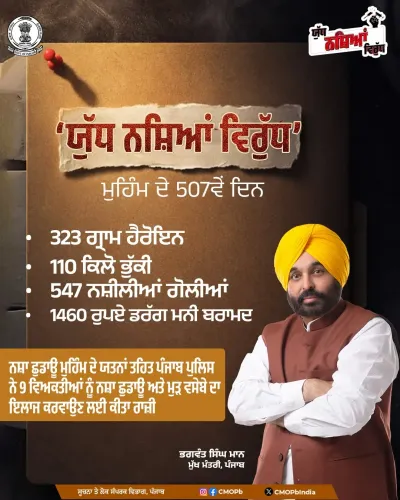
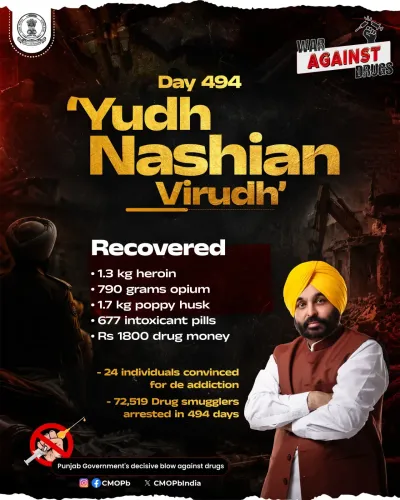
Punjab Police continues 'Yudh Nashian Virudh' on Day 455
Synopsis
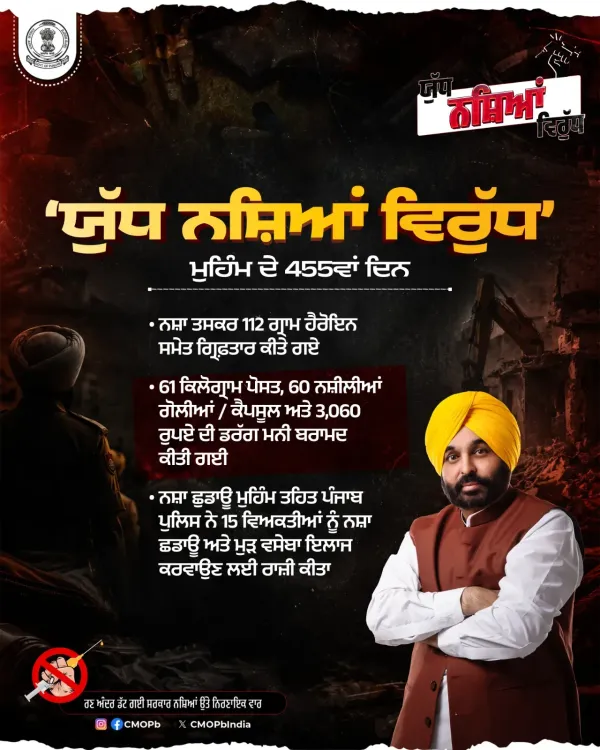
Punjab Police sustained its 'Yudh Nashian Virudh' anti-narcotics drive on its 455th consecutive day on 31 May 2026, seizing 112 grams of heroin and 61 kg of poppy husk, pushing cumulative drug-smuggler arrests to 65,824. Fifteen individuals were also referred for de-addiction treatment.
Key Takeaways
Day 455: Punjab Police continued 'Yudh Nashian Virudh' without interruption on 31 May 2026 .
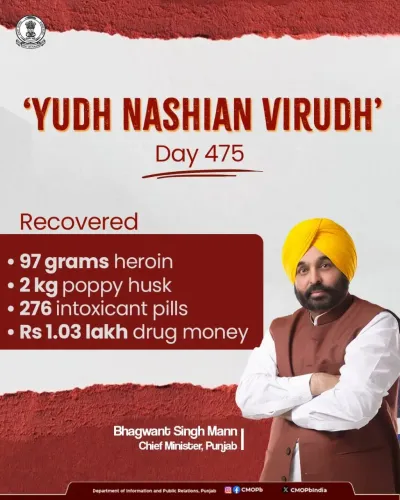
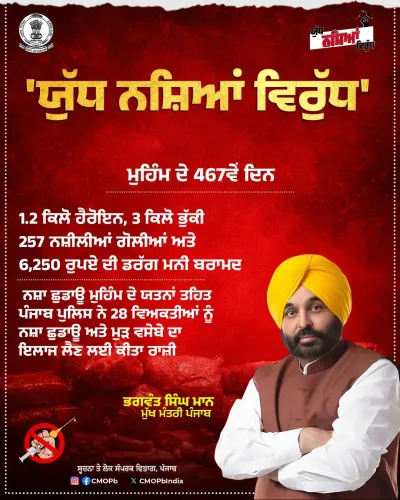
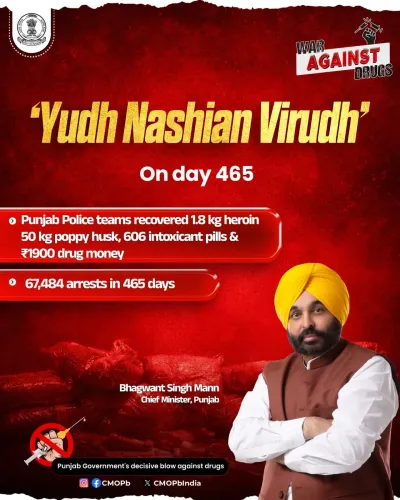
Fresh seizures included 112 grams of heroin , 61 kg of poppy husk , and 60 intoxicant pills/capsules .
Rs 3,060 in drug money was recovered from arrested smugglers.
Cumulative drug-smuggler arrests since the campaign's launch have reached 65,824 .
15 individuals were convinced to voluntarily undergo de-addiction and rehabilitation treatment on Day 455.
The campaign operates under the NDPS Act, 1985 and combines enforcement with structured rehabilitation outreach.
The Chief Minister's Office of Punjab on Sunday, 31 May 2026 announced that Punjab Police has sustained its anti-narcotics drive 'Yudh Nashian Virudh' ('War Against Drugs') into its 455th consecutive day, with fresh arrests of drug smugglers and the seizure of narcotics and drug money.
What happened on Day 455
Police teams arrested drug smugglers and recovered 112 grams of heroin, 61 kilograms of poppy husk, 60 intoxicant pills and capsules, and Rs 3,060 in drug money from their possession. Separately, under the campaign's de-addiction component, 15 individuals were persuaded to voluntarily undergo de-addiction and rehabilitation treatment.Context
The cumulative tally of drug smugglers arrested since the campaign's launch has now reached 65,824 in 455 days, according to the official update. The 'Yudh Nashian Virudh' campaign combines daily enforcement operations with structured outreach to users, with the Chief Minister's Office publishing granular daily updates as a transparency and accountability measure. Punjab, which shares a long border with Pakistan, has reported elevated rates of opioid and synthetic drug abuse for more than fifteen years, making the issue a persistent governance and public-health challenge.Policy Backdrop
Anti-narcotics enforcement in Punjab has been a recurring electoral and governance theme across successive state governments. The current administration under Chief Minister Bhagwant Mann of the Aam Aadmi Party, in office since March 2022, has made the campaign a flagship priority, framing it as a sustained, data-driven operation rather than a periodic crackdown. Cases are registered under the Narcotic Drugs and Psychotropic Substances (NDPS) Act, 1985, the primary central legislation governing heroin, poppy husk, and synthetic drug offences. The campaign operates alongside operations by the central Narcotics Control Bureau and occasional joint task forces.Stakeholders and Impact
The daily de-addiction referrals — 15 persons on Day 455 alone — reflect the campaign's dual mandate: punitive enforcement against traffickers and rehabilitative outreach to users. Punjab's youth, border-district residents, and families affected by addiction are the primary beneficiaries of both tracks. Civil society groups monitoring the campaign have consistently called for greater attention to conviction rates and long-term rehabilitation outcomes alongside arrest and seizure figures, a conversation the state government has indicated it intends to address through planned expansion of de-addiction infrastructure.What's Next
With the campaign showing no sign of pause at the 455-day mark, attention will shift to mid-term assessments of conviction rates under the NDPS Act and the capacity of state-run de-addiction centres to absorb the growing number of individuals being referred for rehabilitation. Any announcement on the expansion of such centres or a formal review of the campaign's outcomes would mark a significant policy milestone for the Mann government.Point of View
Converting enforcement data into a real-time governance scorecard. Reaching 65,824 arrests in 455 days is a politically significant milestone, but analysts note that arrest volumes tell only part of the story — conviction rates, asset forfeitures, and recidivism figures remain largely absent from the official narrative. The rehabilitation strand, while modest in daily numbers, signals an awareness that pure enforcement cannot resolve a deep-rooted public-health crisis. Whether the administration can demonstrate durable outcomes — not just daily tallies — will determine the campaign's long-term credibility.
NationPress
25 Sept 2026
Frequently Asked Questions
What is 'Yudh Nashian Virudh' in Punjab?
'Yudh Nashian Virudh' ('War Against Drugs') is an ongoing anti-narcotics campaign run by Punjab Police under the Bhagwant Mann government, combining daily enforcement operations against drug smugglers with de-addiction and rehabilitation outreach for users. It has been running continuously since its launch and provides daily public updates on arrests and seizures.
How many drug smugglers have been arrested in Punjab's anti-drug campaign?
As of Day 455 of the campaign on 31 May 2026, a cumulative total of 65,824 drug smugglers have been arrested under 'Yudh Nashian Virudh', according to the Chief Minister's Office of Punjab.
What drugs were seized by Punjab Police on 31 May 2026?
On Day 455 of the campaign, Punjab Police recovered 112 grams of heroin , 61 kilograms of poppy husk , 60 intoxicant pills and capsules , and Rs 3,060 in drug money .
Why is Punjab particularly affected by drug trafficking?
Punjab shares a long international border with Pakistan, which has historically been a major route for cross-border flows of heroin and synthetic drugs. The state has reported elevated rates of opioid and synthetic drug abuse for over fifteen years, making anti-narcotics enforcement a recurring priority for successive state governments.
What rehabilitation steps are being taken alongside arrests in Punjab?
Alongside enforcement, Punjab Police's de-addiction component persuades users to voluntarily undergo treatment at state-run rehabilitation centres. On Day 455 alone, 15 individuals were convinced to seek de-addiction and rehabilitation treatment.