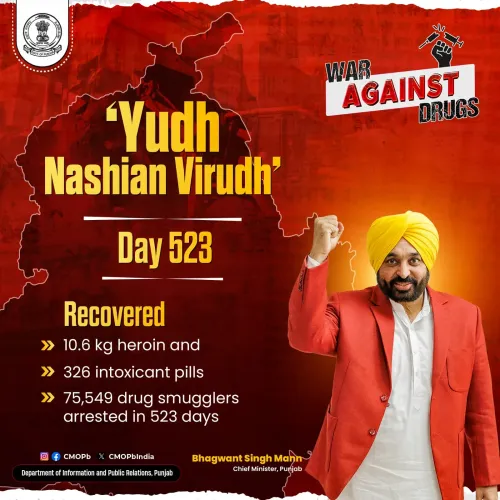
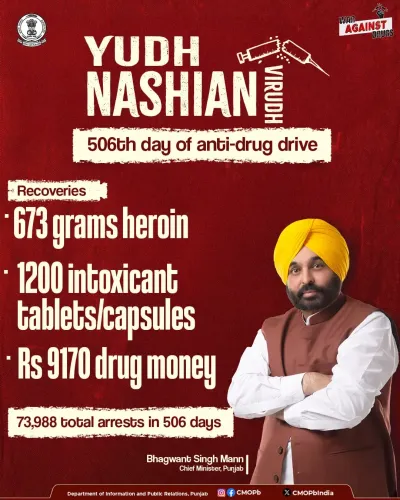
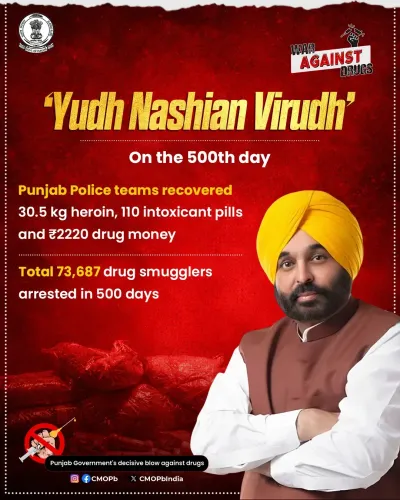
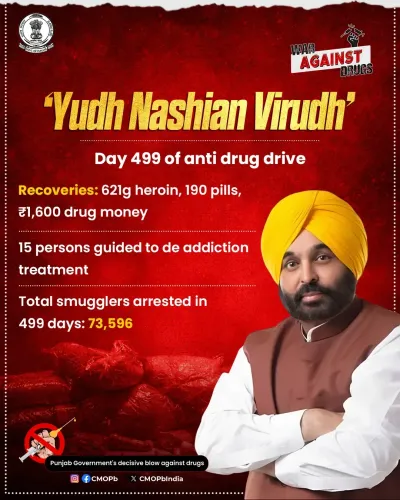
Punjab Police hits Day 492 of Yudh Nashian Virudh, arrests 72,175
Synopsis
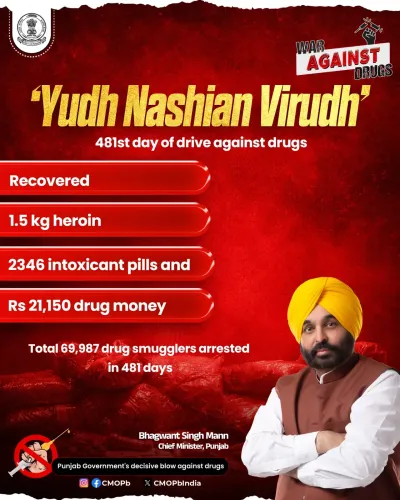
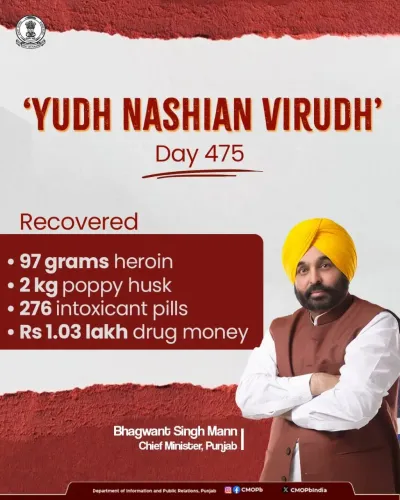
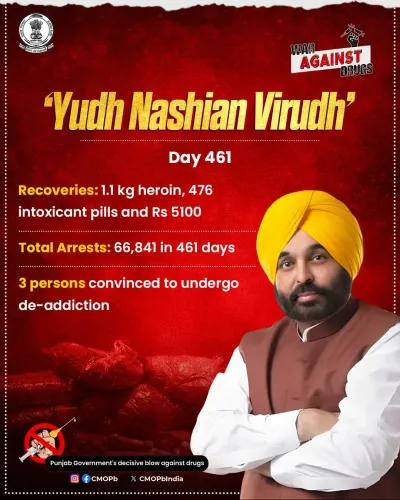
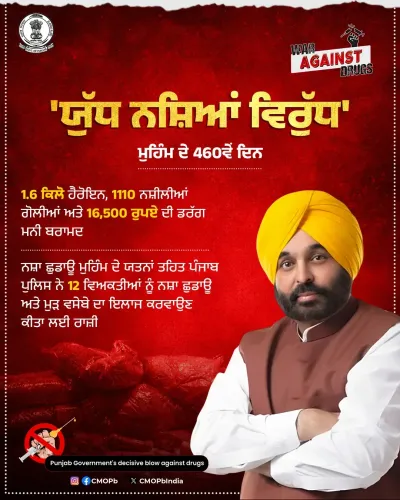
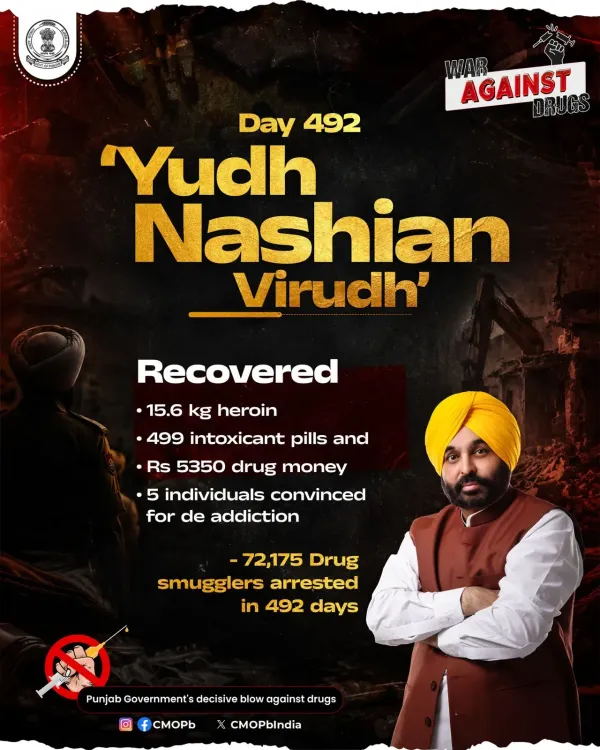
Punjab Police's Yudh Nashian Virudh anti-drug drive reached its 492nd day on 7 July 2026, with total arrests hitting 72,175. The latest sweep yielded 15.6 kg of heroin, 499 intoxicant pills, and Rs 5,350 in drug money, while five persons were referred for de-addiction treatment.
Key Takeaways
Yudh Nashian Virudh completed its 492nd consecutive day of operations on 7 July 2026 .
Cumulative drug-smuggler arrests have reached 72,175 since the campaign's launch.
The latest drive recovered 15.6 kg of heroin and 499 intoxicant pills from arrested smugglers.
Rs 5,350 in drug money was also seized in the same operation.
Five persons were convinced to undergo de-addiction and rehabilitation treatment as part of the demand-reduction effort.
The campaign runs a dual-track model: supply-side enforcement combined with community rehabilitation outreach.
The Chief Minister's Office of Punjab announced on Tuesday, 7 July 2026 that the state police's ongoing anti-narcotics drive, Yudh Nashian Virudh, has entered its 492nd consecutive day, with cumulative arrests of drug smugglers reaching 72,175 since the campaign began.
Context
In the latest single-day sweep, Punjab Police teams recovered 15.6 kg of heroin, 499 intoxicant pills, and Rs 5,350 in drug money from arrested smugglers. Alongside enforcement, police convinced five persons to voluntarily enrol in de-addiction and rehabilitation treatment as part of the campaign's demand-reduction pillar.
The CMO post, carrying the hashtags #YudhNashianVirudh and #WarAgainstDrugs, reaffirmed the dual-track strategy: supply disruption through arrests and seizures, combined with community-level rehabilitation outreach.
Policy Backdrop
Yudh Nashian Virudh — translating roughly to 'War Against Drugs' — is a statewide initiative launched under Chief Minister Bhagwant Mann's Aam Aadmi Party government, which took office in March 2022 with an explicit pledge to dismantle Punjab's entrenched narcotics networks. The campaign combines daily enforcement drives by district and special police units with structured referrals to government-run de-addiction centres.
Punjab's drug challenge is rooted in its geography: the state shares a border with Pakistan and sits downstream from the Golden Crescent — the Afghanistan-Iran-Pakistan corridor that is among the world's largest heroin-producing zones. Synthetic drugs and pharmaceutical opioids have compounded the problem in recent years, making multi-agency enforcement a necessity rather than an option.
Stakeholders and Impact
Border communities, farming households, and urban youth remain the populations most acutely affected by drug trafficking and addiction in Punjab. For these groups, the daily arrest tallies represent both a security dividend and a signal that the state is sustaining pressure on supply chains that have historically been resilient.
The de-addiction component — with five persons referred for treatment in a single day's reporting — reflects the government's acknowledgement that enforcement alone cannot resolve a public-health crisis. Rehabilitation referrals, even in small numbers, are tracked and publicised as proof of a whole-of-society approach.
What's Next
Observers will watch for consolidated quarterly data from Punjab Police on total seizure volumes, conviction rates, and de-addiction centre occupancy — metrics that would allow independent assessment of whether the campaign's scale translates into durable outcomes. Possible coordination with central narcotics agencies and neighbouring states on cross-border trafficking routes is also anticipated as the drive crosses further milestones.
With the campaign now past 492 days of uninterrupted operation, the Mann government's ability to sustain enforcement momentum while scaling rehabilitation capacity will be the defining test of its anti-drug governance pledge.
Point of View
175 over 492 days signals institutional persistence, but the more revealing metric will be whether rehabilitation referrals and conviction rates scale proportionately with the enforcement numbers. Punjab's cross-border heroin problem has historically outlasted enforcement surges, making the de-addiction component — however modest in daily terms — the longer-term policy variable worth tracking. The campaign's sustainability past the 500-day mark and into the electoral cycle will test whether it remains a policing priority or transitions into a political talking point.
NationPress
6 Oct 2026
Frequently Asked Questions
What is Yudh Nashian Virudh?
Yudh Nashian Virudh, meaning 'War Against Drugs,' is a continuous anti-narcotics campaign run by Punjab Police under Chief Minister Bhagwant Mann's government, combining daily arrests of drug smugglers with de-addiction referrals for affected individuals.
How many drug smugglers have been arrested in Punjab's anti-drug drive?
As of Day 492 on 7 July 2026, the total number of drug smugglers arrested under the Yudh Nashian Virudh campaign has reached 72,175.
What was seized in the latest Punjab Police drug raid?
In the latest operation reported on 7 July 2026, Punjab Police recovered 15.6 kg of heroin, 499 intoxicant pills, and Rs 5,350 in drug money from arrested smugglers.
Why is Punjab so affected by the drug problem?
Punjab borders Pakistan and lies downstream from the Golden Crescent — one of the world's largest heroin-producing corridors — making it a key transit and consumption zone for heroin and synthetic drugs.
Does Punjab Police also focus on rehabilitation, not just arrests?
Yes. Alongside enforcement, the Yudh Nashian Virudh campaign includes a de-addiction component where police personnel convince drug users to voluntarily enrol in government rehabilitation centres; five such referrals were reported on 7 July 2026 alone.