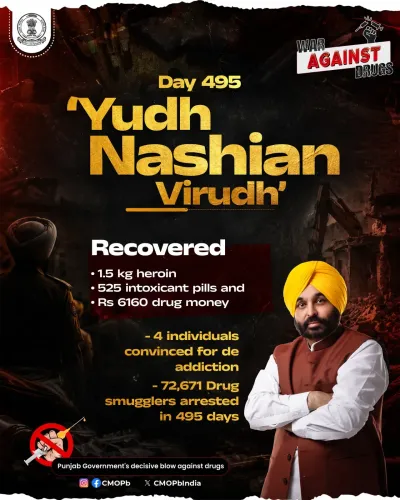
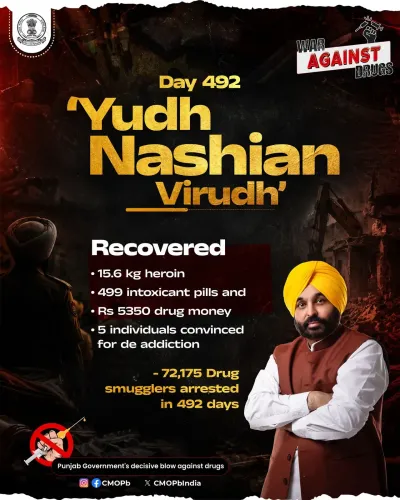
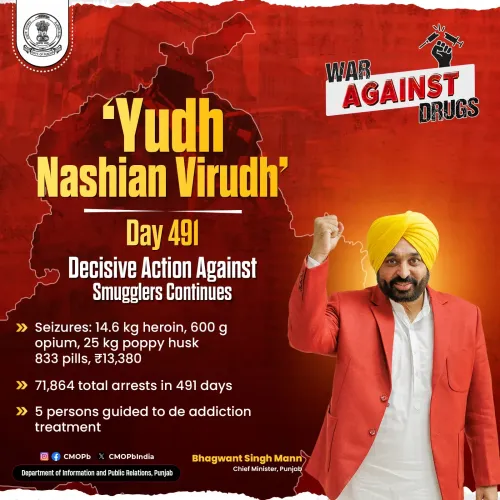
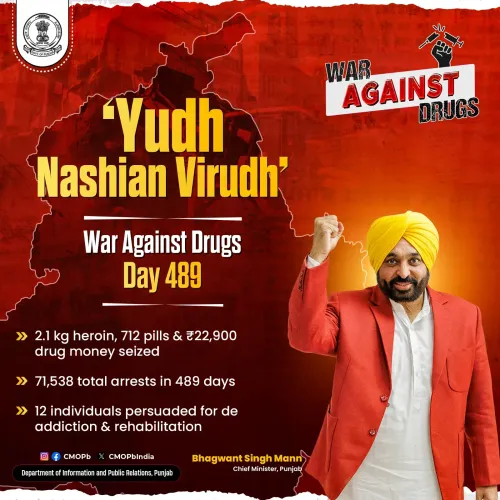
Punjab Police arrests 73,815 drug smugglers in 503 days of 'Yudh Nashian Virudh'
Synopsis
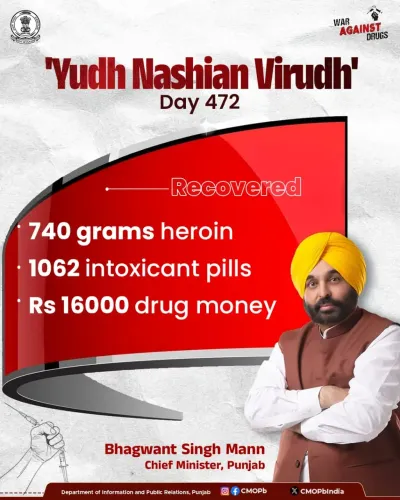
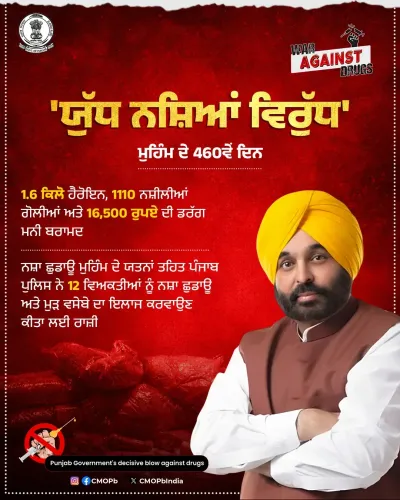
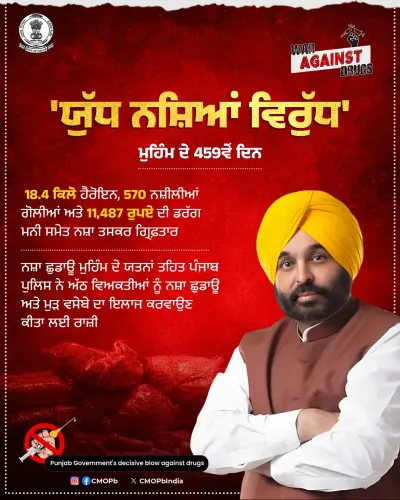
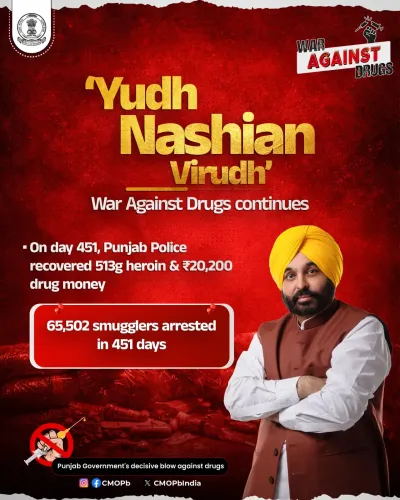
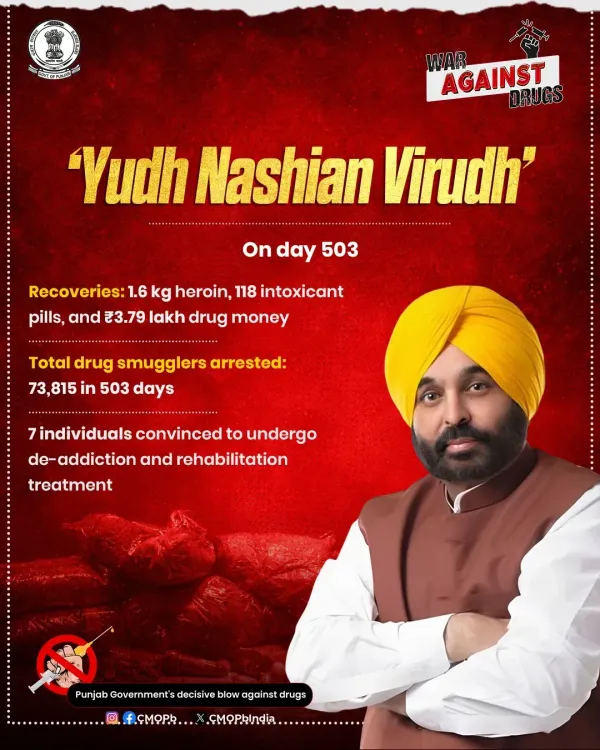
The Chief Minister's Office of Punjab reported on 18 July 2026 that the 'Yudh Nashian Virudh' anti-drug drive has reached day 503, with cumulative arrests of 73,815 drug smugglers, fresh recoveries of 1.6 kg heroin, 118 intoxicant pills, ₹3.79 lakh in drug money, and seven persons referred to de-addiction treatment.
Key Takeaways
503 consecutive days : The Yudh Nashian Virudh drive has run without interruption as of 18 July 2026 .
73,815 drug smugglers have been arrested in total since the campaign began.
Day-503 recoveries include 1.6 kg heroin , 118 intoxicant pills , and ₹3.79 lakh in drug money.
Seven persons were counselled and referred to de-addiction and rehabilitation treatment on the same day.
The campaign combines supply-side enforcement with demand-reduction through voluntary rehabilitation referrals.
Punjab's border geography with Pakistan remains a key driver of persistent heroin inflows targeted by the drive.
The Chief Minister's Office of Punjab announced on Saturday, 18 July 2026 that the state police's ongoing anti-drug drive Yudh Nashian Virudh ('War Against Drugs') has entered its 503rd consecutive day, with fresh recoveries of 1.6 kg heroin, 118 intoxicant pills, and ₹3.79 lakh in drug money from arrested smugglers. The cumulative arrest tally under the campaign has now reached 73,815, while seven more persons were persuaded to enter de-addiction and rehabilitation treatment on the same day.
Context
The CMO Punjab post states: 'Police teams have continued its drive against drugs 'Yudh Nashian Virudh' for the 503rd day. Following the arrests of drug smugglers, the Punjab Police recovered 1.6 kg heroin, 118 intoxicant pills and ₹3.79 lakh drug money from their possession.' The daily social-media update is part of a sustained public-accountability exercise the Aam Aadmi Party government of Chief Minister Bhagwant Mann has maintained since the drive's launch.
Punjab shares a long border with Pakistan and has for decades faced documented inflows of heroin and, more recently, synthetic drugs. The state's geographic vulnerability has made it a focal point for successive governments' counter-narcotics efforts.
Policy Backdrop
When the AAP government assumed office in March 2022, it declared a comprehensive war on drugs among its first policy priorities, branding the campaign Yudh Nashian Virudh. The initiative combines traditional enforcement — arrests, seizures, and drug-money confiscation — with a demand-reduction component that involves police personnel counselling users and facilitating voluntary enrolment in de-addiction centres.
The dual supply-and-demand approach mirrors frameworks adopted in other high-prevalence Indian states, though Punjab's border geography makes enforcement particularly complex. The previous Congress administration under Amarinder Singh had run a comparable campaign called 'Nasha Mukt Punjab', underscoring that the drug challenge predates any single government's tenure.
Stakeholders and Impact
The most direct beneficiaries of the de-addiction component are Punjab's youth, particularly in border districts such as Amritsar, Gurdaspur, and Tarn Taran, where drug prevalence has historically been highest. Seven individuals were referred to rehabilitation on 18 July 2026 alone, a figure the CMO highlights as evidence that the campaign goes beyond punitive action.
For families and communities, each arrest and rehabilitation referral represents an incremental reduction in local supply and demand. However, civil-society observers have long noted that sustained rehabilitation infrastructure — beds, counsellors, and follow-up care — is as critical as arrest numbers in determining long-term outcomes.
What's Next
The Punjab Police is expected to continue releasing daily operational updates as the drive progresses. Analysts and opposition parties will watch whether the government supplements enforcement milestones with announcements of additional de-addiction facility capacity or dedicated budget allocations in the next state budget session. The trajectory of cumulative arrests and the pace of rehabilitation referrals will serve as the primary benchmarks for assessing whether Yudh Nashian Virudh is shifting from a policing exercise to a durable public-health intervention.
Point of View
815 arrests over 503 days provides a headline number that is difficult for opponents to dismiss, yet the rehabilitation referral count — seven persons on a single day — points to the harder, slower work of demand reduction that rarely generates comparable political momentum. The broader pattern across Indian states suggests that enforcement-heavy drives tend to plateau in impact unless matched by proportional investment in treatment infrastructure, making the next budget cycle a critical test of whether this government's anti-drug commitment extends beyond policing metrics.
NationPress
18 Jul 2026
Frequently Asked Questions
What is 'Yudh Nashian Virudh' in Punjab?
'Yudh Nashian Virudh' — meaning 'War Against Drugs' in Punjabi — is the Punjab government's ongoing anti-narcotics campaign launched after the AAP government took office in March 2022. It combines police enforcement, arrests of drug smugglers, seizure of contraband, and voluntary de-addiction referrals.
How many drug smugglers have been arrested in Punjab's anti-drug drive?
As of day 503 of the drive — 18 July 2026 — the total number of drug smugglers arrested under 'Yudh Nashian Virudh' has reached 73,815 , according to the Chief Minister's Office of Punjab.
What drugs were recovered by Punjab Police on 18 July 2026?
Punjab Police recovered 1.6 kg of heroin , 118 intoxicant pills , and ₹3.79 lakh in drug money on day 503 of the 'Yudh Nashian Virudh' drive, on 18 July 2026 .
Why does Punjab have such a severe drug problem?
Punjab shares a long border with Pakistan, making it a major transit route for heroin and synthetic drugs. The state has faced sustained cross-border narcotics inflows for more than two decades, prompting successive state governments to mount large-scale enforcement campaigns.
What is the de-addiction component of Punjab's drug drive?
Alongside arrests, Punjab Police personnel counsel drug users and persuade them to voluntarily enter de-addiction and rehabilitation centres. On 18 July 2026 , seven persons were referred to treatment under this component of 'Yudh Nashian Virudh'.