Punjab Police deports fugitive gangster from Ethiopia
Synopsis
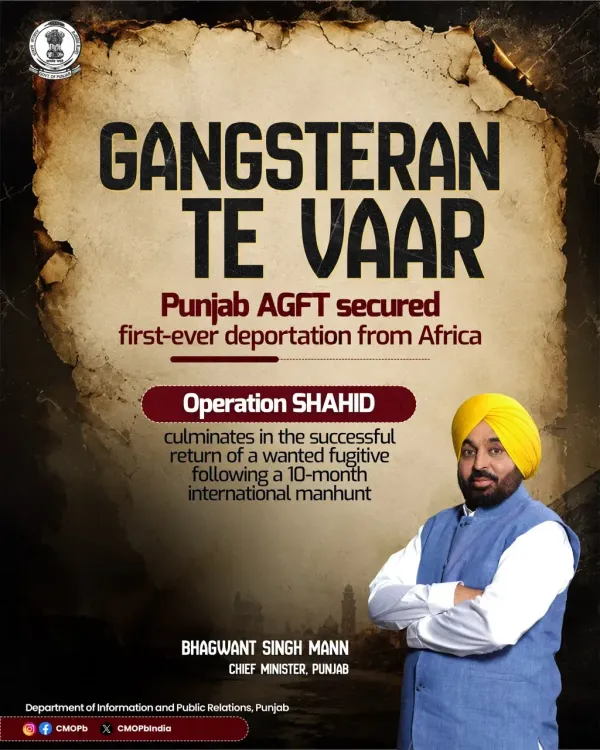
Punjab Police's Anti-Gangster Task Force, backed by OFTEC and Central Agencies, has deported a fugitive gangster from Ethiopia under Chief Minister Bhagwant Mann's 'Gangsteran Te Vaar' campaign — marking a significant cross-continental enforcement win for the state.
Key Takeaways
Punjab Police's AGTF secured the deportation of a fugitive gangster from Ethiopia on 9 November 2026 .
The operation was conducted under CM Bhagwant Mann 's 'Gangsteran Te Vaar' (War on Gangsters) campaign.
OFTEC (Overseas Fugitive Tracking and Extradition Cell) of Counter Intelligence and Central Agencies provided critical support.
The case highlights Punjab's expanding use of international coordination to pursue transnational crime networks.
Punjab's AAP government has prioritised overseas fugitive tracking as a law-enforcement pillar since taking office in 2022 .
A fugitive gangster hiding thousands of kilometres away in Ethiopia has been brought back to India — a result that Punjab Police is calling a major breakthrough in its ongoing crackdown on transnational organised crime. The Chief Minister's Office of Punjab announced on Monday, 9 November 2026, that the deportation was secured through a coordinated operation under the campaign 'Gangsteran Te Vaar' (War on Gangsters), launched on the directions of Chief Minister Bhagwant Mann.
'Gangsteran Te Vaar' reaches East Africa
The operation involved Punjab Police's Anti-Gangster Task Force (AGTF), working in close coordination with the Overseas Fugitive Tracking and Extradition Cell (OFTEC) of Counter Intelligence and supported by Central Agencies. The convergence of state-level specialised units with central government machinery signals a deliberate escalation in how Punjab is pursuing organised crime figures who flee beyond India's borders.
Ethiopia's appearance in this case underlines a broadening geography. Fugitives from Punjab's gangster networks have historically sought refuge in countries with limited extradition frameworks, testing the state's ability to reach them. This deportation suggests those calculations are shifting.
AGTF and OFTEC: Punjab's transnational crime machinery
The Anti-Gangster Task Force was stood up precisely to cut through the complexity of organised crime that links Punjab's streets to diaspora networks and foreign soil. OFTEC, its international-facing counterpart within Counter Intelligence, handles the diplomatic and legal legwork of tracking and recovering fugitives who have crossed borders. Together, the two units represent the most specialised anti-gang architecture the state has fielded.
Since Chief Minister Bhagwant Mann's Aam Aadmi Party government came to power in 2022, Punjab has emphasised international coordination as a pillar of its law-enforcement strategy — a response to the stubborn reality that gang violence at home is frequently directed from abroad.
A persistent threat, a sharper response
Punjab has grappled with transnational gangster networks for more than two decades. The pattern is well-worn: operatives on the ground in Punjab, financiers and commanders embedded in diaspora communities overseas, and communication lines that cross continents. Breaking that chain requires more than local policing — it demands the kind of cross-border legal cooperation that this deportation from Ethiopia now demonstrates is achievable.
The 'Gangsteran Te Vaar' campaign is Punjab's most visible assertion that the state will pursue these networks wherever they go. Each deportation adds operational credibility to that claim.
With a fugitive now back on Indian soil, the question is how many more names on the AGTF's international watch-list are about to find their shelter running out.
Point of View
Anti-gangster wins are both a governance imperative and an electoral asset, given that organised crime and drug networks remain the state's most emotionally charged public-safety issue. The deployment of OFTEC alongside Central Agencies also signals a maturing federal cooperation model — one that sidesteps the traditional state-centre friction on policing. If further deportations follow, the campaign could redefine the ceiling of what a state police force can achieve beyond its borders.
NationPress
9 Nov 2026
Frequently Asked Questions
What is the 'Gangsteran Te Vaar' campaign in Punjab?
'Gangsteran Te Vaar' (War on Gangsters) is an anti-organised crime campaign launched by Punjab Police on the directions of Chief Minister Bhagwant Mann, targeting gangster networks operating inside and outside India.
What is Punjab Police's Anti-Gangster Task Force (AGTF)?
The AGTF is a specialised Punjab Police unit dedicated to dismantling organised crime and gangster networks, often working in coordination with central agencies on cross-border cases.
What is OFTEC and what does it do?
OFTEC, the Overseas Fugitive Tracking and Extradition Cell, is a unit within Punjab Police's Counter Intelligence that handles international tracking, legal coordination, and deportation or extradition of fugitives who have fled abroad.
Why was a Punjab gangster hiding in Ethiopia?
Punjab's transnational gangster networks have historically used countries with limited extradition arrangements as safe havens. The specific reasons for this individual's presence in Ethiopia have not been officially disclosed.
How has Bhagwant Mann's government tackled organised crime in Punjab?
Since coming to power in 2022, the Aam Aadmi Party government in Punjab has emphasised specialised task forces, international coordination through OFTEC, and Central Agency support to pursue gang figures both domestically and overseas.