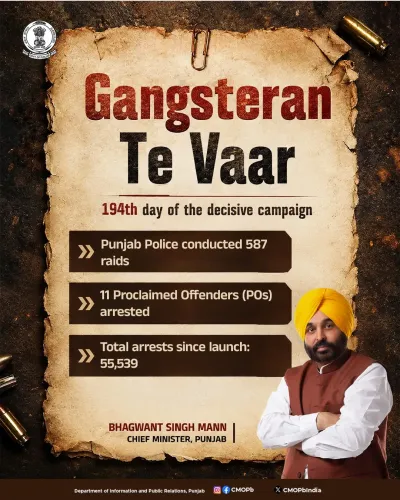
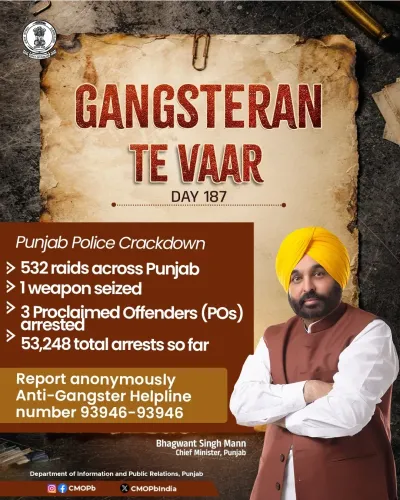
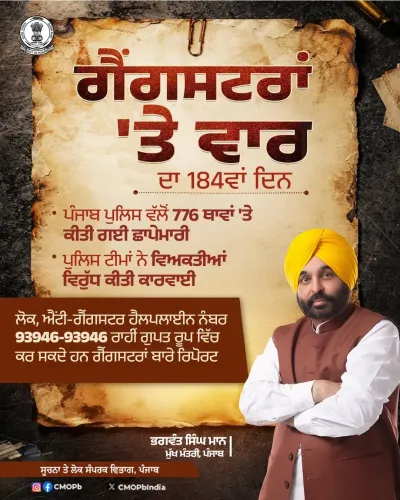
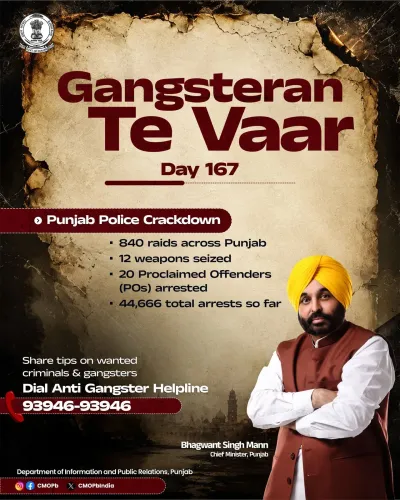
Punjab Police Conducts 369 Raids on Day 127 of Gangsteran Te Vaar

Synopsis
On the 127th day of Punjab's Gangsteran Te Vaar campaign, police raided 369 mapped locations tied to gangster associates statewide, seizing 9 weapons and pushing total arrests since the campaign's launch to 32,305.
Key Takeaways
369 simultaneous raids were conducted across Punjab on May 28, 2026 , targeting pre-identified and mapped locations linked to gangster associates.
Nine weapons were seized during the single-day operation.
Total arrests under Gangsteran Te Vaar have now reached 32,305 since the campaign's launch.
The campaign is now in its 127th day , reflecting a sustained, long-duration enforcement drive rather than a one-off crackdown.
The intelligence-led approach — using identified and mapped locations — marks a systematic departure from reactive policing.
Conviction rates and potential new organised-crime legislation remain the key metrics to watch going forward.
The Chief Minister's Office of Punjab announced on Thursday, May 28, 2026 that Punjab Police conducted 369 coordinated raids on the 127th day of the ongoing anti-gangster campaign Gangsteran Te Vaar ('Strike Against Gangsters'), targeting identified and mapped locations linked to gangster associates across the state.
What Happened
Police teams simultaneously descended on 369 locations identified as belonging to or frequented by associates of organised criminal networks. The operation resulted in multiple arrests along with the seizure of nine weapons. With this single-day action, the campaign's cumulative arrest count since its launch has reached 32,305.
The CMO's post stated: 'As the decisive Gangsteran Te Vaar campaign enters its 127th day, the Punjab Police conducted 369 raids at identified and mapped locations linked to associates of gangsters across the state. Police teams arrested individuals along with nine weapons, taking the total arrests to 32,305 since the launch of the campaign.'
Context
Punjab has historically grappled with organised criminal networks that intersect with cross-border smuggling routes and local extortion rackets. The state's geographic position — sharing an international border with Pakistan — has made it a persistent flashpoint for arms and narcotics trafficking that fuels gang activity.
Following the 2022 Punjab assembly elections, the Aam Aadmi Party government led by Chief Minister Bhagwant Mann prioritised dismantling these networks as a central law-and-order commitment. Gangsteran Te Vaar was launched as a sustained, state-wide enforcement mechanism rather than a one-off crackdown.
Policy Backdrop
The campaign represents a continuation of a broader pattern in Punjab where successive governments have deployed large-scale coordinated raids to disrupt gang infrastructure. What distinguishes the current drive is its emphasis on mapping and geo-tagging associate locations before raids — a more systematic, intelligence-led approach compared to earlier reactive operations.
The use of 'identified and mapped' locations signals that Punjab Police has invested in building a structured database of gangster networks, allowing simultaneous multi-point operations that reduce the window for suspects to evade or warn each other.
Stakeholders and Impact
The most direct impact falls on gangster associates — individuals who may not be principal offenders but who provide logistics, shelter, or intelligence to criminal networks. Sustained pressure on this layer is designed to erode the operational capacity of gang leaders, many of whom operate from outside India.
Urban and rural communities across Punjab — particularly those in districts with historically high gang activity — stand to benefit if the campaign succeeds in reducing extortion, targeted killings, and drug distribution. However, civil liberties observers typically watch such large-scale drives to ensure due process is maintained for those arrested.
What's Next
The scale of arrests — now exceeding 32,000 since the campaign's launch — will eventually test the state's prosecution machinery. Conviction rates from this volume of arrests will be a key indicator of whether the campaign translates into lasting disruption of criminal networks or remains primarily a deterrence exercise.
Analysts will also watch whether the Punjab government introduces supplementary legislation targeting organised crime in the next assembly session, which could provide stronger legal tools to sustain the enforcement gains made under Gangsteran Te Vaar.
Point of View
Not a short-term optic. Crossing 32,000 arrests is a significant operational milestone, but the real test — conviction rates and durable network disruption — lies ahead. The mapping-first, raid-second methodology suggests institutional learning from past crackdowns that fizzled due to poor targeting. If prosecution infrastructure keeps pace, this campaign could set a replicable model for other states wrestling with organised crime.
NationPress
22 Sept 2026
Frequently Asked Questions
What is the Gangsteran Te Vaar campaign in Punjab?
Gangsteran Te Vaar ('Strike Against Gangsters') is an ongoing Punjab Police campaign launched under the Bhagwant Mann government to dismantle organised criminal networks through coordinated, intelligence-led raids targeting gangsters, their associates, weapons, and support infrastructure across the state.
How many arrests have been made in the Gangsteran Te Vaar campaign so far?
As of May 28, 2026 — the campaign's 127th day — total arrests have reached 32,305 since the launch of Gangsteran Te Vaar .
How many raids did Punjab Police conduct on May 28, 2026?
Punjab Police conducted 369 raids on May 28, 2026 , simultaneously targeting identified and mapped locations linked to gangster associates across the state.
What weapons were seized in today's Punjab Police raids?
Nine weapons were seized during the raids conducted on May 28, 2026 as part of the Gangsteran Te Vaar campaign.
Why does Punjab have a serious gangster problem?
Punjab 's international border with Pakistan has historically made it a corridor for arms and narcotics smuggling, which in turn finances and arms local criminal networks. Organised gangs have also been linked to extortion and targeted violence, making sustained law enforcement action a recurring priority for successive state governments.