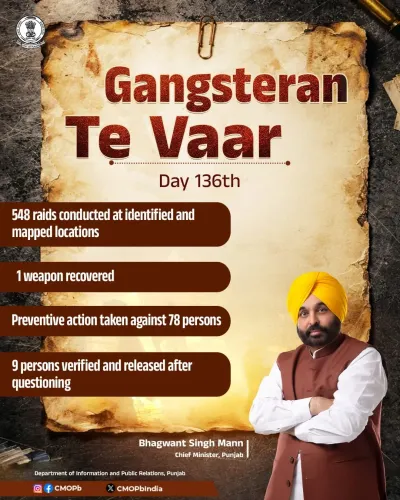
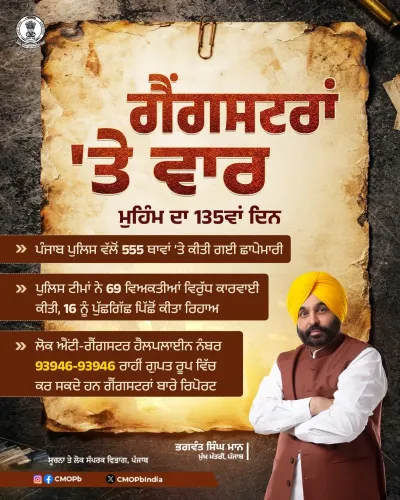
Punjab Police hits Day 248 of 'Gangsteran Te Vaar', 73,661 arrested

Synopsis
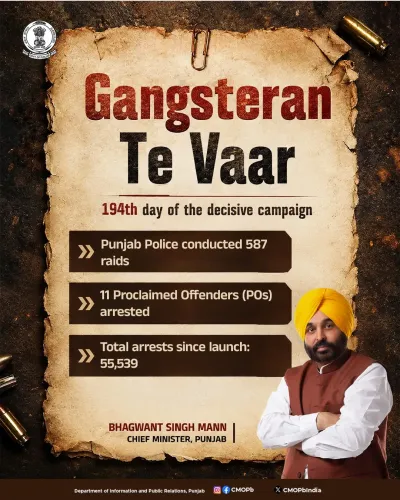
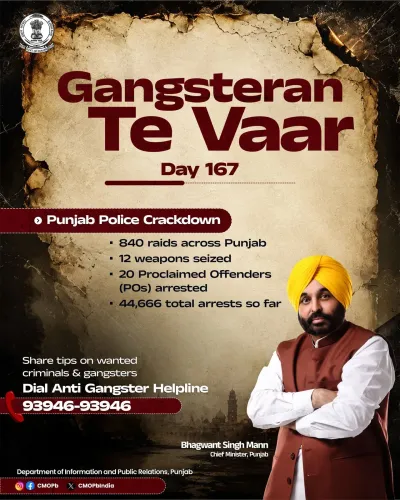
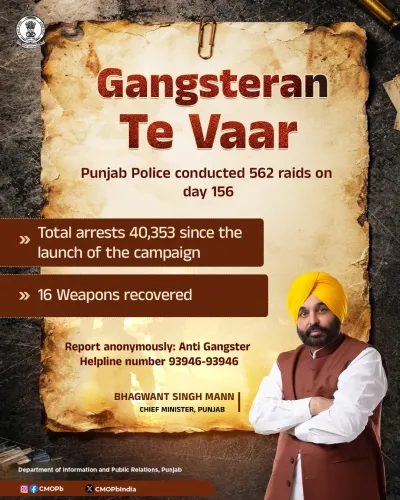
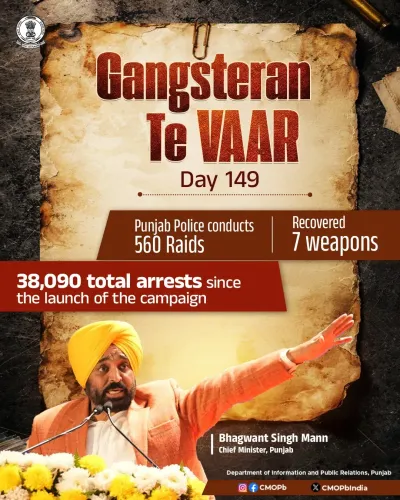
On Day 248 of the 'Gangsteran Te Vaar' campaign, Punjab Police conducted 578 raids linked to gangster associates across the state, pushing total arrests to 73,661 since the drive's launch, the Chief Minister's Office of Punjab announced on 26 September 2026.
Key Takeaways
Day 248 of the 'Gangsteran Te Vaar' anti-gangster campaign was marked by 578 raids at mapped locations across Punjab.
Total arrests since the campaign's launch have reached 73,661 , averaging roughly 297 arrests per day .
Raids target locations identified and mapped as linked to gangster associates , indicating an intelligence-led operational model.
Chief Minister Bhagwant Mann's AAP government has framed sustained law-and-order action as a core governance commitment since winning power in March 2022 .
Key pending metrics include conviction rates, charge-sheet filing ratios, and whether gang leadership structures have been durably dismantled.
Nearly 250 days in, and Punjab Police shows no sign of easing off the accelerator. On Day 248 of the state's sustained anti-gangster drive, police teams fanned out across Punjab to execute 578 raids at locations identified and mapped as linked to gangster associates — pushing the campaign's total arrest count to a staggering 73,661, according to the Chief Minister's Office of Punjab on Saturday, 26 September 2026.
578 raids, one more day in a campaign that refuses to pause
The 'Gangsteran Te Vaar' — Punjabi for 'Strike on Gangsters' — is not a single sweep but a rolling, data-driven operation. Each day's raids are drawn from a mapped database of associates, safe houses, and logistical nodes tied to organised crime networks across the state. The 578 raids on Day 248 represent both the operational scale and the methodical intelligence work that underpins the campaign: identify, map, hit.
Arrests from the day's operations added to the cumulative tally, bringing the total to 73,661 individuals taken into custody since the campaign's launch. That number, spread across nearly eight and a half months, averages out to roughly 297 arrests every single day — a pace that signals sustained institutional pressure rather than a one-time crackdown.
AAP's law-and-order wager since the 2022 mandate
When Bhagwant Mann led the Aam Aadmi Party to a landslide victory in the March 2022 Punjab assembly elections, law and order — specifically the twin crises of gang violence and drug networks — ranked among the most urgent promises to keep. Punjab had witnessed a sharp intensification of organised crime and gang rivalries through the 2010s, with high-profile shootings and extortion cases making headlines and shaking public confidence. The AAP government moved quickly to position Punjab Police as the frontline of its governance credibility.
'Gangsteran Te Vaar' sits squarely within that political and administrative logic — a campaign designed to be visible, sustained, and numerically accountable. The daily reporting of raid counts and arrest totals is itself a governance signal: this administration wants citizens to track the scorecard.
What the numbers don't yet tell us
Scale is one thing; outcome is another. The campaign's arrest totals are substantial, but the harder metrics — charge-sheet filing rates, trial timelines, conviction percentages, and whether senior gang leadership has been dismantled rather than just foot-soldiers swept up — remain the questions that will define the drive's lasting legacy. Analysts and civil liberties observers have long noted that in mass-arrest campaigns, the quality of prosecution and court-stage outcomes matter as much as the headline numbers.
Any new legislation to sharpen anti-gangster legal provisions — including asset-attachment frameworks and organised-crime statutes — would signal that the government is building judicial infrastructure to match its police muscle.
Nearly 73,700 arrests and counting, Punjab's most sustained anti-gangster drive is now writing its own chapter in the state's law-and-order history — the question is whether the courtroom holds what the police have built.
Point of View
Meaning a campaign of this scale is politically necessary but not sufficient on its own. The real test will come in courtrooms: if conviction rates lag far behind arrest rates, opponents will reframe the drive as theatre. Conversely, if the campaign produces durable disruption of gang networks and drug supply chains, it could become a replicable model for other states grappling with similar challenges.
NationPress
26 Sept 2026
Frequently Asked Questions
What is the 'Gangsteran Te Vaar' campaign in Punjab?
'Gangsteran Te Vaar' is an ongoing Punjab Police anti-gangster operation launched by the Bhagwant Mann-led AAP government, targeting organised crime networks, gang associates, and drug-linked criminal infrastructure across the state through systematic daily raids and arrests.
How many arrests have been made in the Gangsteran Te Vaar campaign?
As of Day 248 of the campaign on 26 September 2026, total arrests since the launch have reached 73,661, according to the Chief Minister's Office of Punjab.
How many raids did Punjab Police conduct on Day 248?
Punjab Police conducted 578 raids on Day 248 of the 'Gangsteran Te Vaar' campaign, targeting locations identified and mapped as linked to gangster associates across the state.
Who is leading the anti-gangster drive in Punjab?
The drive is conducted by Punjab Police under the overall direction of the state government led by Chief Minister Bhagwant Mann of the Aam Aadmi Party, which has prioritised cracking down on organised crime since coming to power in March 2022.
Why does Punjab have a persistent gangster and organised crime problem?
Punjab's organised crime challenge intensified through the 2010s, fuelled by gang rivalries, drug trafficking networks, and extortion rackets. The state's border geography and historical socio-economic factors have made it a recurring focus for law-enforcement campaigns by successive governments.