Has Punjab Finally Restored Canal Water Supply After 40 Years?

Synopsis
Punjab's government has made a groundbreaking move by restoring canal water supply to tail-end farms in the Kandi belt after 40 years, bringing much-needed relief to farmers. With a significant investment, this revitalization impacts 433 villages and 1.25 lakh acres of agricultural land, marking a pivotal change in the region's irrigation system.
Key Takeaways
Restoration of canal water supply ends a 40-year drought in Punjab's Kandi belt.
Investment of Rs 238.90 crore revitalizes the Kandi Canal system.
Benefits 433 villages and covers 1.25 lakh acres of agricultural land.
Major financial commitment from the Punjab government.
Visible improvements for farmers who had lost hope.
Chandigarh, Jan 7 (NationPress) In a significant move, the Punjab government has successfully restored canal water supply to tail-end farms in the Kandi belt, marking the end of a 40-year irrigation drought in this hilly and drought-prone area. This initiative brings immense relief to farmers who have long struggled with water scarcity.
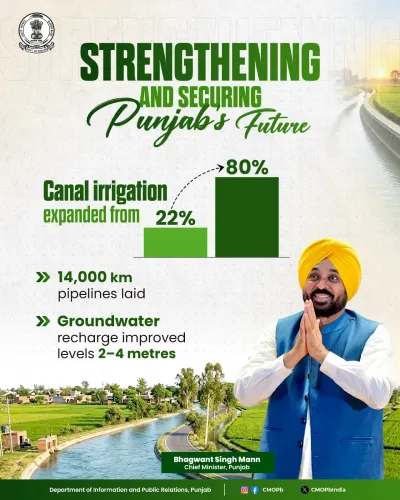
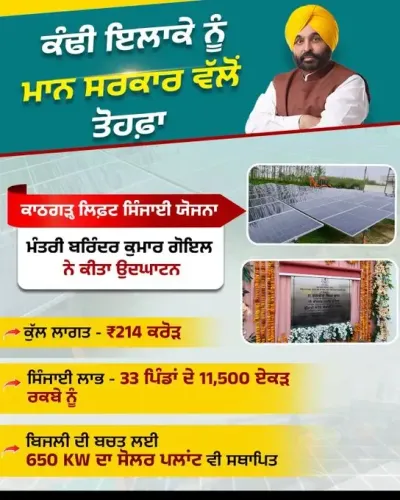
The revitalization of the Kandi Canal system, which involved an investment of Rs 238.90 crore, now allows irrigation to reach 433 villages and covers an impressive 1.25 lakh acres of agricultural land within the Kandi region. This marks a significant shift in Punjab's irrigation landscape.
Water Resources and Soil and Water Conservation Minister Barinder Kumar Goyal emphasized that the government prioritizes irrigation revival and has backed it with an unprecedented financial commitment. He stated, “From 2022 to 2025, the Punjab government has allocated over Rs 4,557 crore to canal irrigation, which is nearly 2.5 times the Rs 2,046 crore spent by the previous Congress government between 2019 and 2022.”
Goyal highlighted the visible impact on farmers, saying, “In several regions, farmers who had lost hope are now receiving canal water after almost 40 years.”
The Kandi Canal network, which has a capacity of 463 cusecs and spans a total length of 129.035 km from Talwara to Balachaur, had deteriorated significantly over the years. While construction was completed from Talwara to Hoshiarpur in 1998 and from Hoshiarpur to Balachaur in 2016, widespread leakage and seepage had hindered water from reaching the tail-end areas.
“The Mann government has addressed this longstanding issue by investing Rs 238.90 crore, ensuring that canal water now flows from Talwara to Balachaur, reaching distant areas after nearly 40 years,” he explained.
The revitalized canal system now benefits 433 villages across Hoshiarpur and Shaheed Bhagat Singh Nagar districts, irrigating 1.25 lakh acres of agricultural land in Dasuya, Mukerian, Tanda-Urmar, Sham Churasi, Hoshiarpur, Chabbewal, Garhshankar, and Balachaur.
Point of View
The restoration of canal water supply in Punjab is a pivotal development reflecting the government's commitment to addressing long-standing irrigation challenges. This initiative not only supports local farmers but also signifies a broader effort to enhance agricultural sustainability in drought-prone regions. The substantial investment underscores a proactive approach towards revitalizing critical infrastructure, ultimately benefiting the agricultural landscape of the state.
NationPress
24 Sept 2026
Frequently Asked Questions
What is the significance of restoring canal water supply in Punjab?
Restoring canal water supply in Punjab is crucial for revitalizing agriculture in the Kandi belt, benefiting thousands of farmers who have faced water scarcity for decades.
How much has the Punjab government invested in canal irrigation?
The Punjab government has invested over Rs 4,557 crore in canal irrigation from 2022 to 2025, significantly more than previous spending.
Which areas benefit from the restored canal water supply?
The restored canal water supply benefits 433 villages across Hoshiarpur and Shaheed Bhagat Singh Nagar districts, covering 1.25 lakh acres of agricultural land.
What challenges did the Kandi Canal system face before restoration?
The Kandi Canal system faced severe deterioration, with widespread leakage and seepage preventing water from reaching tail-end areas.
How does this restoration impact farmers?
Farmers who had abandoned hope are now receiving canal water after nearly 40 years, significantly improving their agricultural prospects.