Punjab Launches Transformative Irrigation Project in Kandi Region
Synopsis
Punjab's government, led by Minister Barinder Kumar Goyal, has initiated a groundbreaking irrigation project in the Kandi belt, set to irrigate 4,000 acres of previously rainfed land, promising to enhance agricultural productivity and farmer incomes significantly.
Key Takeaways
4,000 acres of rainfed land to be irrigated.
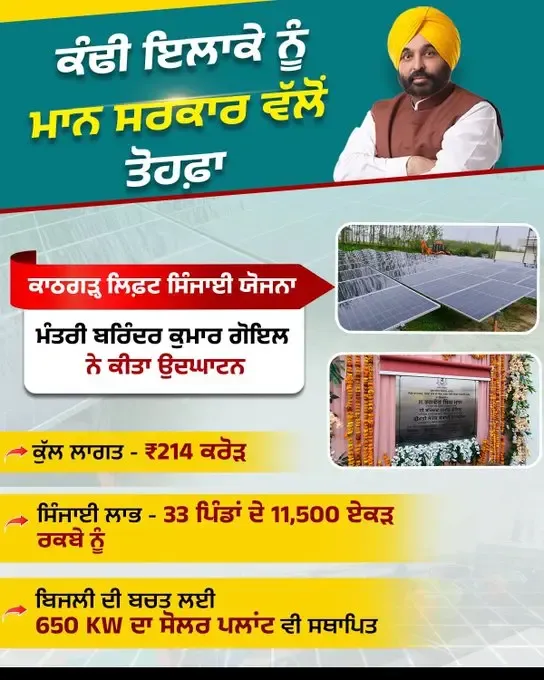
Investment of Rs 214 crore in irrigation infrastructure.
Project to reduce groundwater dependence.
Phased execution for gradual expansion.
Training of technical staff to ensure project success.
Chandigarh, March 19 (NationPress) The Punjab government has made significant strides in the historically overlooked Kandi region, as stated by Barinder Kumar Goyal, the Minister of Water Resources and Soil Conservation. A substantial initiative has been launched to irrigate an initial 4,000 acres of rainfed semi-hilly land, transforming it into viable agricultural territory.
With an investment of Rs 214 crore in the Kathgarh Lift Irrigation Scheme, canal water will now reach elevated areas for the first time. Goyal underscored the administration's commitment to farmer-centric policies, showcasing increased water use, major infrastructure investment, and a sustainable vision that connects farmer welfare with economic growth.
This landmark project was inaugurated by Goyal, who highlighted that for the first time, canal water is being successfully transported to higher altitudes, ensuring reliable irrigation for the drought-prone and rain-fed areas of the Kandi belt.
The initiative is set to boost agricultural output and enhance farmers' incomes, fundamentally altering the agricultural landscape by allowing for better crop cultivation and increased land value, according to an official statement.
During the inauguration, Goyal stated, "The Kathgarh Lift Irrigation Scheme will be a pivotal milestone in providing irrigation to regions that have been historically underserved due to their elevation through the Kandi Canal and Bist Doab systems. This project will notably decrease reliance on groundwater and yield long-lasting advantages for the area."
He provided insights into the project's execution, which is divided into three phases.
"The first phase, which encompasses 4,000 acres across 13 villages, was completed in February 2026 at a cost of Rs 67 crore. The second phase, with an allocation of Rs 107 crore, aims to cover 5,500 acres in 14 villages by September 2026, while the third phase, budgeted at Rs 40 crore, will extend irrigation to 2,000 acres in six villages. Additionally, a 650 KW solar power facility has been established to alleviate electricity costs," he explained.
Goyal detailed the technical specifications, noting that the scheme is linked to the Bist Doab Canal, which has a discharge capacity of 67 cusecs, with water being elevated via pumps and distributed through a comprehensive pipeline system to various agricultural fields.
He emphasized the project's importance, saying, "Farmers in the Kandi region have been heavily reliant on rainfall due to deep groundwater levels and ineffective tubewells, limiting crop diversity and productivity. The semi-hilly terrain previously made traditional canal systems unviable, contributing to lower land prices. Advanced satellite and drone surveys were undertaken, and personnel received training at IIT Roorkee and IIT Ropar to facilitate the project's design, which was executed rapidly within six months."
"Previously, irrigation was available for 28,205 acres across 72 villages in the Balachaur constituency. With the implementation of this scheme, irrigation coverage will expand to 39,705 acres across 105 villages, with approximately 94,000 km of pipelines laid to ensure efficient water delivery to the fields," he added.
Point of View
It is evident that this irrigation initiative marks a significant advancement for Punjab's agricultural sector. The project not only addresses longstanding challenges faced by farmers but also aligns with the government's broader vision for economic development in the region.
NationPress
3 Oct 2026
Frequently Asked Questions
What is the purpose of the Kathgarh Lift Irrigation Scheme?
The scheme aims to irrigate rainfed semi-hilly terrain in the Kandi region, transforming it into cultivable land for enhanced agricultural productivity.
How much has been invested in the Kathgarh Lift Irrigation Scheme?
The total investment for the project is Rs 214 crore.
What are the phases of the irrigation project?
The project is being executed in three phases, with the first covering 4,000 acres already completed, and subsequent phases planned to expand coverage to additional acres.
How will this project affect local farmers?
It will reduce dependence on groundwater, enhance crop diversity, and increase farmers' incomes by providing reliable irrigation.
What technology was used in the project?
Advanced satellite and drone surveys were conducted, and technical personnel were trained at IIT Roorkee and IIT Ropar to design the project.