CM Mann's Punjab launches ₹13 cr canal irrigation project in Amargarh

Synopsis
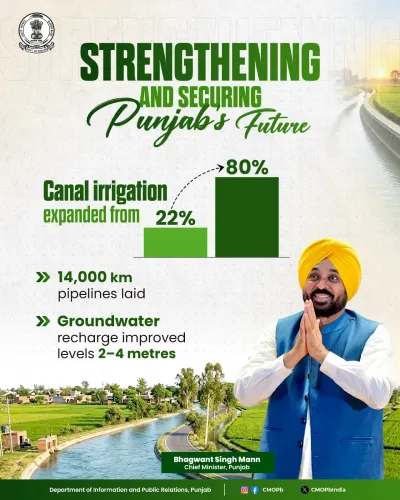
The Punjab Government has launched a ₹13 crore canal irrigation project in villages Manakmajra and Dehleez Khurd of Amargarh constituency, set to bring canal water to over 3,832 acres of farmland for the first time, as part of CM Bhagwant Mann's groundwater conservation drive.
Key Takeaways
The Punjab Government has initiated a ₹13 crore irrigation project in Amargarh Assembly constituency .
The project covers villages Manakmajra and Dehleez Khurd and will supply canal water to more than 3,832 acres of agricultural land.
This is the first time canal water will reach these villages, reducing dependence on groundwater extraction.
The initiative aligns with the Punjab Preservation of Subsoil Water Act, 2009 and broader state efforts to combat groundwater depletion.
Chief Minister Bhagwant Mann 's government has framed canal expansion as a structural response to Punjab's over-exploited groundwater blocks.
The Chief Minister's Office of Punjab announced on Tuesday, 9 June 2026 that the Punjab Government, led by Chief Minister Bhagwant Mann, has initiated a ₹13 crore irrigation project covering villages Manakmajra and Dehleez Khurd in the Amargarh Assembly constituency, aimed at bringing canal water to agricultural land for the first time.
Context
The project is designed to supply canal water to more than 3,832 acres of agricultural land in the two villages, which have historically relied on groundwater for irrigation. The announcement positions this initiative as part of the state government's broader commitment to protecting groundwater reserves and strengthening Punjab's canal network infrastructure.
Amargarh is an assembly constituency in Punjab's Malwa region, an area characterised by intensive agricultural activity and significant dependence on tube wells and groundwater extraction. The constituency's farming community stands to be among the direct beneficiaries of the new canal supply.
Policy Backdrop
Punjab's groundwater crisis has been building for decades, driven by the state's dominant wheat-rice cropping cycle, which demands heavy and repeated irrigation. The state enacted the Punjab Preservation of Subsoil Water Act, 2009, which delayed paddy transplantation dates to reduce peak groundwater extraction, but the underlying depletion trend has persisted across large parts of the state.
Successive state governments have pursued canal rehabilitation and the construction of new watercourses, often drawing on central schemes such as the Pradhan Mantri Krishi Sinchayee Yojana (PMKSY), to shift irrigation dependency from groundwater to surface water. The present ₹13 crore project in Amargarh continues this established pattern of expanding canal coverage in blocks classified as over-exploited.
The Bhagwant Mann-led Aam Aadmi Party government, in office since 2022, has repeatedly cited groundwater conservation and rural agricultural infrastructure as priority areas, framing canal expansion as a structural remedy rather than a short-term intervention.
Stakeholders and Impact
Farmers and agricultural landowners across Manakmajra and Dehleez Khurd are the immediate stakeholders. For these communities, access to canal water for the first time would reduce reliance on costly and energy-intensive tube-well irrigation, potentially lowering input costs and easing pressure on the local water table.
The project's scale — covering more than 3,832 acres — suggests a meaningful shift in the irrigation profile of the two villages. If successfully commissioned, the works could serve as a replicable model for similarly water-stressed constituencies in the Malwa belt.
What's Next
The key milestones to watch will be the physical progress of the ₹13 crore civil works and the timeline for commissioning the new canal supply. Independent monitoring of groundwater levels in the project area after commissioning would provide measurable evidence of the initiative's conservation impact.
Given the government's stated commitment to canal expansion, further announcements covering neighbouring constituencies in the Malwa region are plausible. The Amargarh project may set a benchmark for cost, acreage coverage, and delivery timelines that informs the scale of any such replication.
Point of View
Village-level delivery rather than macro-level policy intent. The ₹13 crore figure and the 3,832-acre coverage give the initiative measurable parameters, which will ultimately test the government's follow-through when physical commissioning is due. More broadly, the project reflects a state-level consensus, cutting across party lines, that canal-based irrigation is the only durable answer to Punjab's groundwater emergency — a consensus that successive governments have acknowledged but struggled to translate into widespread on-ground change.
NationPress
19 Sept 2026
Frequently Asked Questions
What is the Punjab canal irrigation project announced in Amargarh?
The Punjab Government has initiated a ₹13 crore irrigation project in villages Manakmajra and Dehleez Khurd in Amargarh Assembly constituency that will bring canal water to more than 3,832 acres of agricultural land for the first time.
Why is Punjab launching canal irrigation projects?
Punjab faces severe groundwater depletion caused by intensive wheat-rice cultivation. The state is expanding canal networks to reduce farmer dependence on tube wells and groundwater extraction, which has pushed many blocks into the 'over-exploited' category.
Which villages benefit from the Amargarh irrigation project?
The villages of Manakmajra and Dehleez Khurd in Amargarh Assembly constituency are the direct beneficiaries, with over 3,832 acres of farmland set to receive canal water for the first time.
What is the Punjab Preservation of Subsoil Water Act?
Enacted in 2009, the Punjab Preservation of Subsoil Water Act delayed paddy transplantation dates to reduce peak groundwater extraction during the kharif season. It is one of the state's key legislative tools for groundwater conservation.
How much has the Punjab Government spent on the Amargarh canal project?
The Punjab Government has initiated the project at a cost of ₹13 crore, as announced by the Chief Minister's Office on 9 June 2026.