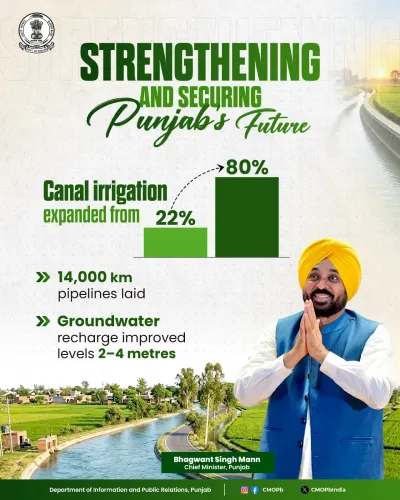
CM Bhagwant Mann: Punjab canal water use up from 22% to 80%

Synopsis
Chief Minister Bhagwant Mann says Punjab's canal irrigation usage has surged from 22% to over 80% under the AAP government's push to revive the state's historic canal network. Canals linked to the Shahpur Kandi Dam on the Ravi river are set to become operational in October 2026, extending irrigation to thousands of additional acres.
Key Takeaways
The Chief Minister's Office of Punjab announced on 24 June 2026 that canal water usage in the state has risen from 22 per cent to above 80 per cent .
CM Bhagwant Mann credited government efforts to strengthen the canal irrigation system for the sharp increase.
Canals linked to the Shahpur Kandi Dam on the Ravi river near Pathankot will become operational from October 2026 .
The new canals are expected to provide irrigation water to thousands of acres currently without assured surface-water supply.
The shift from tubewells to canal water is aimed at addressing Punjab's critical groundwater depletion and reducing the state's electricity subsidy burden.
The Chief Minister's Office of Punjab announced on Wednesday, 24 June 2026 that canal irrigation usage across the state has risen sharply from 22 per cent to over 80 per cent, crediting sustained government efforts to revive and strengthen the canal network. Chief Minister Bhagwant Mann made the statement, also revealing that canals linked to the Shahpur Kandi Dam project will become operational from October, bringing irrigation water to thousands of additional acres.
Context
Posting in Punjabi, CM Mann stated: 'ਨਹਿਰੀ ਪਾਣੀ ਦੀ ਵਰਤੋਂ 22 ਫ਼ੀਸਦੀ ਤੋਂ ਵਧ ਕੇ 80 ਫ਼ੀਸਦੀ ਤੋਂ ਉੱਪਰ ਪਹੁੰਚ ਗਈ ਹੈ' ('canal water usage has risen from 22 per cent to above 80 per cent'). He attributed the jump to deliberate steps taken by the Punjab government to strengthen the canal irrigation system. The announcement signals a significant reversal of a decades-long trend in which farmers relied almost entirely on tubewells.
The Shahpur Kandi Dam, a multipurpose project on the Ravi river near Pathankot, was formally inaugurated in February 2024. Its associated canal network is designed to carry surface water to Punjab's border districts as well as parts of Jammu and Kashmir.
Policy Backdrop
Punjab has long grappled with severe groundwater depletion, driven by over-reliance on electric tubewells for paddy cultivation. The shift to groundwater pumping hollowed out the historic canal network, leaving large stretches silted and under-maintained. Successive state governments identified canal revival as a priority, but progress was slow until the current Aam Aadmi Party (AAP) administration, led by Bhagwant Mann since March 2022, accelerated maintenance and desilting work.
Restoring surface-water irrigation also carries a fiscal dimension: every unit of canal water that replaces a tubewell reduces the state's electricity subsidy burden, which runs into thousands of crore rupees annually. The Punjab government has framed canal revival as both an agrarian and a financial reform.
Stakeholders and Impact
Punjab's farming community — the primary stakeholder — stands to benefit most directly. Canal water is cheaper and less energy-intensive than groundwater pumping, lowering input costs for cultivators. The operational launch of Shahpur Kandi-linked canals from October 2026 is expected to bring thousands of acres currently dependent on rain or tubewells under assured surface irrigation.
Broader ecological benefits include a potential slowdown in the rate of groundwater table decline, which has reached critical levels in several districts of Punjab. Environmental agencies and agricultural universities in the state have consistently flagged groundwater depletion as an existential threat to the region's long-term food security.
What's Next
The key milestone to watch is the October 2026 commissioning of the Shahpur Kandi Dam-linked canals. Official data on the additional acreage brought under irrigation will be the clearest measure of whether the stated gains translate into ground-level impact. If the canal network sustains the reported 80-per-cent usage level through the rabi season, it could set a template for other water-stressed states grappling with similar groundwater crises.
Point of View
If sustained, would represent one of the most consequential agricultural-infrastructure turnarounds in Punjab's recent history. For the AAP government, the figure is a politically valuable proof point ahead of future electoral cycles, framing infrastructure delivery as its core identity. The October commissioning of Shahpur Kandi-linked canals is the next credibility test: actual acreage covered will either validate the headline number or invite scrutiny. More broadly, Punjab's canal revival effort is being watched as a potential model for other groundwater-stressed states in the Indo-Gangetic plain.
NationPress
22 Sept 2026
Frequently Asked Questions
What did CM Bhagwant Mann say about Punjab canal irrigation?
CM Bhagwant Mann stated that canal water usage in Punjab has risen from 22 per cent to over 80 per cent as a result of the state government's efforts to strengthen the canal irrigation system.
When will Shahpur Kandi Dam canals become operational?
According to CM Mann, canals linked to the Shahpur Kandi Dam are expected to become operational from October 2026, bringing irrigation water to thousands of additional acres.
What is the Shahpur Kandi Dam and where is it located?
The Shahpur Kandi Dam is a multipurpose project on the Ravi river near Pathankot in Punjab. It was formally inaugurated in February 2024 and is designed to supply irrigation water to Punjab's border districts and parts of Jammu and Kashmir.
Why is canal irrigation important for Punjab farmers?
Canal irrigation reduces farmers' dependence on costly tubewell pumping, lowering input costs and helping slow the rapid depletion of Punjab's groundwater table, which has reached critical levels in several districts.
How does reviving canal irrigation help Punjab's government finances?
Every unit of canal water that replaces tubewell pumping reduces the electricity subsidy the Punjab government pays, which currently runs into thousands of crore rupees annually, making canal revival both an agrarian and a fiscal priority.