CM Bhagwant Mann to Lay 7,000 km More Pipelines in Punjab
Synopsis
Chief Minister Bhagwant Singh Mann announced at a Lok Milni in Bhallur, Moga on 1 July 2026 that Punjab will lay 7,000 km more irrigation pipelines by year-end, extending canal water to all farms and building on 14,000 km already completed under the AAP government.
Key Takeaways
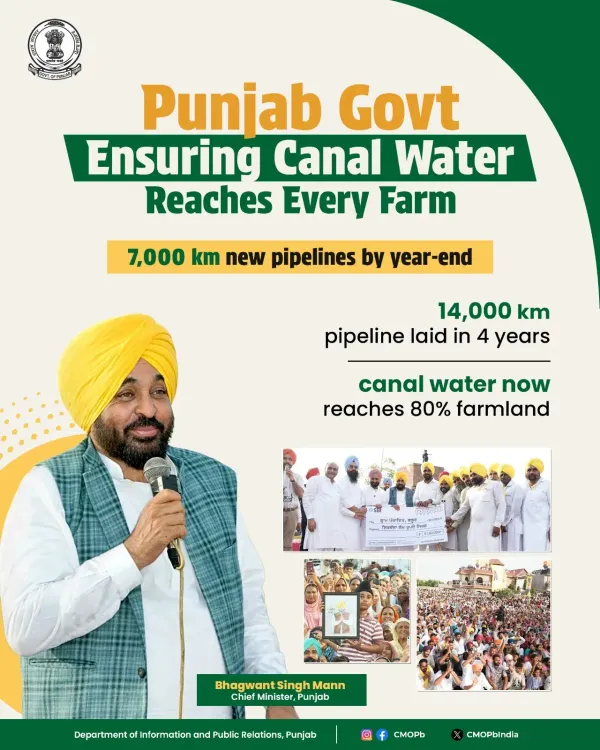
7,000 km of additional irrigation pipelines will be laid by the end of 2026 , as announced by CM Bhagwant Singh Mann .
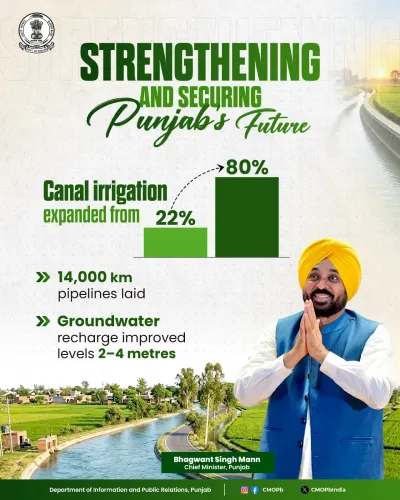
14,000 km of pipelines have already been laid over the last four years — equivalent to the distance from Canada to Moga .
Canal water now reaches nearly 80 per cent of agricultural land in Punjab , according to the Chief Minister.
The government is building water recharge points alongside the pipeline network to raise groundwater levels.
The programme targets Punjab's chronic groundwater depletion driven by decades of tubewell-dependent paddy cultivation.
Completion of this phase would bring the total pipeline network under the current government to approximately 21,000 km .
The Chief Minister's Office of Punjab announced on Wednesday, 1 July 2026 that Chief Minister Bhagwant Singh Mann has committed to laying an additional 7,000 kilometres of irrigation pipelines by the end of this year, extending canal water access to every farm in the state. The announcement was made during a Lok Milni (public interaction) programme held in Bhallur, Moga.
What Was Announced
CM Bhagwant Singh Mann stated that the Punjab Government will lay 7,000 km of new pipelines before the close of 2026, with the goal of ensuring canal water reaches every agricultural plot in the state. He added that the government is simultaneously creating water recharge points to arrest the decline in groundwater levels across the state.
Mann noted that 14,000 kilometres of pipelines have already been laid over the last four years — a distance he described as equivalent to that from Canada to Moga. He said the state government has so far ensured canal water reaches nearly 80 per cent of agricultural land in Punjab.
Context
Punjab is one of India's most intensively farmed states, and its agriculture has long depended on groundwater drawn through tubewells. Decades of paddy cultivation have caused rapid aquifer depletion, particularly across central districts including Moga, Ludhiana and Sangrur. The Central Ground Water Board has flagged several of these districts as 'over-exploited' in successive assessments.
When the Aam Aadmi Party government came to power in March 2022, it launched an accelerated canal-lining and pipeline distribution programme aimed at shifting irrigation away from tubewells and towards surface-canal networks. The pipeline drive is part of a wider package that includes recharge structures and crop-diversification incentives.
Policy Backdrop
Successive Punjab governments have attempted to revive the state's canal network, originally built during the colonial era, but implementation lagged for years due to funding constraints and land-acquisition disputes. The current administration has framed the pipeline programme as a structural solution — delivering pressurised canal water directly to farm boundaries rather than relying on open channels that lose water to seepage and evaporation.
Water recharge points, mentioned by Mann at the Bhallur event, are engineered structures that direct surplus monsoon and canal water underground to replenish aquifers. Their inclusion alongside the pipeline rollout signals an attempt to address both supply-side distribution and long-term groundwater sustainability simultaneously.
Stakeholders and Impact
The primary beneficiaries are Punjab's farmers, who currently pay significant electricity costs to pump groundwater for irrigation. Reliable canal water supply at the field level could reduce input costs and ease pressure on the state's heavily subsidised power grid. Rural households in farming communities would also benefit from stabilised water tables that support domestic wells.
For the broader state economy, reducing groundwater extraction could improve the long-term viability of agriculture in Punjab, which contributes a significant share to India's central grain pool. Environmental groups and water-policy experts have consistently argued that surface-water distribution is the only durable alternative to tubewell dependence in the Indo-Gangetic plains.
What's Next
The administration has set a year-end 2026 deadline for completing the additional 7,000 km of pipelines. District-wise progress reports and the next Central Ground Water Board assessment of water-table trends in Punjab will be closely watched as indicators of whether the programme is achieving its stated objectives. The completion of this phase would bring the total pipeline network laid under the current government to approximately 21,000 kilometres.
Point of View
000-km milestone in vivid comparative terms (Canada to Moga), the Chief Minister is clearly building a legacy narrative around rural infrastructure. The simultaneous push for groundwater recharge points suggests the administration is aware that distribution alone cannot reverse aquifer decline, and is attempting a more integrated water-management approach. Whether the year-end deadline for 7,000 km holds will be the real test of execution capacity and bureaucratic follow-through.
NationPress
30 Sept 2026
Frequently Asked Questions
How many kilometres of irrigation pipelines has Punjab laid so far?
The Punjab Government has laid 14,000 kilometres of irrigation pipelines over the last four years, according to Chief Minister Bhagwant Singh Mann.
What is Punjab's plan for canal water irrigation in 2026?
The Punjab Government plans to lay an additional 7,000 km of pipelines by the end of 2026 to ensure canal water reaches every farm in the state.
What percentage of Punjab's farmland gets canal water now?
Chief Minister Bhagwant Singh Mann stated that canal water currently reaches nearly 80 per cent of agricultural land in Punjab.
Why is Punjab building water recharge points?
Water recharge points are being built to direct surplus water underground and raise the groundwater level, addressing the long-term aquifer depletion caused by decades of tubewell-based irrigation.
Where did CM Bhagwant Mann make the pipeline announcement?
The announcement was made during a Lok Milni programme in Bhallur, Moga on 1 July 2026 .