Punjab Govt expands Patiala Canal Division network for farmers

Synopsis
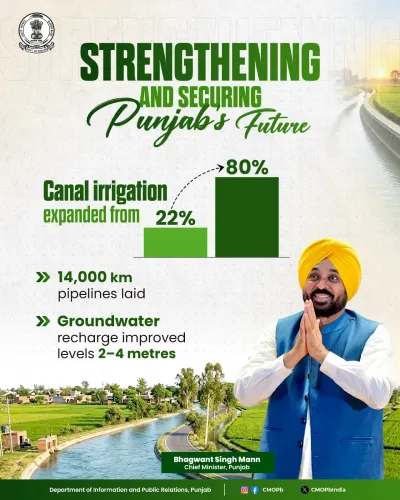
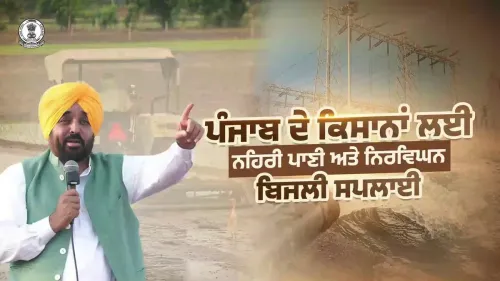
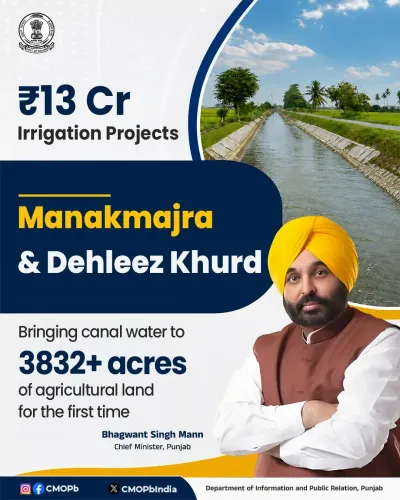
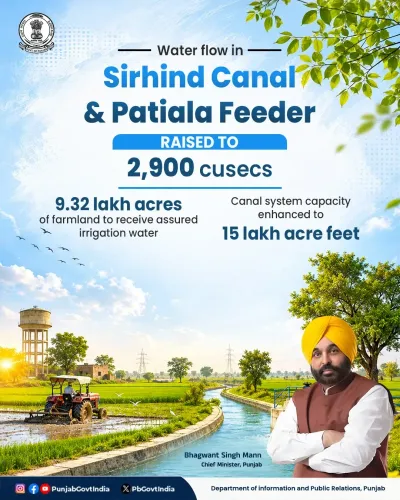
The Chief Minister's Office of Punjab announced that the state government, through the Patiala Canal Division, has expanded the canal network and lined canals to bring thousands of acres under irrigation, aiming to strengthen water supply and empower farmers across the region.
Key Takeaways
The Punjab Government has expanded the canal network through the Patiala Canal Division to improve irrigation coverage.
Canal lining has been undertaken to reduce seepage losses and bring thousands of acres under assured irrigation.
The initiative is aimed at empowering Punjab farmers by improving water supply reliability.
The work aligns with national schemes including Pradhan Mantri Krishi Sinchayee Yojana (launched 2015 ) and the Accelerated Irrigation Benefits Programme (active since 1996–97 ).
Improved canal supply is expected to reduce farmer dependence on groundwater pumping, lowering input costs.
District-level outcome data on additional irrigated acreage and water savings will be key indicators for upcoming kharif and rabi seasons.
The Chief Minister's Office of Punjab announced on Tuesday, 26 May 2026 that the Punjab Government, through the Patiala Canal Division, has expanded and lined canals to bring thousands of acres under irrigation and improve water supply for farmers across the region.
Context
The official post states that the initiative aims 'to strengthen irrigation and empower farmers' by expanding the canal network and lining canals to reduce water loss. The announcement highlights the government's focus on improving agricultural water access, particularly through the Patiala Canal Division, a key irrigation department unit managing canal infrastructure and water distribution in Patiala district.
Canal lining is a well-established technique that reduces seepage, ensures more water reaches farm fields, and helps conserve groundwater — a critical concern in Punjab, a state that has faced acute groundwater depletion driven by intensive rice-wheat cultivation.
Policy Backdrop
Punjab possesses one of India's densest canal networks, built largely on the Indus basin system following the 1947 partition and shaped significantly by the Indus Waters Treaty. The state has historically pursued canal lining and rehabilitation under the centrally sponsored Accelerated Irrigation Benefits Programme, active since 1996–97, which targets seepage reduction and efficiency gains across the irrigation network.
From the 1970s onward, Punjab also participated in the Command Area Development and Water Management programme, focused on on-farm development and irrigation efficiency. More recently, these efforts align with the national Pradhan Mantri Krishi Sinchayee Yojana, launched in 2015, which prioritises the principle of 'Har Khet Ko Pani' — water to every farm — and 'More Crop Per Drop.'
Successive state governments have treated canal modernisation as a strategic priority, not only to sustain agriculture but also to manage waterlogging in some areas while addressing groundwater stress in others, and to navigate ongoing interstate water allocation disputes.
Stakeholders and Impact
Punjab farmers stand as the primary beneficiaries of the expanded and lined canal network. Improved water supply through the Patiala Canal Division is expected to reduce dependence on groundwater pumping, lowering electricity and input costs for cultivators who rely on tubewells when canal water is unavailable or insufficient.
The canal lining work is designed to bring thousands of acres under assured irrigation, potentially benefiting smallholder and marginal farmers who lack the resources to sink deep tubewells. Improved irrigation reliability also supports timely sowing and better crop yields across kharif and rabi seasons.
What's Next
District-level progress reports on the actual additional acreage brought under irrigation and measurable water savings will be closely watched in the coming kharif and rabi seasons. The government's ability to demonstrate on-ground outcomes — in terms of reduced groundwater extraction and expanded irrigated area — will determine the programme's impact on Punjab's long-term agricultural sustainability.
Continued investment in canal infrastructure by the Punjab Government signals a broader policy commitment to surface water utilisation over groundwater, a shift that analysts and agricultural experts have long advocated as essential to reversing the state's deepening water crisis.
Point of View
The government signals a district-level, operationally specific approach rather than a broad policy declaration. The move also reflects the political salience of farmer welfare in Punjab, where agricultural distress and water scarcity remain defining electoral concerns. Whether the initiative translates into measurable groundwater relief will be the real test of its long-term significance.
NationPress
11 Oct 2026
Frequently Asked Questions
What has the Punjab Government done through the Patiala Canal Division?
The Punjab Government has expanded the canal network and lined canals through the Patiala Canal Division to bring thousands of acres under irrigation and improve water supply for farmers.
Why is canal lining important for Punjab farmers?
Canal lining reduces water seepage, ensuring more water reaches farm fields. This helps reduce farmer dependence on costly groundwater pumping and supports reliable irrigation across both kharif and rabi seasons.
What is the Accelerated Irrigation Benefits Programme?
The Accelerated Irrigation Benefits Programme is a centrally sponsored scheme active since 1996–97 that funds canal lining, rehabilitation, and irrigation efficiency improvements across Indian states including Punjab.
How does this canal expansion relate to Punjab's groundwater crisis?
Punjab faces severe groundwater depletion due to intensive rice-wheat cultivation reliant on tubewells. Expanding and lining canals increases surface water availability, reducing the need for groundwater extraction.
Which national scheme supports canal irrigation modernisation in Punjab?
The Pradhan Mantri Krishi Sinchayee Yojana, launched in 2015, supports canal modernisation and irrigation expansion nationally under the goals of 'Har Khet Ko Pani' and 'More Crop Per Drop,' with Punjab's efforts aligned to this framework.