CM Mann's Anti-Gangster Drive Hits Day 123: 488 Raids, 31,430 Arrests
Synopsis
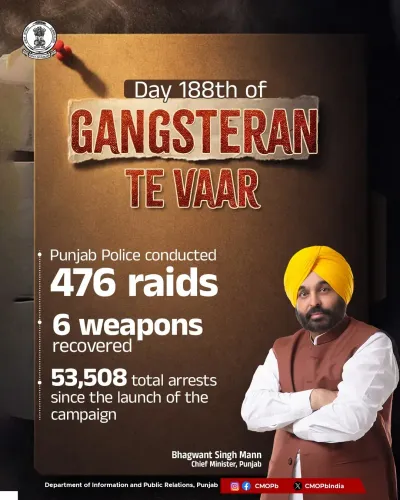
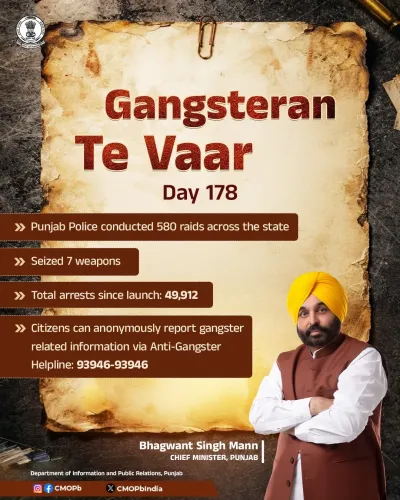
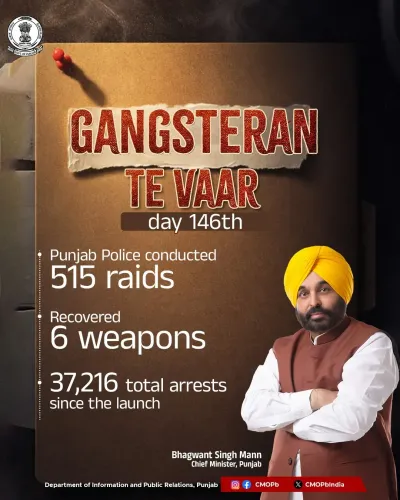
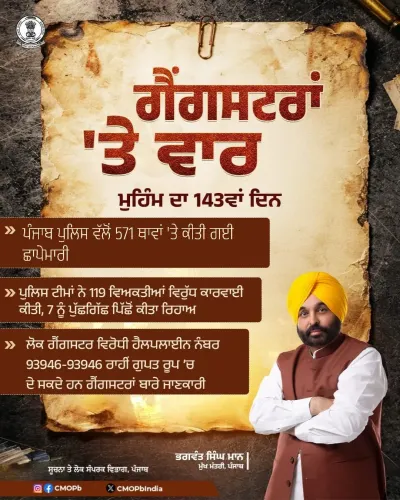
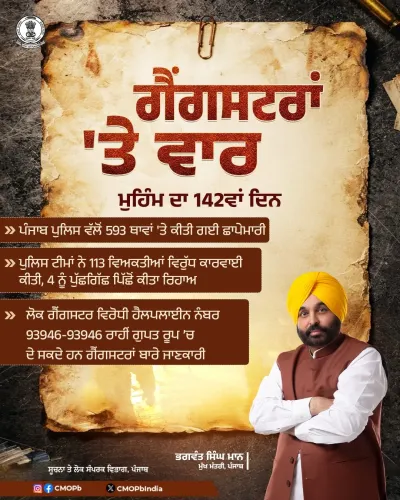
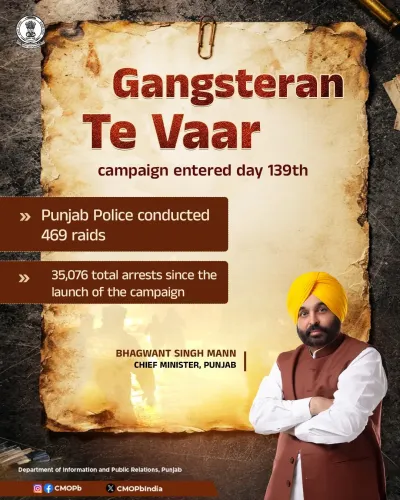
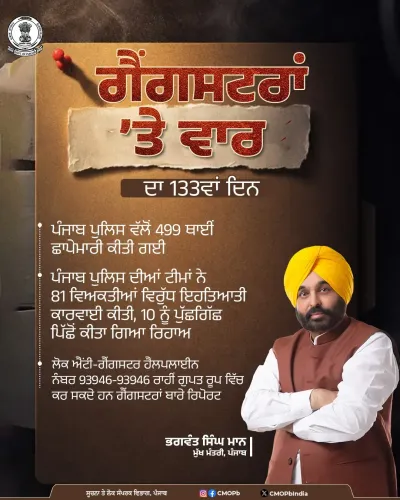
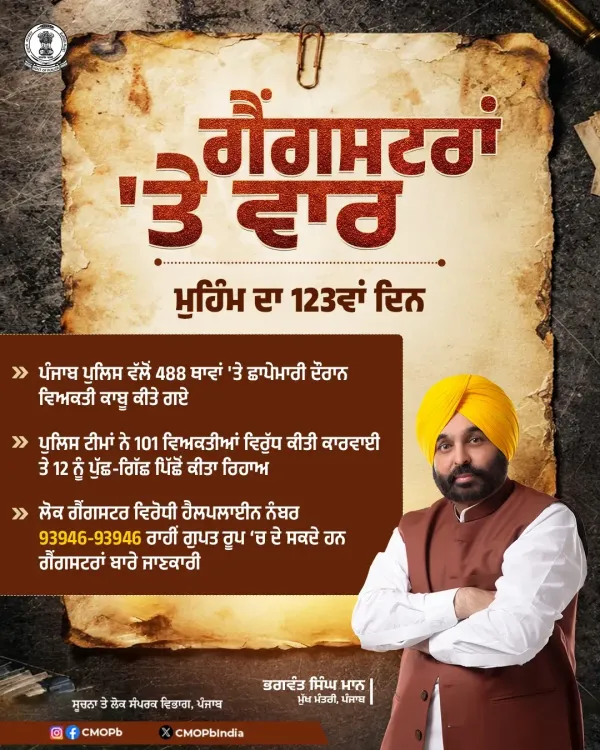
On Day 123 of Chief Minister Bhagwant Singh Mann's 'Gangsteran Te Vaar' campaign, Punjab Police conducted 488 raids at mapped gangster-associate locations across the state, arresting individuals with four weapons and raising the campaign's total arrest count to 31,430.
Key Takeaways
488 raids were conducted on Day 123 of the 'Gangsteran Te Vaar' campaign at pre-identified and mapped locations linked to gangster associates across Punjab .
The day's operations led to fresh arrests of individuals found with four weapons .
Cumulative arrests since the campaign's launch have reached 31,430 .
The campaign is being run under the direct directions of Chief Minister Bhagwant Singh Mann of the Aam Aadmi Party .
The state government uses a data-driven, location-mapping methodology to coordinate simultaneous, large-scale daily raids.
The CMO Punjab is publishing daily updates, creating a public accountability record of the ongoing operation.
The Chief Minister's Office of Punjab announced on Sunday, 24 May 2026 that the ongoing 'Gangsteran Te Vaar' anti-gangster campaign, launched under the directions of Chief Minister Bhagwant Singh Mann, completed its 123rd day with Punjab Police conducting 488 raids at identified and mapped locations linked to associates of gangsters across the state.
What Happened on Day 123
On the campaign's 123rd day, police teams carried out simultaneous raids at 488 locations that had been pre-identified and mapped as hideouts or meeting points of gangster associates. The day's operations resulted in fresh arrests of individuals found in possession of four weapons, pushing the campaign's cumulative arrest tally to 31,430 since its launch.
The post, shared in both Punjabi and English by the official CMO Punjab account, described the drive as a 'faislakun muhim' (decisive campaign), underscoring the state government's framing of the effort as a sustained, mission-mode operation rather than a one-off crackdown.
Context
Punjab has grappled with organised crime, inter-gang violence, and drug-trafficking networks for over two decades. These networks have historically operated across state and international borders, with gang members often communicating and directing operations from abroad.
When the Aam Aadmi Party government came to power in March 2022, it identified dismantling these networks as a governance priority. The 'Gangsteran Te Vaar' campaign operationalises that commitment through a data-driven model: police units map known associates, log their locations, and conduct coordinated, simultaneous raids to deny gangsters their support infrastructure.
Policy Backdrop
The campaign's architecture — daily raids on pre-mapped locations, cumulative public reporting of arrests, and regular updates via the Chief Minister's Office — reflects a deliberate transparency strategy. By publishing day-by-day figures, the government creates a public accountability trail and signals operational continuity to both law enforcement personnel and criminal networks.
Successive Punjab governments have periodically launched targeted police operations against organised crime. What distinguishes the present campaign is its reported scale and the systematic mapping methodology, which aims to disrupt the logistical and financial support structures that allow gangsters to operate even while incarcerated or abroad.
Stakeholders and Impact
For ordinary Punjab residents — particularly in districts historically affected by gang violence such as Amritsar, Ludhiana, and Mohali — the campaign's stated objective is to reduce extortion, targeted killings, and the fear that organised crime generates in everyday life. Families of those caught in the crossfire of gang conflicts represent a key constituency watching these figures.
For gangster networks, the sustained pressure on associates — the foot soldiers, logistics providers, and safe-house operators — is designed to erode operational capacity even when top-tier gang leaders remain at large or overseas. The seizure of weapons, even in small numbers per day, is framed as a cumulative effort to reduce the arms available to these networks.
What's Next
The CMO's daily reporting cadence suggests the campaign is designed for the long term, with no announced end date. Analysts and residents will watch whether the cumulative arrest numbers translate into measurable reductions in gang-related crimes, extortion calls, and targeted violence in the weeks ahead. The government's willingness to sustain the operational tempo beyond Day 123 will be a key indicator of political commitment as the campaign moves deeper into its fourth month.
Point of View
430 arrests over 123 days is a striking headline figure, but the deeper policy question is whether disrupting the associate layer of gangster networks translates into durable reductions in organised crime or simply displaces it. Punjab's history of cyclical crackdowns followed by network reconstitution means the campaign's true test will come in crime statistics months after the operational tempo eases. For Chief Minister Mann, sustaining this cadence into the campaign's fifth month reinforces the AAP government's law-and-order credentials ahead of future electoral cycles.
NationPress
20 Sept 2026
Frequently Asked Questions
What is the 'Gangsteran Te Vaar' campaign in Punjab?
'Gangsteran Te Vaar' (meaning 'Strike on Gangsters') is an ongoing anti-gangster campaign launched by the Punjab government under the directions of Chief Minister Bhagwant Singh Mann, involving daily coordinated raids on pre-mapped locations linked to gangster associates across the state.
How many arrests have been made in Punjab's anti-gangster campaign so far?
As of Day 123 of the campaign, a total of 31,430 arrests have been made since the campaign's launch, according to the Chief Minister's Office of Punjab.
How many raids did Punjab Police conduct on Day 123 of the campaign?
Punjab Police conducted 488 raids on Day 123 of the 'Gangsteran Te Vaar' campaign, targeting identified and mapped locations linked to associates of gangsters across the state.
Who is directing the anti-gangster campaign in Punjab?
The campaign is being conducted under the direct directions of Chief Minister Bhagwant Singh Mann , who leads the Aam Aadmi Party government in Punjab.
Why has Punjab been facing a gangster problem?
Punjab has faced persistent challenges from organised crime, inter-gang conflicts, and drug-trafficking networks for over two decades, with criminal networks often operating across state and international borders. The current government has made dismantling these networks a key governance priority since coming to power in March 2022.