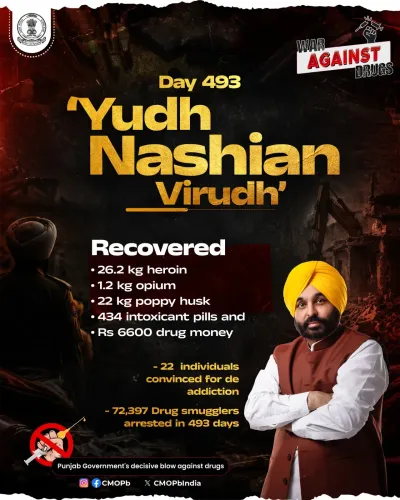
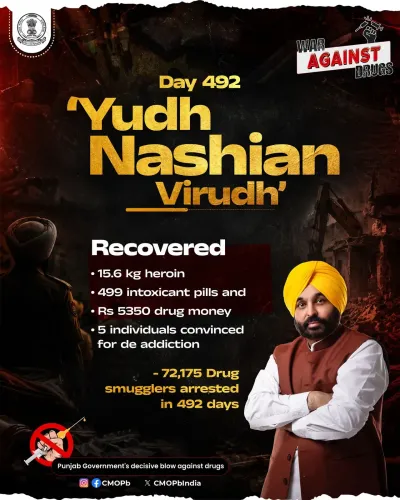
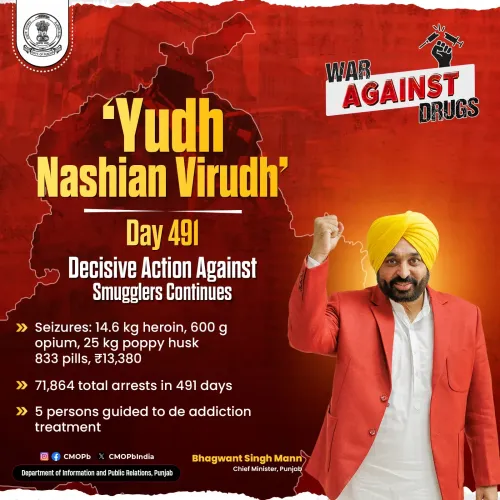
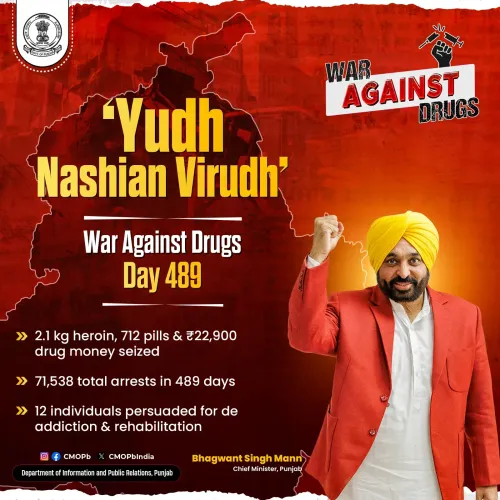
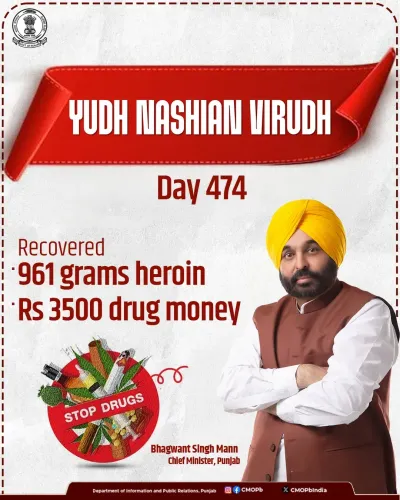
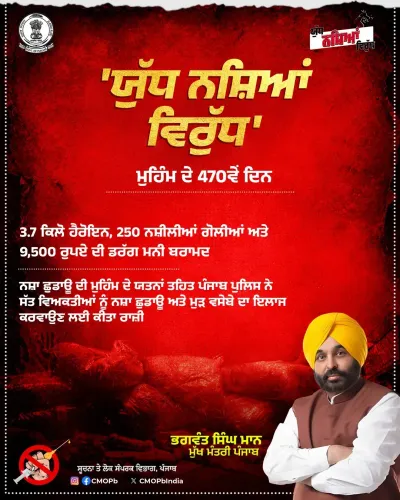
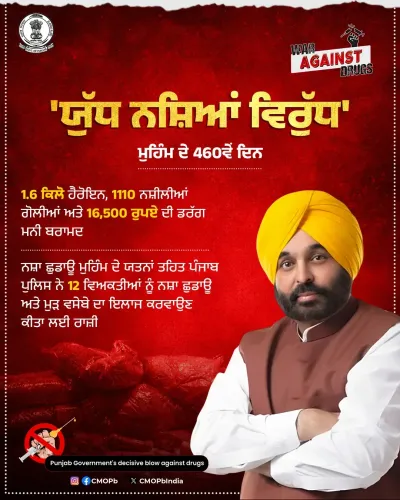
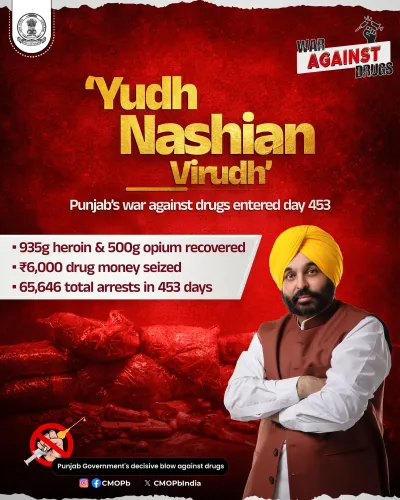
Punjab's Yudh Nashian Virudh hits Day 508, arrests cross 74,000
Synopsis
Punjab's Yudh Nashian Virudh campaign completed 508 days on 23 July 2026, with cumulative arrests reaching 74,372. A single day's operations netted 1.1 kg heroin, 500 g opium, 299 intoxicant pills, and Rs 4,600 in drug money. Five persons were also referred for de-addiction treatment.
Key Takeaways
The Yudh Nashian Virudh anti-narcotics campaign completed its 508th consecutive day on 23 July 2026 .
Cumulative drug smuggler arrests since the campaign's launch have reached 74,372 .
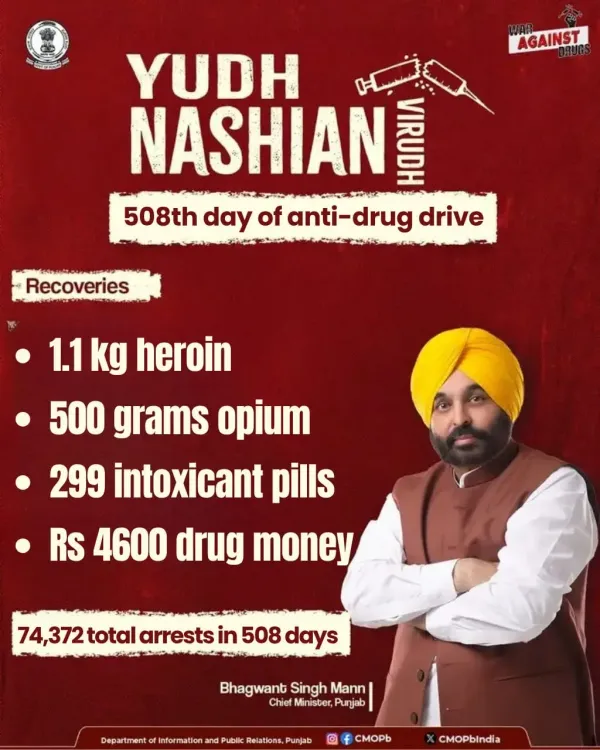
Day 508 recoveries included 1.1 kg heroin , 500 grams opium , 299 intoxicant pills , and Rs 4,600 in drug money.
Five persons were convinced to voluntarily enter de-addiction and rehabilitation treatment as part of the campaign's outreach.
The campaign was launched by Chief Minister Bhagwant Mann 's Aam Aadmi Party government shortly after taking office in March 2022 .
Punjab 's cross-border drug trafficking routes from Pakistan have made the state a persistent focus of national anti-narcotics policy.
The Chief Minister's Office of Punjab announced on Thursday, 23 July 2026 that the state's ongoing anti-narcotics campaign, Yudh Nashian Virudh, has entered its 508th consecutive day, with cumulative arrests of drug smugglers reaching 74,372 since the drive began.
What the Day's Operations Recovered
Punjab Police teams, continuing their daily enforcement sweep, recovered 1.1 kg of heroin, 500 grams of opium, and 299 intoxicant pills from arrested drug smugglers on the day. Authorities also seized Rs 4,600 in drug money linked to the trafficking network. The recoveries reflect the mix of hard narcotics and pharmaceutical drugs that enforcement teams encounter across the state's trafficking corridors.
Context: A Campaign Built on Daily Accountability
Yudh Nashian Virudh — loosely translated as 'War Against Drugs' — was launched by the Aam Aadmi Party government of Chief Minister Bhagwant Mann shortly after it assumed office in March 2022. The campaign has been characterised by daily public updates on arrests and seizures, a deliberate communication strategy designed to demonstrate sustained policing intensity. Punjab, which shares an international border with Pakistan, has long been documented as a high-pressure zone for cross-border drug trafficking, with opioid addiction rates among the state's youth drawing national attention for decades.
Successive governments — including the Congress administration from 2017 to 2022 — launched comparable anti-narcotics operations and expanded de-addiction infrastructure, but the scale of the problem has persisted. The AAP government positioned Yudh Nashian Virudh as a more aggressive and transparent continuation of those efforts.
Rehabilitation: Five More Convinced to Seek Treatment
Beyond enforcement, the CMO's update noted that Punjab Police convinced five persons to voluntarily undergo de-addiction and rehabilitation treatment as part of the campaign's outreach component. While modest in number, the rehabilitation push represents an attempt to address demand-side factors alongside supply-side crackdowns. Critics and public health advocates have long argued that enforcement alone cannot resolve Punjab's addiction crisis without proportionate investment in treatment infrastructure and community support systems.
Stakeholders and Impact
The primary beneficiaries of sustained enforcement are Punjab's youth, who have historically borne the heaviest social cost of drug addiction in the state. Families of addicts, village communities near border districts, and local health workers are all directly affected by the campaign's dual approach of arrests and rehabilitation referrals. Drug smuggling networks, which reportedly extend across border routes and into urban supply chains, face cumulative pressure as arrest tallies mount.
What's Next
The consistent daily reporting cadence suggests the CMO Punjab intends to sustain public visibility of the campaign well beyond the 500-day mark. Analysts and civil society groups will watch for the release of consolidated quarterly data on seizure volumes and rehabilitation outcomes, which would allow independent assessment of the campaign's long-term impact. Any proposed legislative measures to strengthen border controls or expand state-funded treatment centres would mark the next significant policy step in Bhagwant Mann's anti-narcotics agenda.
Point of View
Keeping the AAP government's flagship anti-drug promise in the public eye. With arrests now exceeding 74,000 over 508 days, the sheer volume of the numbers signals institutional commitment, but independent verification of outcomes — particularly on rehabilitation and recidivism — remains limited. The token rehabilitation referrals (five persons on a given day) underscore the persistent gap between enforcement intensity and treatment capacity, a structural challenge that has outlasted multiple governments in Punjab. How the Mann administration bridges that gap, rather than the arrest count alone, will define the campaign's lasting legacy.
NationPress
23 Jul 2026
Frequently Asked Questions
What is Yudh Nashian Virudh?
Yudh Nashian Virudh is Punjab's ongoing anti-narcotics campaign launched by Chief Minister Bhagwant Mann's Aam Aadmi Party government shortly after it took office in March 2022. The campaign combines daily enforcement operations — arrests and drug seizures — with rehabilitation outreach to convince addicts to seek treatment.
How many drug smugglers have been arrested in Punjab's anti-drug drive?
As of Day 508 of the Yudh Nashian Virudh campaign (23 July 2026), a total of 74,372 drug smugglers have been arrested since the drive began, according to the Chief Minister's Office of Punjab.
What drugs were seized on Day 508 of the Punjab anti-drug campaign?
On the 508th day of Yudh Nashian Virudh, Punjab Police recovered 1.1 kg of heroin, 500 grams of opium, 299 intoxicant pills, and Rs 4,600 in drug money from arrested smugglers.
Why is Punjab particularly affected by drug trafficking?
Punjab shares an international border with Pakistan and has historically been a major transit and destination point for cross-border drug trafficking since the 1980s. High addiction rates among the state's youth have made narcotics a persistent political and public health issue across successive state governments.
Does the Punjab anti-drug campaign include rehabilitation?
Yes. Alongside enforcement, Punjab Police conduct community outreach to convince drug users to voluntarily undergo de-addiction and rehabilitation treatment. On Day 508, five persons were referred for such treatment, reflecting the campaign's dual focus on supply-side arrests and demand-side rehabilitation.