Puri hails Andaman gas finds as step toward energy self-reliance

Synopsis
Union Petroleum Minister Hardeep Singh Puri has welcomed the discovery of natural gas in two of three exploratory wells in the Andaman region by Oil India Limited, calling it a historic stride toward energy self-reliance under PM Modi's Samudra Manthan initiative and the broader Atmanirbhar Bharat framework.
Key Takeaways
Gas was found in two of three exploratory wells drilled in the Andaman region by Oil India Limited .
Union Petroleum Minister Hardeep Singh Puri called the find 'a historic step toward an energy self-reliant India' on 7 July 2026 .
The minister linked the discovery to PM Narendra Modi's 'Samudra Manthan' campaign, said to have been launched on 15 August .
India imports over 80 per cent of its crude oil, making domestic finds of high strategic and economic value.
The Hydrocarbon Exploration and Licensing Policy (HELP) and Open Acreage Licensing Policy (OALP) , introduced in 2016 , underpin the current exploration drive in frontier basins.
Commercial viability of the Andaman gas find will depend on forthcoming appraisal drilling and reserve estimation.
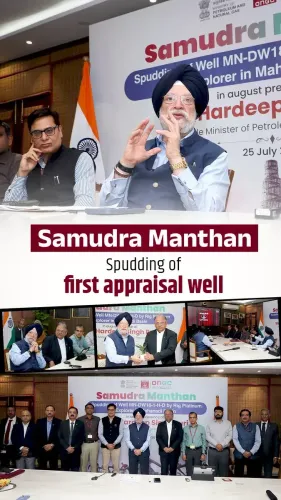
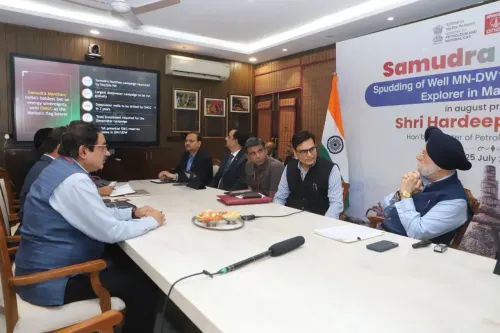
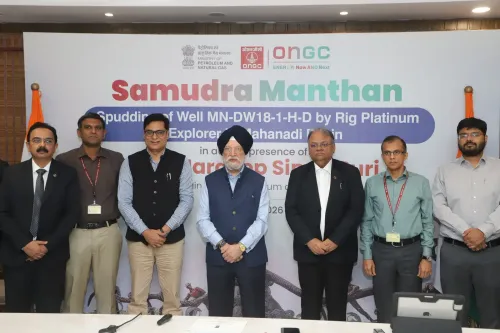
Union Petroleum Minister Hardeep Singh Puri on Tuesday, 7 July 2026 described the discovery of natural gas in two of three exploratory wells drilled in the Andaman region as a landmark signal for India's energy sector, calling it a step toward an energy-independent nation and crediting Prime Minister Narendra Modi's 'Samudra Manthan' initiative as the catalyst for this offshore exploration push.
Context
Puri's post, addressed jointly to Oil India Limited, stated: 'अंडमान में तीन अन्वेषण कुओं में से दो में गैस की खोज भारत के ऊर्जा क्षेत्र के लिए अत्यंत महत्वपूर्ण संकेत है' — 'The discovery of gas in two of three exploratory wells in Andaman is an extremely important signal for India's energy sector.' The minister further said this was 'not merely a natural gas discovery, but a historic step toward an energy self-reliant India.'
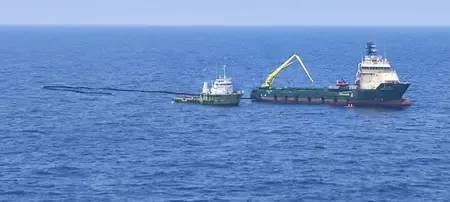
Oil India Limited, a public sector undertaking under the Ministry of Petroleum and Natural Gas, has been conducting exploration in frontier offshore basins including blocks in the Andaman Sea, which forms part of the Bay of Bengal. Frontier basin exploration in such geologically complex areas carries high risk but also high reward given India's acute import dependence.
Policy Backdrop
India imports more than 80 per cent of its crude oil requirements, making domestic hydrocarbon discoveries of strategic and economic significance. Successive governments have sought to reverse this through licensing reforms, and in 2016 the government replaced the older New Exploration Licensing Policy with the Hydrocarbon Exploration and Licensing Policy (HELP) and introduced the Open Acreage Licensing Policy (OALP) to attract investment into under-explored basins.
Puri invoked the Atmanirbhar Bharat framework in his remarks, arguing that increased domestic energy capacity would reduce import dependence, strengthen energy security, and provide 'a new foundation for the country's economic strength.' He specifically cited the 'Samudra Manthan' campaign, which he said was launched by PM Modi on 15 August last year, as the starting point of what he called 'India's energy revolution.'
Stakeholders and Impact
Oil India Limited stands at the centre of this development as the exploration entity operating in the Andaman blocks. A commercially viable gas find in these offshore waters could open a new frontier for domestic gas supply, benefiting industries that depend on imported liquefied natural gas and potentially easing pressure on the country's energy import bill.
The Andaman and Nicobar Islands' location in the eastern Bay of Bengal also carries strategic significance, given the broader geopolitical importance of the Indo-Pacific maritime domain. Any large-scale hydrocarbon development in the region would require substantial infrastructure investment and environmental clearances, processes that involve multiple central and island-territory stakeholders.
What's Next
The immediate focus will be on the results of appraisal drilling to determine the commercial viability and volume of the gas discovered in the two Andaman wells. The third exploratory well in the same campaign will also be watched closely. Should early appraisal results prove encouraging, the government may initiate fresh bidding rounds or award additional production-sharing contracts under the HELP/OALP framework for adjacent acreage.
The Andaman finds, if confirmed as commercially productive, could incrementally shift India's energy supply calculus at a time of global price volatility and evolving supplier dynamics — adding a domestic offshore dimension to a portfolio that has so far leaned heavily on imports and onshore production.
Point of View
Elevating what is technically a preliminary find into a political milestone ahead of any commercial appraisal. The invocation of the 'Samudra Manthan' campaign — linked to the symbolically charged 15 August date — signals the government's intent to build a sustained public narrative around offshore energy as a pillar of economic sovereignty. For the BJP, domestic hydrocarbon discoveries offer a rare opportunity to demonstrate tangible progress on energy security, a metric that directly affects household fuel prices and industrial costs. The real test, however, will come when appraisal drilling translates exploration signals into confirmed reserves and production timelines.
NationPress
6 Oct 2026
Frequently Asked Questions
What was discovered in the Andaman exploratory wells?
Natural gas was discovered in two of the three exploratory wells drilled in the Andaman region by Oil India Limited, according to a post by Union Petroleum Minister Hardeep Singh Puri on 7 July 2026.
What is the Samudra Manthan campaign?
Samudra Manthan is a government campaign for advancing India's ocean-based energy exploration, which Minister Puri says was launched by Prime Minister Narendra Modi on 15 August. Its full scope and details are yet to be officially detailed in the public record.
Which company is drilling in the Andaman offshore blocks?
Oil India Limited, a central public sector undertaking under the Ministry of Petroleum and Natural Gas, is conducting the exploratory drilling in the Andaman blocks.
How much of India's crude oil is imported?
India historically imports more than 80 per cent of its crude oil requirements, making domestic hydrocarbon discoveries strategically significant for energy security and reducing the import bill.
What policy governs offshore exploration in India?
Offshore and frontier basin exploration in India is governed by the Hydrocarbon Exploration and Licensing Policy (HELP) and the Open Acreage Licensing Policy (OALP), both introduced in 2016 to attract investment into under-explored areas.