Puri Hails Natural Gas Find in Andaman Sea Exploratory Well

Synopsis
Union Petroleum Minister Hardeep Singh Puri has confirmed the presence of natural gas at Sri Vijayapuram-3, an Oil India exploratory well 15 km off the Andaman Islands at 355 m depth. The find is the second hydrocarbon presence in three wells drilled under India's deepwater Andaman campaign, advancing the Samudra Manthan Mission.
Key Takeaways
Natural gas confirmed at Sri Vijayapuram-3, an Oil India exploratory well 15 km off the east coast of the Andaman Islands at a water depth of 355 metres .
Initial production testing at 1,900-plus metres depth in the Eocene formation established gas presence through continuous flaring.
Hydrocarbon presence has now been reported in 2 out of 3 exploratory wells drilled by OIL in the current Andaman campaign.
Oil India is conducting gas sampling to assess composition, calorific value, and isotope data to determine commercial viability.
The find falls under the Samudra Manthan Mission announced by PM Modi on Independence Day 2025 , targeting deepwater and ultra-deepwater drilling across India's offshore basins.
Global deepwater majors including Petrobras, TotalEnergies, Shell, bp, and ExxonMobil are identified as potential exploration partners for scaling up the Andaman campaign.
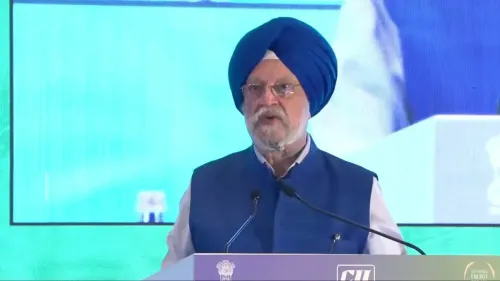
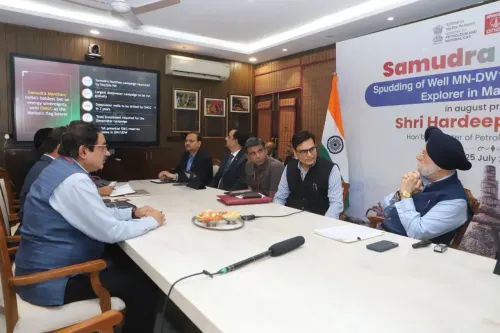
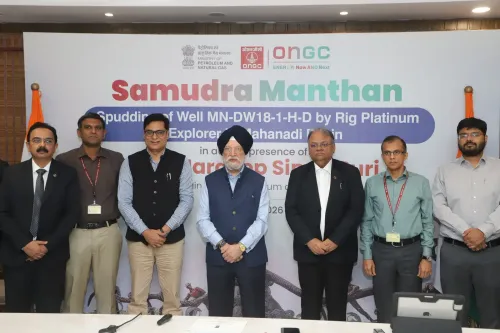
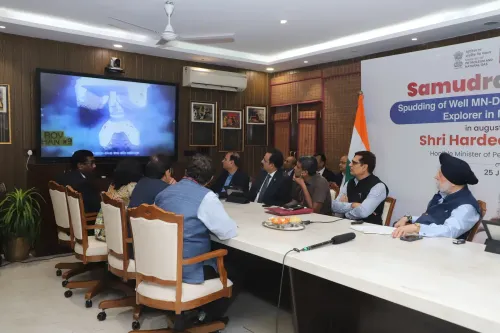
Union Petroleum Minister Hardeep Singh Puri on Friday, 5 June 2026 announced the confirmed presence of natural gas at Sri Vijayapuram-3, an exploratory well drilled by Oil India Limited (OIL) approximately 15 km off the east coast of the Andaman Islands at a water depth of 355 metres — marking a significant milestone in India's deepwater exploration drive.
Context
Initial production testing of the well at a depth of 1,900-plus metres in the Eocene formation has established the presence of natural gas through continuous flaring. The Eocene formation, a sedimentary rock layer dating back tens of millions of years, is considered a prospective hydrocarbon-bearing horizon in the Andaman Basin. Oil India is now conducting gas sampling to assess the composition, calorific value, and isotope characteristics of the find to determine its commercial and geological significance.
Puri noted that hydrocarbon presence has now been reported in 2 out of 3 exploratory wells drilled by OIL in its current Andaman campaign. 'This presence of natural gas will help us in taking forward our exploration ambitions,' the minister said, pointing to collaboration with global deepwater specialists including Petrobras, TotalEnergies, bp, Shell, and ExxonMobil.
Policy Backdrop
The discovery is part of the Samudra Manthan Mission — India's National Deep Water Exploration Mission — under which a large number of deepwater and ultra-deepwater exploration wells are planned across India's offshore basins to fully exploit the country's hydrocarbon reserves. The mission was announced by Prime Minister Narendra Modi on Independence Day 2025.
India's upstream exploration framework has evolved significantly over the past decade. The Hydrocarbon Exploration and Licensing Policy (HELP), launched in 2016, replaced the earlier New Exploration Licensing Policy regime by introducing revenue-sharing contracts. The Open Acreage Licensing Policy (OALP), introduced in 2017, further allowed companies to nominate exploration blocks on a continuous basis, opening frontier areas like the Andaman Basin to renewed interest.
Oil India Limited, a Maharatna public sector undertaking, has been at the forefront of this push into frontier offshore basins. The Andaman Sea, located in the northeastern part of the Indian Ocean, has long been identified as a prospective but under-explored hydrocarbon province, and the current campaign represents one of the most concerted efforts to assess its potential.
Stakeholders and Impact
A commercially viable natural gas discovery in the Andaman Basin would carry significant implications for India's energy security and its stated goal of reducing import dependence. Rising domestic natural gas demand — driven by the power, fertiliser, and city gas distribution sectors — has kept India heavily reliant on liquefied natural gas imports. Any material domestic find in a frontier basin would ease that pressure over the medium term.
For global deepwater majors such as Petrobras, TotalEnergies, Shell, and ExxonMobil, a confirmed gas-bearing well strengthens the investment case for participating in future Andaman Basin licensing rounds. These companies bring proprietary deepwater drilling and reservoir-management technology that Indian PSUs seek to leverage under the Amrit Kaal energy self-reliance framework.
Upstream investors and energy-sector analysts will closely track the laboratory results from Sri Vijayapuram-3 as the first quantitative indicator of whether the Andaman Basin can graduate from a frontier prospect to a producing province.
What's Next
Oil India is expected to complete gas sampling and isotope studies in the coming weeks, with results determining the next phase of appraisal drilling. The composition and calorific value data will be critical in deciding whether a commercial development programme is warranted. Under the Samudra Manthan Mission, additional deepwater and ultra-deepwater wells are planned across India's offshore basins, meaning the Andaman campaign is one part of a broader national exploration push.
Should the gas find at Sri Vijayapuram-3 prove commercially significant upon further appraisal, it would represent a major step in India's ambition to develop frontier offshore reserves and reduce its dependence on hydrocarbon imports — a central plank of energy policy in the Amrit Kaal period leading up to 2047.
Point of View
Coming just months after the Samudra Manthan Mission was formally launched. A two-out-of-three hit rate in the Andaman campaign is a credible early signal, though the critical question — commercial quantum — remains unanswered until gas sampling is complete. The explicit naming of five global deepwater majors signals that New Delhi is actively courting technology-rich partners for the next phase, using early results to sweeten the pitch. This fits a broader pattern of pairing domestic PSUs with international expertise to accelerate India's upstream ambitions under the Amrit Kaal energy self-reliance framework.
NationPress
24 Sept 2026
Frequently Asked Questions
What is the Sri Vijayapuram-3 well and where is it located?
Sri Vijayapuram-3 is an exploratory well drilled by Oil India Limited approximately 15 km off the east coast of the Andaman Islands in the Bay of Bengal, at a water depth of 355 metres.
What is the Samudra Manthan Mission?
The Samudra Manthan Mission, also called the National Deep Water Exploration Mission, was announced by Prime Minister Narendra Modi on Independence Day 2025. It plans a large number of deepwater and ultra-deepwater exploration wells across India's offshore basins to exploit the country's hydrocarbon reserves.
Has natural gas been commercially confirmed at Sri Vijayapuram-3?
Not yet commercially confirmed. Initial production testing has established the presence of natural gas through continuous flaring, but Oil India is still conducting gas sampling to assess composition, calorific value, and isotope characteristics before any commercial assessment can be made.
Which global energy companies are involved in India's Andaman deepwater exploration?
Petroleum Minister Hardeep Singh Puri named Petrobras, TotalEnergies, bp, Shell, and ExxonMobil as global deepwater exploration experts with whom India plans to advance its Andaman Basin exploration ambitions.
What is Oil India Limited's role in India's upstream energy sector?
Oil India Limited is a Maharatna public sector undertaking engaged in hydrocarbon exploration and production. It has been conducting exploratory drilling in the Andaman Basin as part of India's push to develop frontier offshore reserves and reduce import dependence.