Amit Shah: Modi govt cut Naxal support, freed security forces
Synopsis
Home Minister Amit Shah quoted PM Modi claiming the BJP government ended political support to Naxalites and freed security forces to act independently — a sharp contrast with the UPA era that the BJP has long drawn as central to its internal-security record.
Key Takeaways
Amit Shah quoted PM Modi on November 8, 2026 saying the government ended support that earlier administrations had provided to Naxalites.
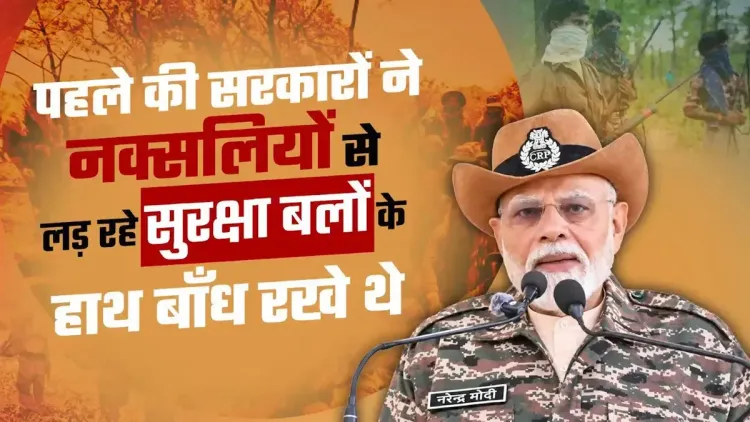
Security forces were given the freedom to take 'every necessary decision' independently, according to the quoted remarks.
The UPA government launched Operation Green Hunt in 2009 ; the NDA introduced the SAMADHAN doctrine in 2017 as a replacement framework.
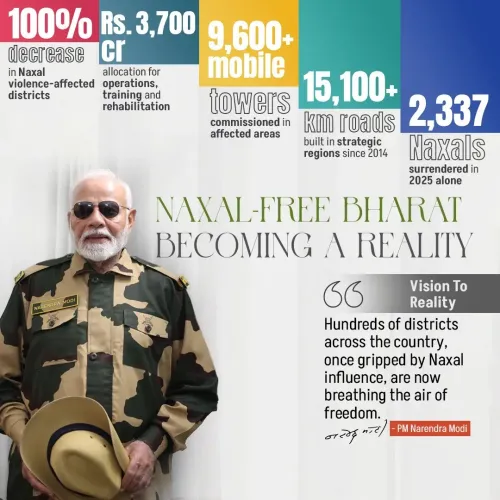
The Ministry of Home Affairs has reported a decline in LWE-affected districts and violence incidents since 2014 .
Operations have intensified most visibly in Chhattisgarh, Jharkhand, and Odisha — the core of the Red Corridor.
The specific speech or event in which PM Modi made the referenced remarks has not been publicly identified.
A political declaration with sharp historical teeth: Union Home Minister Amit Shah took to X on Sunday, November 8, 2026 to relay what he described as Prime Minister Modi's own account of how the current government dismantled the support system Naxalites had enjoyed under previous administrations — and handed security forces the operational freedom they had long been denied.
Shah quoted Prime Minister Modi directly, writing: 'मोदी जी ने बताया कि पहले की सरकारों द्वारा नक्सलियों को जो सपोर्ट मिलता था, उसे हमने बंद किया और सुरक्षा बलों को हर जरूरी निर्णय लेने की आजादी दी।' — translated: 'Modi ji explained that the support Naxalites received from earlier governments has been stopped by us, and security forces have been given the freedom to take every necessary decision.'
From Operation Green Hunt to SAMADHAN: a doctrine shift
The remark lands inside a long policy arc. The UPA government launched Operation Green Hunt in 2009, a large-scale security offensive in the so-called Red Corridor spanning Chhattisgarh, Jharkhand, and Odisha. Critics at the time — and the BJP in opposition — argued the approach was inconsistent and that political considerations constrained ground commanders. When the NDA government took office in 2014, it recalibrated. By 2017, the Ministry of Home Affairs had formalised the SAMADHAN doctrine — an acronym outlining a multi-pronged strategy combining security operations with development programmes in affected districts. The key departure, as the government has consistently argued, was decentralising operational decision-making to field commanders rather than funnelling every call through political channels.Shrinking the Red Corridor — what the numbers say
The Ministry of Home Affairs has documented a steady decline in both LWE-affected districts and violence incidents since 2014. The number of districts classified as left-wing extremism-affected has fallen significantly over the past decade, with the government attributing the trend to this twin-track approach: sustained security pressure combined with infrastructure and welfare delivery in long-neglected tribal belts. Residents of these districts — historically caught between insurgent demands and state neglect — are the most direct stakeholders in whether the policy holds.BJP's counter-Naxal narrative and the opposition framing it challenges
Shah's post is not just a policy update — it is a pointed piece of political framing. The BJP has consistently argued that Congress-era governments provided, whether by design or default, an enabling environment for Naxalite activity. The post reprises that argument by putting the critique in Prime Minister Modi's own voice, amplifying it through the Home Minister's platform. Opposition parties have contested this framing, arguing that Operation Green Hunt itself demonstrated UPA's willingness to deploy force, and that development deficits — not political sympathy — have historically fuelled recruitment in affected regions. What is not in dispute: the operational tempo against Naxalite groups has intensified markedly in recent years, with a string of major encounters reported across Chhattisgarh and neighbouring states. The next annual left-wing extremism report from the Ministry of Home Affairs will be the clearest factual test of how much ground the government's strategy has actually taken back — and how much of the Red Corridor remains lit.Point of View
The message is elevated from a party talking point to a prime-ministerial assertion. The timing matters: with the Ministry of Home Affairs preparing to release its next LWE report, the government appears to be front-loading the political credit for measurable reductions in violence. The framing also pre-empts any opposition counter-narrative by anchoring the claim in operational facts — the SAMADHAN doctrine, the decline in affected districts — that are difficult to dispute wholesale, even if the causal attribution remains contested.
NationPress
8 Nov 2026
Frequently Asked Questions
What did Amit Shah say about Naxalites in his November 2026 post?
Amit Shah quoted PM Modi saying the BJP government stopped the support that previous governments had provided to Naxalites and gave security forces the freedom to take all necessary operational decisions independently.
What is the SAMADHAN doctrine on Naxalism?
SAMADHAN is a multi-pronged counter-left-wing-extremism strategy introduced by the NDA government in 2017, combining security operations with development programmes in affected districts. It replaced the earlier UPA-era Operation Green Hunt as the primary policy framework.
Has Naxal violence decreased under the Modi government?
The Ministry of Home Affairs has documented a decline in both the number of LWE-affected districts and violence incidents since 2014, attributing the trend to intensified security operations and development initiatives in Chhattisgarh, Jharkhand, and Odisha.
What was Operation Green Hunt?
Operation Green Hunt was a large-scale security offensive launched by the UPA government in 2009 to combat Naxalite insurgents in the Red Corridor. The BJP criticised it at the time as inconsistently applied and politically constrained.
Which states are most affected by Naxal insurgency in India?
Chhattisgarh, Jharkhand, and Odisha form the core of the Red Corridor — the belt of central and eastern Indian states where Naxalite groups have historically been most active. Security operations coordinated by the Ministry of Home Affairs are concentrated in these states.