Amit Shah: Armed Naxals Gone, Now Fight 'Ideological Naxalism'
Synopsis
Union Home Minister Amit Shah shared a quote from PM Narendra Modi on 8 November 2026, declaring the defeat of armed Naxalism in India and framing 'ideological Naxalism' as the country's next internal-security challenge.
Key Takeaways
Amit Shah posted on 8 November 2026 quoting PM Modi: 'The armed Naxals are finished… now the country has to be secured from the intellectual Naxals.' The government has reported a progressive reduction in Naxal-affected districts and violence levels since 2014 .
The Ministry of Home Affairs under Shah has led combined security and development operations across the Red Corridor in Chhattisgarh, Jharkhand, Odisha , and Telangana .
The pivot to 'ideological Naxalism' signals the government intends to focus next on alleged urban and intellectual support networks for Maoist groups.
The approach has drawn both support from security stakeholders and scrutiny from civil liberties advocates regarding scope and due process.
The guns may have fallen silent across India's Red Corridor, but Union Home Minister Amit Shah is signalling that the battle is far from over — only the terrain has shifted. On Sunday, 8 November 2026, Shah shared a pointed quote attributed to Prime Minister Narendra Modi, declaring that while armed Naxalism has been defeated, the country must now defend itself against what he called 'ideological Naxalism.'
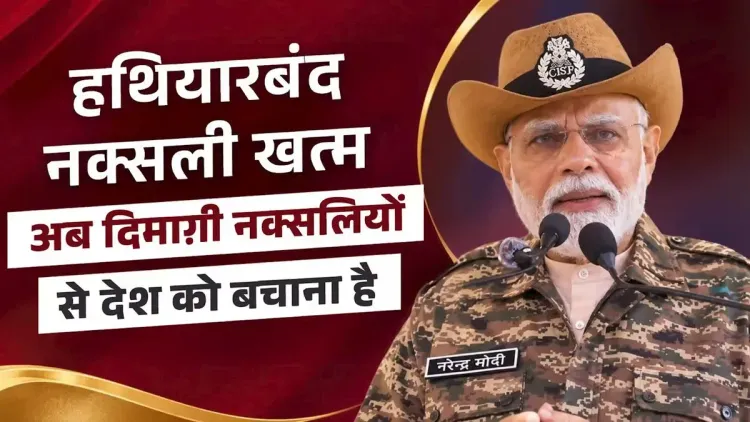
The post, shared in Hindi, carries a direct quote: 'हथियारबंद नक्सली खत्म हुए…अब दिमाग़ी नक्सलियों से देश को सुरक्षित करना है' — 'The armed Naxals are finished… now the country has to be secured from the intellectual Naxals.' The framing is deliberate and charged: a declaration of victory on one front, and an immediate opening of another.
A Decade of Shrinking the Red Corridor
The claim of defeating armed Naxalism carries weight rooted in a decade of counter-insurgency policy. Since 2014, the central government has consistently reported a reduction in Naxal-affected districts, combining kinetic security operations by central paramilitary forces with development programmes targeting the tribal heartland of central and eastern India. The Ministry of Home Affairs, which Shah heads, has periodically released data showing declining violence incidents, surrenders, and the shrinking geographical footprint of Maoist groups. The corridor that once stretched from Chhattisgarh through Jharkhand, Odisha, and into Telangana has contracted significantly under sustained pressure.
The Pivot to 'Ideological Naxalism'
The second half of the statement is where the political and policy signal gets sharp. The government's framing has long argued that armed cadres on the ground drew sustenance — strategic, legal, and moral — from sympathetic networks in cities and universities, often termed 'urban Naxals' in official and political discourse. By quoting Modi on this pivot, Shah is signalling that the Ministry of Home Affairs sees the ideological ecosystem as the residual, unfinished dimension of the Naxal challenge. This framing has real policy implications: it shapes how agencies prioritise surveillance, prosecution, and counter-narrative efforts well beyond the forests of Bastar or Saranda.
Why Tribal Communities and Civil Liberties Groups Watch This Closely
The government's two-track approach — kinetic action against armed groups and legal-ideological pressure on alleged support networks — has drawn very different reactions from different stakeholders. Security forces and many in affected communities welcome the territorial rollback of Maoist violence, which devastated livelihoods and blocked development for decades. But the expansion of the frame to 'intellectual' or 'urban' Naxalism has also drawn scrutiny from civil liberties advocates and legal experts, who have raised concerns about the breadth of its application. The tension between security imperatives and due-process protections sits at the heart of this debate — and Shah's post suggests the government intends to press ahead on both tracks simultaneously.
With the Ministry of Home Affairs now explicitly framing ideological counter-measures as the next chapter of the anti-Naxal campaign, the question is not whether this effort will intensify — it is how the state will define its boundaries.
Point of View
The Home Minister is elevating it to a prime ministerial mandate, lending institutional weight to what has until now often been political rhetoric. This positions the Ministry of Home Affairs to expand its operational focus beyond forests and tribal districts into urban networks, campuses, and legal ecosystems — a move with significant implications for the intersection of national security and civil liberties. The timing also reinforces the BJP government's long-running narrative that defeating an insurgency requires dismantling its ideological infrastructure, not just its armed cadres.
NationPress
8 Nov 2026
Frequently Asked Questions
What did Amit Shah say about Naxalism on 8 November 2026?
Shah quoted PM Modi saying that armed Naxals have been defeated and that the country must now be secured from 'intellectual' or 'ideological Naxals' — referring to alleged support networks in cities and academia.
What is 'intellectual Naxalism' or 'urban Naxalism'?
It is a term the Indian government uses to describe individuals or groups in urban settings — including academics, lawyers, and activists — whom it accuses of providing ideological, legal, or logistical support to Maoist armed groups.
Has India defeated armed Naxalism?
The central government has reported a substantial reduction in Naxal-affected districts and incidents of violence since 2014, though independent assessments of the full picture continue to vary.
Which states were most affected by Naxalism in India?
The so-called Red Corridor spans parts of Chhattisgarh, Jharkhand, Odisha, and Telangana, where Maoist groups have historically been most active.
What is Amit Shah's role in India's anti-Naxal policy?
As Union Home Minister, Amit Shah oversees internal security and has directed combined operations — paramilitary deployments alongside development schemes — in Naxal-affected areas since 2019.