Puri backs ₹84,000 cr 'Samudra Manthan' deep-sea energy mission
Synopsis
Union Petroleum Minister Hardeep Singh Puri has championed the ₹84,000 crore 'Samudra Manthan' mission to fast-track deep-sea hydrocarbon exploration in India, framing it as the defining proof of the Modi government's commitment to energy self-reliance at the CII energy conclave on 7 August 2026.
Key Takeaways
Union Petroleum Minister Hardeep Singh Puri announced and backed the ₹84,000 crore 'Samudra Manthan' mission on 7 August 2026 at the CIIIECE 2026 conclave.
The mission aims to accelerate deep-sea hydrocarbon exploration to reduce India's crude oil import dependence, which has historically exceeded 80 percent .
Puri attributed the mission's vision to Prime Minister Narendra Modi , placing it within the Atmanirbhar Bharat framework.
The announcement was made before a major industry audience of the Confederation of Indian Industry (CII) , signalling an intent to attract private and commercial investment.
India's 2016 HELP policy was a prior attempt at exploration reform; Samudra Manthan represents a significantly larger capital commitment to frontier deep-water geology.
Key details — specific blocks, bidding rounds, and timelines — are awaited from the Directorate General of Hydrocarbons and ONGC .
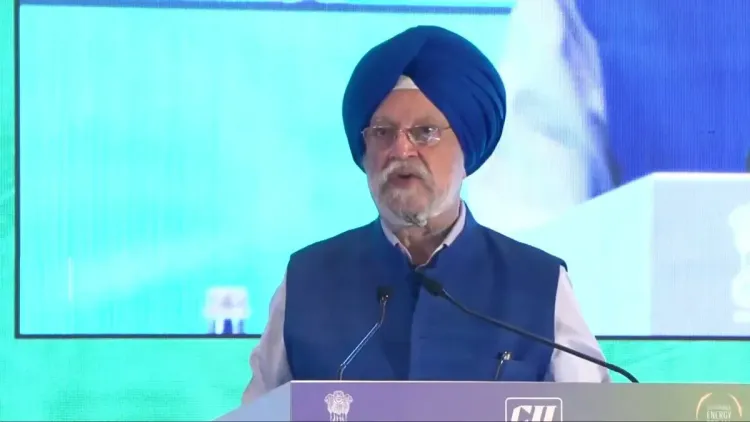
India is plunging into the deep — literally. Union Petroleum Minister Hardeep Singh Puri on Friday, 7 August 2026, hailed the ₹84,000 crore 'Samudra Manthan' mission as a historic leap toward energy self-reliance, calling it the single largest proof of India's faith in its own energy future.
Speaking in the context of the CII International Energy Conclave and Exhibition (CIIIECE) 2026, Puri framed the mission in unmistakably grand terms — borrowing from Hindu mythology itself. 'Samudra Manthan se nikla yeh amrit' ('the nectar that emerged from the churning of the ocean'), he wrote, invoking the ancient legend of gods and demons churning the cosmic ocean to extract immortal nectar. The metaphor is deliberate: India is churning its own seabed, and the prize is energy independence.
What 'Samudra Manthan' targets in India's deep waters
The mission is aimed at accelerating deep-sea hydrocarbon exploration at a scale India has not attempted before. For decades, India has imported more than 80 percent of its crude oil — a structural vulnerability that has weighed on the current account, exposed the economy to global price shocks, and complicated energy security planning. Successive governments have tried to chip away at that dependence; the Hydrocarbon Exploration and Licensing Policy (HELP), introduced in 2016 to replace the older NELP framework, was one such attempt — streamlining licensing and opening more acreage to private and foreign players.
Samudra Manthan, if it delivers on its stated ambition, would represent a step-change rather than an incremental reform. A ₹84,000 crore outlay directed at deep-water blocks signals that the government is betting on frontier geology — the kind of reserves that sit kilometres below the ocean surface and require sophisticated drilling technology, significant capital, and long lead times before the first barrel flows.
Puri's pitch at CIIIECE 2026 — and what industry will be watching
The timing of the announcement — at a major industry conclave convened by the Confederation of Indian Industry (CII) — is not incidental. Energy conclaves are where policy signals meet investment decisions, and Puri's language was calibrated for that audience: 'not merely an investment, but the greatest proof of India's belief in its energy future.' That is a pitch to exploration companies, equipment suppliers, and financiers simultaneously.
What the industry will now press for are specifics: which deep-water blocks will be opened, on what licensing terms, and whether new bidding rounds are imminent. The Directorate General of Hydrocarbons and ONGC will be central to execution. The minister attributed the mission's vision to Prime Minister Narendra Modi, describing it as the product of 'far-sighted leadership' — placing Samudra Manthan squarely within the broader Atmanirbhar Bharat (self-reliant India) framework that has defined the government's economic narrative since 2020.
India's offshore sedimentary basins — particularly in the Krishna-Godavari and Andaman regions — have long been flagged as under-explored. Whether Samudra Manthan accelerates drilling in those basins, or opens entirely new frontier acreage, will determine whether the ₹84,000 crore translates into barrels — or remains a bold headline.
Point of View
The mythology of cosmic ocean-churning maps neatly onto deep-water drilling ambition. For Puri, whose ministry has struggled to move the needle on India's stubborn 80-percent import dependence, a ₹84,000 crore mission headline is also a political reset — shifting the conversation from what hasn't changed to what is being attempted. The CII platform was chosen deliberately: industry bodies translate ministerial intent into investment pipelines, and the conclave is where commitment becomes credible. The real test will come in the next exploration licensing round — if block awards and drilling commitments follow, Samudra Manthan could mark a genuine inflection; if they don't, it risks joining a long list of announced-but-stalled offshore ambitions.
NationPress
22 Sept 2026
Frequently Asked Questions
What is the Samudra Manthan mission announced by Hardeep Singh Puri?
Samudra Manthan is a ₹84,000 crore government mission aimed at accelerating deep-sea hydrocarbon exploration in India to reduce the country's dependence on crude oil imports, which has historically exceeded 80 percent of total demand.
Why is India investing in deep-sea oil exploration?
India imports over 80 percent of its crude oil, making it highly vulnerable to global price swings and supply disruptions. Deep-sea exploration targets untapped offshore reserves that could meaningfully reduce this import dependence over time.
What is CIIIECE 2026 and why was the announcement made there?
CIIIECE 2026 is the Confederation of Indian Industry's International Energy Conclave and Exhibition, a major platform where energy policy signals are directed at industry investors, exploration companies, and equipment suppliers — making it a strategic venue for a large-scale mission announcement.
How does Samudra Manthan relate to India's Atmanirbhar Bharat policy?
Minister Puri framed the mission as part of Prime Minister Modi's Atmanirbhar Bharat (self-reliant India) vision, positioning domestic energy production as central to economic sovereignty and reduced strategic vulnerability.
What was India's previous offshore exploration reform before Samudra Manthan?
In 2016, the government replaced the New Exploration Licensing Policy (NELP) with the Hydrocarbon Exploration and Licensing Policy (HELP), which streamlined licensing and opened more acreage to private players — but India's import dependence remained above 80 percent.