Puri Meets Navy Chief, Eyes Stronger Petroleum-Navy Ties
Synopsis
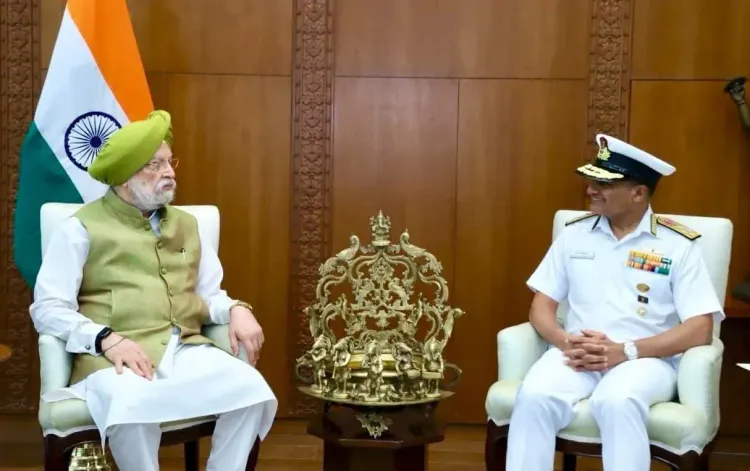
Union Petroleum Minister Hardeep Singh Puri met Chief of Naval Staff Admiral Krishna Swaminathan on 1 July 2026, discussing ways to deepen ties between the Petroleum Ministry and Indian Navy HQ. Puri, who served as Joint Secretary (Navy) from 1994 to 1997, brought personal institutional memory to talks centred on maritime energy security.
Key Takeaways
Union Petroleum Minister Hardeep Singh Puri hosted Chief of Naval Staff Admiral Krishna Swaminathan at his office on 1 July 2026 .
Discussions focused on strengthening the existing association between the Ministry of Petroleum and Natural Gas and Indian Navy Headquarters .
Puri recalled his posting as Joint Secretary (Navy) in the Ministry of Defence from 1994 to 1997 , underscoring personal familiarity with naval affairs.
Admiral Swaminathan was described as a specialist in Communication and Electronic Warfare .
The meeting reflects India's sustained inter-ministerial effort to protect seaborne crude oil supply lines critical to national energy security.
Future joint statements or MoUs on maritime energy security are being watched as potential outcomes.
Union Petroleum Minister Hardeep Singh Puri on Wednesday, 1 July 2026 received Chief of Naval Staff Admiral Krishna Swaminathan at his office in New Delhi, using the occasion to explore deeper institutional cooperation between the Ministry of Petroleum and Natural Gas and Indian Navy Headquarters.
Context
Puri, a career diplomat turned Cabinet minister, welcomed the Navy chief with a personal note of familiarity, recalling his tenure as Joint Secretary (Navy) in the Ministry of Defence from 1994 to 1997. That posting gave him firsthand exposure to naval operations and inter-ministerial coordination at a formative period in India's maritime security architecture. He described Admiral Swaminathan as a 'distinguished Communication and Electronic Warfare specialist', signalling the technical dimension of the Navy chief's career.
The meeting was also attended, in spirit, by the broader institutional relationship the two organisations have built over decades. Discussions centred on 'ways to further strengthen the existing association' between the Petroleum Ministry and Indian Navy HQ, according to Puri's post on X.
Policy Backdrop
India's energy security is inextricably linked to maritime safety. The country imports a large share of its crude oil by sea, making the Indian Ocean sea lines of communication a strategic priority for both the Ministry of Petroleum and Natural Gas and the Indian Navy. Successive governments since the 1990s have emphasised inter-ministerial coordination between defence and energy portfolios to safeguard these routes.
The Ministry of Defence and the Petroleum Ministry have maintained institutional links on maritime energy infrastructure protection and supply-chain resilience. As maritime domain awareness has grown into a central pillar of national security planning, such coordination has taken on added operational significance, particularly given heightened regional tensions in key shipping corridors.
Stakeholders and Impact
For the Indian Navy, closer ties with the Petroleum Ministry can translate into better intelligence-sharing on energy infrastructure vulnerabilities and coordinated planning for protection of offshore oil assets, undersea pipelines, and import terminals. For the Petroleum Ministry, the Navy's reach across the Indian Ocean Region provides a security umbrella for the supply chains that keep India's refineries running.
Energy sector stakeholders — including state-run upstream and downstream firms — stand to benefit from any formal framework that reduces risk to seaborne crude supplies. Personnel continuity, illustrated by Puri's own Defence Ministry background, helps bridge what can otherwise be siloed bureaucratic cultures.
What's Next
Observers will watch for any joint statements, memoranda of understanding, or working-group announcements flowing from the meeting. References in forthcoming defence or petroleum budget presentations to maritime energy security cooperation would signal that the discussions have moved from the ministerial to the operational level. The meeting sets a visible marker for inter-ministerial engagement at the very top of both hierarchies, raising expectations of concrete institutional follow-through.
Point of View
Reinforcing his standing beyond the energy portfolio. This fits a wider BJP-government pattern of projecting whole-of-government coherence on national security, where civilian ministries are increasingly visible partners to the uniformed services. The meeting raises the question of whether a formal coordination mechanism — perhaps an MoU or a joint working group — is in the pipeline between the two organisations.
NationPress
1 Jul 2026
Frequently Asked Questions
Why did Petroleum Minister Hardeep Singh Puri meet the Chief of Naval Staff?
Puri met Admiral Krishna Swaminathan on 1 July 2026 to discuss ways to strengthen cooperation between the Ministry of Petroleum and Natural Gas and Indian Navy Headquarters, particularly on maritime energy security.
What is the connection between the Indian Navy and India's petroleum sector?
India imports a large share of its crude oil by sea, making the Indian Ocean shipping lanes critical to energy supply. The Indian Navy protects these sea lines of communication, making coordination with the Petroleum Ministry essential for energy security.
Did Hardeep Singh Puri previously work with the Ministry of Defence?
Yes. Puri served as Joint Secretary (Navy) in the Ministry of Defence from 1994 to 1997, giving him direct experience with naval affairs before his diplomatic and political career.
Who is Admiral Krishna Swaminathan?
Admiral Krishna Swaminathan is the Chief of Naval Staff of the Indian Navy and is described by Minister Puri as a distinguished specialist in Communication and Electronic Warfare.
What could come out of the Petroleum Ministry and Indian Navy talks?
Analysts expect possible joint statements, memoranda of understanding, or working-group formations on maritime energy security, with any concrete outcomes likely to be reflected in future defence or petroleum policy announcements.