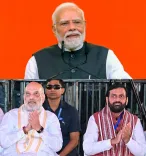
Raghav Chadha marks 25 years of Modi in government
Synopsis
AAP Rajya Sabha MP Raghav Chadha marked PM Narendra Modi's 25 uninterrupted years in government on 7 October 2026, tracing his arc from Gujarat CM in 2001 through three national Lok Sabha mandates and highlighting Modi's stated goal of a Viksit Bharat by 2047.
Key Takeaways
7 October 2001 : Narendra Modi took oath as Chief Minister of Gujarat, beginning 25 uninterrupted years at the head of a government.
Modi won three successive mandates as Gujarat CM before moving to national leadership from Gandhinagar to Delhi in 2014 .
He has since led India through three consecutive Lok Sabha election victories .
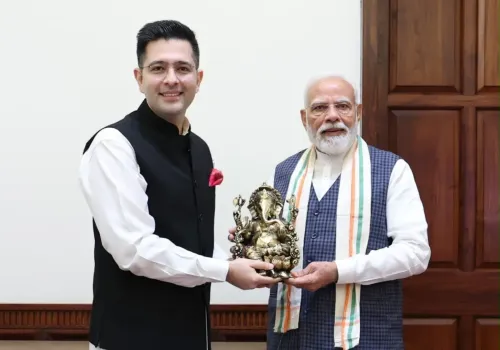
AAP Rajya Sabha MP Raghav Chadha — from an opposition party — issued a detailed, warm tribute, an unusual cross-aisle gesture.
Modi's stated next-phase goals include making India a top-three global economy , investing in semiconductors, AI and space , and achieving Viksit Bharat by 2047 .
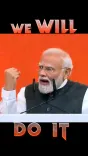
Modi's own three-word summation of his resolve on the day: 'Hum karke rahenge' — 'We will get it done.'
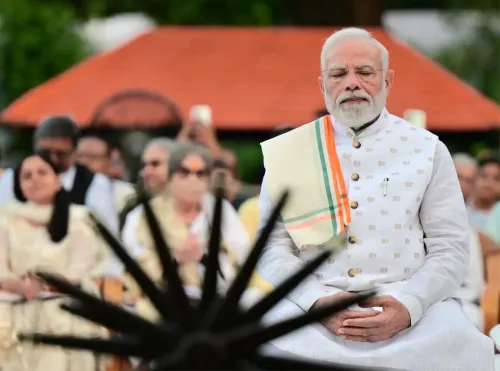
Twenty-five uninterrupted years at the helm of government — from a turbulent Gujarat in 2001 to steering the world's most populous democracy through three consecutive Lok Sabha mandates. AAP Rajya Sabha MP and party spokesperson Raghav Chadha took to X on Wednesday, 7 October 2026 to mark the milestone, offering a detailed, cross-party tribute to Prime Minister Narendra Modi on exactly 25 years since he first took oath as Chief Minister of Gujarat on 7 October 2001.
From Gandhinagar to Raisina Hill: a quarter-century in power
Chadha's post traces a clear arc: Modi entered Gujarat's top office at what he calls 'a difficult time', then secured three successive electoral mandates as Chief Minister before making the transition to national leadership from Gandhinagar to Delhi in 2014. Since then, the Prime Minister has led the country through three consecutive Lok Sabha election victories — a feat that places him among the longest-continuously-serving heads of government in India's democratic history.
The AAP leader credits Gujarat-era experiments — in grievance redressal, rural electrification, water management, technology deployment, and investment attraction — as the seedbed for programmes later scaled nationally. He also points to the last 12 years of expansion in financial inclusion, digital payments, infrastructure, welfare delivery, manufacturing, and healthcare as a distinct, larger phase of the same governance philosophy.
The 'Hum karke rahenge' moment and the Viksit Bharat horizon
What gives Chadha's tribute its forward-looking edge is his focus not on the past but on what Modi said on the day itself. He notes the Prime Minister summarised his next-phase ambition in three words: 'Hum karke rahenge' — a Hindi phrase meaning 'We will get it done.' The stated goals include making India one of the world's top three economies, building a self-reliant manufacturing base, investing in semiconductors, AI, and space technologies, strengthening energy security, and expanding opportunities for India's youth — all oriented toward the declared target of a Viksit Bharat by 2047.
Chadha frames the significance of the milestone not merely in the longevity itself but in the idea of repeated democratic renewal. 'A first mandate can come from hope and expectation,' he writes. 'But when people keep renewing that mandate over many years, the expectations become greater and so does performance.'
An unusual tribute from across the aisle
The post is notable for its source. Raghav Chadha is a Rajya Sabha MP of the Aam Aadmi Party, which has been in active political contest with Modi's Bharatiya Janata Party across multiple state elections, particularly in Delhi and Punjab. A warm, detailed tribute of this length and specificity from an opposition parliamentarian — closing with 'My heartiest congratulations to Hon'ble Prime Minister Shri Narendra Modi ji on this very special milestone' and a wish for 'good health, strength and many more years in the service of Bharat' — is not routine political commentary. It signals either a deliberate gesture of statesmanship or a calculated positioning, and either way, it lands differently than praise from within the ruling coalition.
The hashtag #25YearsOfSeva — 'seva' meaning service — frames the quarter-century in explicitly public-service language, a framing the Prime Minister's own communication has leaned into consistently.
Twenty-five years is a long time in any democracy. The real test of the next chapter will be whether the ambitions Chadha lists — from semiconductor fabs to Viksit Bharat — move from political vocabulary into measurable ground reality.
Point of View
Unsolicited praise sits outside the normal grammar of Indian opposition politics. It could reflect a genuine statesmanlike gesture, a strategic repositioning, or an attempt to distinguish AAP from a more combative opposition posture ahead of electoral cycles. Either way, it hands the Modi narrative an endorsement with cross-party credibility. The framing around 'democratic renewal' — that repeated mandates raise both expectations and performance — is also a double-edged compliment: it implicitly holds the Prime Minister to a higher bar for delivery on the ambitious Viksit Bharat and economic-ranking targets he has publicly set.
NationPress
7 Oct 2026
Frequently Asked Questions
When did Narendra Modi first become Chief Minister of Gujarat?
Narendra Modi took oath as Chief Minister of Gujarat on 7 October 2001 , beginning what would become 25 uninterrupted years at the head of a government.
Why did Raghav Chadha congratulate Narendra Modi?
AAP Rajya Sabha MP Raghav Chadha posted a tribute on X on 7 October 2026 to mark the 25th anniversary of Modi's first oath as Gujarat CM, calling it a milestone of sustained public trust and electoral renewal.
What is Viksit Bharat 2047?
Viksit Bharat — meaning 'Developed India' — is the Modi government's declared goal of transforming India into a fully developed nation by 2047 , the centenary of independence, with targets spanning economic scale, manufacturing, technology, and energy security.
What does 'Hum karke rahenge' mean?
'Hum karke rahenge' is a Hindi phrase meaning 'We will get it done' — the three words PM Modi used on 7 October 2026 to summarise his resolve for the next phase of governance, as noted by Raghav Chadha in his tribute post.
How many Lok Sabha elections has Modi won as Prime Minister?
PM Modi has led the BJP to victory in three consecutive Lok Sabha elections since first becoming Prime Minister after the 2014 general election.