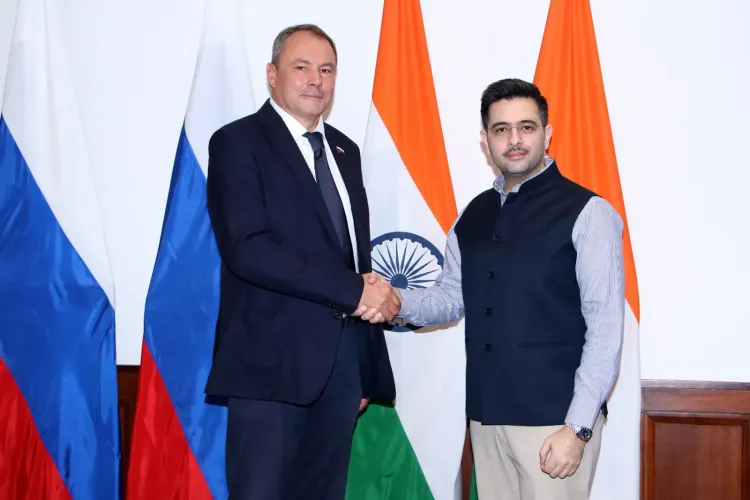
Raghav Chadha meets Petr Tolstoy at BRICS Forum in Delhi
Synopsis
AAP Rajya Sabha MP Raghav Chadha met Petr Tolstoy, great-great-grandson of Leo Tolstoy and a Russian State Duma deputy, at the 12th BRICS Parliamentary Forum in New Delhi, evoking the historic intellectual bond between Leo Tolstoy and Mahatma Gandhi that shaped India's freedom struggle.
Key Takeaways
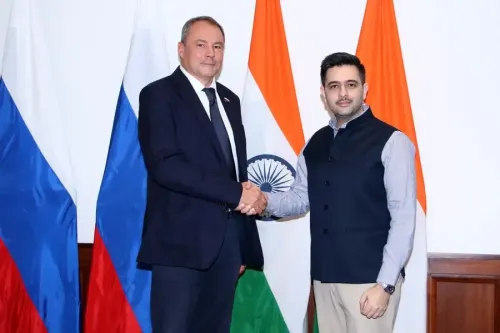
Raghav Chadha met Petr Tolstoy , Russian State Duma deputy and great-great-grandson of Leo Tolstoy, at Parliament House, New Delhi on October 27, 2026 .
The meeting took place on the sidelines of the 12th BRICS Parliamentary Forum .
Leo Tolstoy and Mahatma Gandhi began exchanging letters on truth and non-violence in 1909 , directly influencing Gandhi's philosophy of satyagraha .
Gandhi named his communal settlement in South Africa ' Tolstoy Farm ' in honour of the Russian writer's ideals.
The Tolstoy-Gandhi intellectual connection is a recurring reference point in official India-Russia bilateral friendship narratives.
The BRICS Parliamentary Forum serves as an institutional channel for legislative-level people-to-people contact between member nations.
At the marble corridors of Parliament House, New Delhi, a century-old intellectual thread was briefly, quietly, pulled taut. AAP Rajya Sabha MP Raghav Chadha met Petr Tolstoy — Russian State Duma deputy and great-great-grandson of the legendary novelist Leo Tolstoy — on the sidelines of the 12th BRICS Parliamentary Forum on Tuesday, October 27, 2026.
Chadha shared the encounter on X, calling it 'a special moment' and invoking one of history's most quietly consequential pen-pal relationships: the letters Leo Tolstoy and Mahatma Gandhi began exchanging in 1909, debating truth, love, and non-violence. Those letters, Chadha noted, 'deeply influenced Gandhi ji's principles, which became powerful instruments in India's freedom struggle.'
The letters that shaped a liberation movement
Leo Tolstoy was already in the final years of his life when a young barrister in South Africa first wrote to him. Gandhi had read Tolstoy's The Kingdom of God Is Within You and found in it a philosophical backbone for what would become satyagraha — non-violent resistance. The two men exchanged ideas across continents, and by 1910, Gandhi named his communal settlement in South Africa 'Tolstoy Farm' in direct tribute to the Russian thinker's influence. It was more than a gesture. It was an acknowledgement that the moral architecture of India's independence movement had a Russian cornerstone.
Tolstoy himself was no ordinary aristocrat-turned-author. Born into Russian nobility, he fought in the Crimean War, wrote War and Peace and Anna Karenina, and then spent the rest of his life publicly questioning the privilege his birth had granted him. His writings on non-violence and civil disobedience crossed borders long before the internet made such crossings easy.
Petr Tolstoy at India's Parliament
Petr Tolstoy, the great-great-grandson, serves today as a deputy in Russia's State Duma, making him a parliamentarian in his own right — a fact Chadha noted approvingly, calling him 'a distinguished parliamentarian.' His presence at the BRICS Parliamentary Forum in New Delhi placed him literally inside the legislature of the nation his ancestor most profoundly shaped from afar.
The BRICS Parliamentary Forum brings together legislators from Brazil, Russia, India, China, and South Africa to discuss shared policy concerns at a legislative level, complementing the annual leaders' summits. For India and Russia, these meetings carry an extra layer: a bilateral relationship built on strategic cooperation and, less visibly but just as durably, on cultural and intellectual exchange.
Why this meeting landed the way it did
Chadha framed the encounter around an idea that travels well across the current geopolitical climate: 'while nations may be separated by geography, great ideas know no borders.' India-Russia ties have navigated considerable international pressure in recent years, and the invocation of the Tolstoy-Gandhi connection — rooted in anti-colonial, anti-war philosophy — is a reminder of the ideational glue beneath the strategic partnership.
The Tolstoy-Gandhi intellectual lineage is not merely nostalgia. It surfaces regularly in official narratives of India-Russia friendship, offering both sides a story of mutual respect and shared values that predates and transcends Cold War alliances. When a sitting Indian MP and a sitting Russian MP stand together in New Delhi's Parliament House, that story does some diplomatic work all on its own.
More than a hundred and fifteen years after the first letter was sent, the conversation — in a different form, in a different century — continues.
Point of View
Both sides project a narrative of shared civilisational values that is harder to challenge than purely strategic alignment. For AAP's Raghav Chadha, engaging at the BRICS Parliamentary Forum signals the party's ambitions on the foreign-policy stage, an arena AAP has historically used to build national credibility. The Tolstoy-Gandhi thread also carries a subtle anti-imperial undertone — two thinkers who questioned state violence and colonial power — which resonates with India's traditional non-aligned self-image. In a period when India-Russia ties face international scrutiny, cultural diplomacy of this kind quietly reinforces the relationship's depth.
NationPress
27 Oct 2026
Frequently Asked Questions
Who is Petr Tolstoy and what is his connection to Leo Tolstoy?
Petr Tolstoy is a Russian State Duma deputy and the great-great-grandson of the legendary novelist Leo Tolstoy, author of 'War and Peace' and 'Anna Karenina'.
What is the connection between Leo Tolstoy and Mahatma Gandhi?
Beginning in 1909, Leo Tolstoy and Mahatma Gandhi exchanged letters on truth, love, and non-violence. Tolstoy's writings deeply influenced Gandhi's philosophy of satyagraha, and Gandhi named his South African settlement 'Tolstoy Farm' in his honour.
What is the BRICS Parliamentary Forum?
The BRICS Parliamentary Forum is a recurring meeting of legislators from Brazil, Russia, India, China, and South Africa designed to discuss shared legislative and diplomatic concerns, complementing the annual BRICS leaders' summits.
Where was Tolstoy Farm and why was it named that?
Tolstoy Farm was a communal settlement established by Mahatma Gandhi in South Africa around 1910. Gandhi named it after Leo Tolstoy to honour the Russian writer's intellectual and moral influence on his philosophy of non-violence.
Why did Raghav Chadha meet Petr Tolstoy?
Raghav Chadha met Petr Tolstoy on the sidelines of the 12th BRICS Parliamentary Forum at Parliament House, New Delhi, where both were present as legislators from their respective countries.