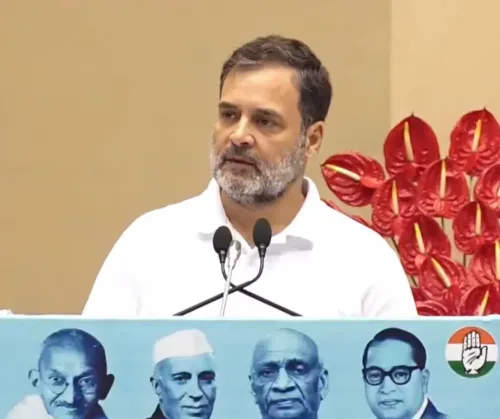
Rahul Gandhi: 'This chain is broken' — a warning on Indian democracy
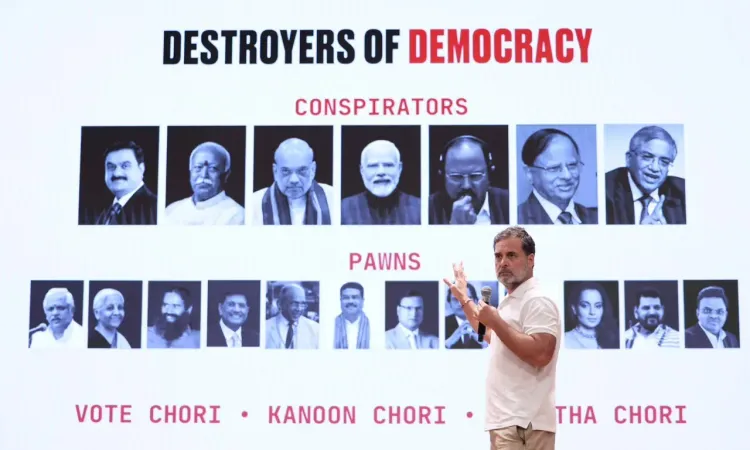
Synopsis
Congress leader Rahul Gandhi declared on September 24, 2026 that India's democratic chain — flowing from the vote through the Constitution to public institutions — is broken in a way that has never happened in the country's history.
Key Takeaways
Rahul Gandhi posted on September 24, 2026 that India's democratic foundation — the vote — has been fundamentally compromised.
He framed the issue as a three-link constitutional chain: vote → constitutional power → authority of laws → legitimacy of institutions.
Gandhi described the current situation as unprecedented in India's post-independence history.
The claim builds on a pattern of electoral integrity concerns Gandhi and the Congress party have raised since 2014 , including around the 2019 and 2024 general elections.
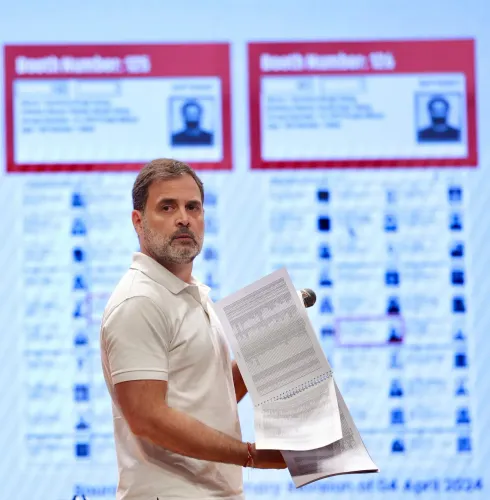
The post, attached to an image or link, invites scrutiny from the Election Commission of India and a parliamentary response from the ruling side.
The vote, Congress leader Rahul Gandhi declared on Thursday, September 24, 2026, is not merely a ritual — it is the root from which the entire constitutional order of India grows. And right now, he says, that root has been severed.
In a pointed post on X, Gandhi laid out a stark three-link chain: the vote produces constitutional power, constitutional power gives authority to laws, and laws lend legitimacy to public institutions. Break the first link, his argument runs, and the whole edifice collapses. 'Today this chain is broken,' he wrote, 'and this has never happened in India.'
A constitutional argument, not just a political one
The framing is deliberate. Rather than attacking a specific party or government, Gandhi is making a structural claim — that whatever is happening to the electoral process represents a rupture without precedent in the republic's history. The language borrows from constitutional theory: legitimacy, authority, foundation. It is the vocabulary of a Leader of the Opposition building a case, not merely firing a broadside.
Gandhi, who holds the Rae Bareli Lok Sabha seat, has raised alarms about electoral integrity repeatedly since 2014, including concerns about Electronic Voting Machines during the 2019 and 2024 general elections. Opposition parties have consistently framed such issues as existential threats to constitutional democracy, carrying them from street rallies into parliamentary debates.
Why 'unprecedented' is the sharpest word in the post
India has lived through Emergency, coalition collapses, hung parliaments, and disputed mandates. For Gandhi to claim that what is happening now — whatever specific incident or evidence the attached link points to — has 'never happened in India' is a maximalist charge. It is an invitation to benchmark the present moment against the full sweep of post-1947 democratic history.
That comparison is politically potent precisely because it is verifiable — or falsifiable. Responses from the Election Commission of India and the ruling establishment, as well as any follow-up parliamentary debate on electoral laws, will determine whether the charge gains traction or gets rebutted with facts.
The institutional stakes Gandhi is pointing to
The deeper message is about cascading consequences. If voters cannot trust that their ballot translates faithfully into representation, then every institution downstream — courts, legislatures, regulators — inherits a legitimacy deficit. It is a systemic argument: fix the source, or nothing else holds. Whether Gandhi's evidence sustains that argument is the question Indian democracy will now have to answer.
The chain, as he sees it, is broken. The burden of proof — and the urgency of repair — is now squarely in public view.
Point of View
Which is a harder charge to dismiss. By invoking the full legitimacy chain from ballot to institution, he raises the political cost of non-response: silence from the Election Commission or the ruling party can itself be read as confirmation. The 'unprecedented in India' formulation is a high-stakes rhetorical gamble — it will be tested against historical record and the specifics of whatever evidence the linked content carries. If the evidence holds, it anchors the Opposition's democratic narrative heading into the next electoral cycle; if it does not, it risks being used to paint the Congress as apocalyptic alarmists.
NationPress
24 Sept 2026
Frequently Asked Questions
What did Rahul Gandhi say about Indian democracy on September 24 2026?
Rahul Gandhi posted that the vote is the foundation of Indian democracy and that the chain connecting it to constitutional power, laws, and public institutions is currently broken — something he called unprecedented in India's history.
What is Rahul Gandhi's current political position?
Rahul Gandhi is the Leader of the Opposition in the Lok Sabha and an Indian National Congress MP representing the Rae Bareli constituency in Uttar Pradesh.
Has Rahul Gandhi raised electoral integrity concerns before?
Yes. Gandhi and the Congress party have consistently raised concerns about the integrity of electoral processes, including Electronic Voting Machines, during the 2019 and 2024 general elections and in multiple parliamentary interventions since 2014 .
What does Gandhi mean by the 'chain' of Indian democracy?
Gandhi describes a constitutional chain: the vote grants power under the Constitution, that power gives authority to laws, and those laws legitimise public institutions. He argues that if the vote is compromised, every institution downstream loses its democratic legitimacy.
What response is expected to Rahul Gandhi's democracy post?
Political observers are watching for a formal response from the Election Commission of India , a rebuttal from the ruling party, and the possibility of related discussions in Parliament on electoral laws and institutional integrity.