Rahul Gandhi marks Independence Day with call to guard democracy
Synopsis
On Independence Day 2026, Congress leader Rahul Gandhi called freedom a responsibility, not just a gift, urging Indians — especially youth — to uphold truth, non-violence, constitutional values and democracy. The message echoes the Congress party's long-standing Gandhian and constitutional framing of national identity.
Key Takeaways
Rahul Gandhi posted an Independence Day message on 15 August 2026 , wishing all Indians on the occasion.
He described freedom as both a gift from freedom fighters and an ongoing civic responsibility.
Gandhi specifically called for walking the path of truth and non-violence — a direct invocation of Gandhian principles.
He urged citizens to keep the values of the Indian Constitution and the Tricolour at heart and to defend democracy 'under all circumstances'.
The message singled out India's youth as being united in protecting these values, expressing pride in their solidarity.
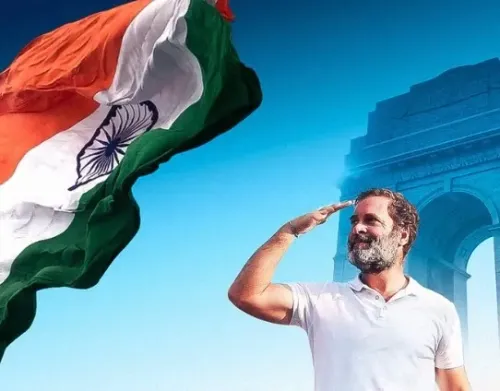
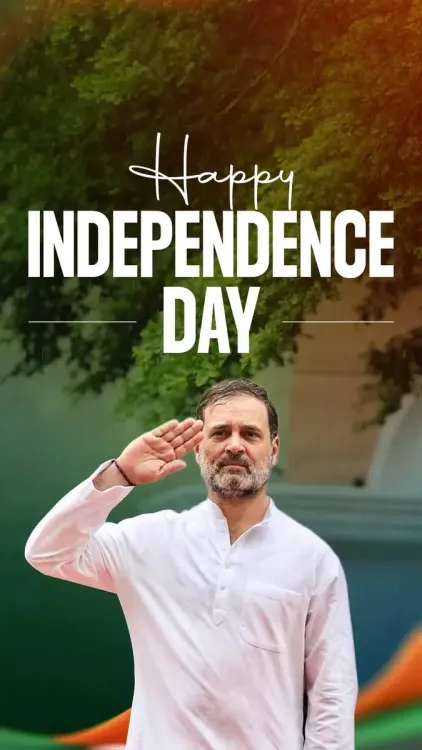
Freedom, Congress leader Rahul Gandhi said on 15 August 2026, is not merely a gift handed down by those who fought for it — it is a living responsibility. In an Independence Day message posted on X, the Leader of the Opposition in Lok Sabha called on every Indian, and especially the country's youth, to walk the path of truth and non-violence, hold the values of the Constitution and the Tricolour close, and defend democracy without exception.
Posting in Hindi, Gandhi wrote: 'आज़ादी हमारे स्वतंत्रता सेनानियों द्वारा दिया गया सिर्फ़ एक तोहफ़ा नहीं, बल्कि एक ज़िम्मेदारी भी है' — 'Freedom is not merely a gift given by our freedom fighters; it is also a responsibility.' He closed with a Jai Hind and the national flag.
Constitution, Tricolour, and the Gandhian thread
The message drew explicitly on the twin pillars that the Indian National Congress has long positioned at the centre of its national identity: the Indian Constitution, adopted after independence as the supreme law enshrining justice, liberty, equality and fraternity, and the Tricolour, adopted on 22 July 1947 as the emblem of a new republic. Gandhi's framing — freedom as an ongoing obligation rather than a settled fact — is consistent with the Congress tradition of invoking Mahatma Gandhi's principles of satya and ahimsa (truth and non-violence) as active political values, not historical relics.
Opposition Independence Day addresses routinely anchor themselves in this constitutional language, but the specific pairing of democratic defence with youth solidarity carries a sharper edge in the current political climate, where debates over institutional integrity and civil liberties have been a recurring flashpoint in Parliament.
Youth at the centre of Gandhi's message
Gandhi singled out India's young citizens — the country's largest demographic — as the guardians of these values. 'I am proud,' he wrote, 'that our fellow citizens, especially the youth, are united in protecting these values.' The emphasis on unity and active protection, rather than passive celebration, frames Independence Day less as a commemorative occasion and more as a civic call to arms. It is a register the Congress has used consistently as it rebuilds its opposition identity heading into the next parliamentary session.
On a day when the national flag flies from every government building and the Prime Minister addresses the nation from the Red Fort, Gandhi's post staked out the opposition's moral coordinates — Gandhian, constitutional, democratic — in three tight sentences. The kicker was quiet but deliberate: Jai Hind. The work, the message implies, is not done.
Point of View
Not achievement — is a studied contrast to purely celebratory state messaging and signals the Congress's intent to occupy the constitutional-democratic high ground as Parliament prepares for its next session. By centring youth and invoking Gandhian values explicitly, the party is reinforcing a narrative of active democratic guardianship that has grown louder in opposition rhetoric over recent years. The message is ceremonial in form but pointed in its political subtext: democratic institutions, it implies, require vigilance, not just gratitude. Whether this framing gains traction will depend on how the opposition coordinates its messaging when Parliament reconvenes.
NationPress
15 Aug 2026
Frequently Asked Questions
What did Rahul Gandhi say on Independence Day 2026?
Rahul Gandhi wished all Indians on Independence Day and said freedom is not merely a gift from freedom fighters but also a responsibility — to follow truth and non-violence, uphold constitutional and Tricolour values, and defend democracy at all times.
Why did Rahul Gandhi mention the Constitution on Independence Day?
Gandhi invoked the Indian Constitution as one of the core values citizens must keep in their hearts, consistent with the Congress party's long-standing framing of the Constitution as the living foundation of India's democratic identity.
What did Rahul Gandhi say about Indian youth on Independence Day?
Gandhi expressed pride that India's citizens, especially the youth, are united in protecting the values of truth, non-violence, the Constitution, and democracy.
What is Rahul Gandhi's current political position?
Rahul Gandhi is the Leader of the Opposition in the Lok Sabha and an Indian National Congress MP from Rae Bareli.
How does Congress typically mark Independence Day?
Congress leaders traditionally use Independence Day messages to invoke freedom fighters, Gandhian principles, and constitutional values, framing democracy protection as an ongoing citizen duty rather than a settled achievement.