Rahul Gandhi at Parliament Street Police Station over Delhi pellet gun firing
Synopsis
Rahul Gandhi walked into a Delhi police station on Friday demanding an FIR over pellet gun use on students — a move that doubles as political theatre ahead of his Pune student rally. The victim reportedly approached police three times without getting even an I/O number, raising serious due-process questions about Delhi Police's conduct.
Key Takeaways
Rahul Gandhi visited Parliament Street Police Station on 21 August with the alleged pellet gun victim to demand registration of an FIR.
Delhi Police allegedly fired pellet guns at student protesters at Jantar Mantar on 20 July during demonstrations against paper leaks and NEET irregularities.
Victim Sahil Lochav reportedly approached Delhi Police on 14 August and again on 17 August without receiving an I/O number or acknowledgement.
Congress argues that pellet gun firing is a cognisable offence, legally mandating FIR registration.
Gandhi's visit precedes the third edition of his 'Chhatron ki Goonj' campaign in Pune on 22 August .
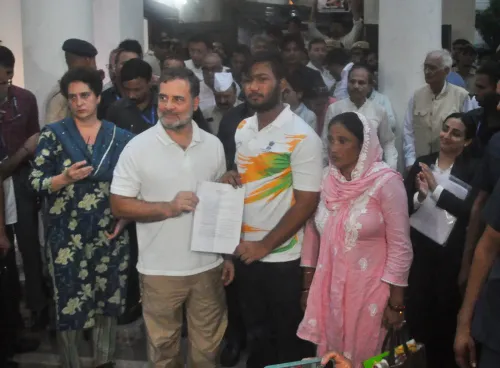
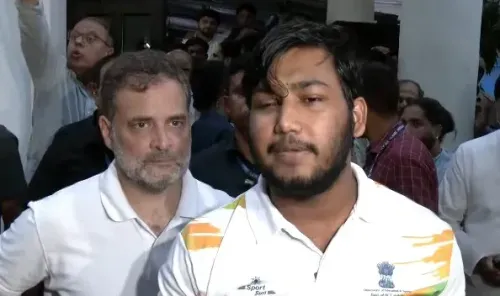
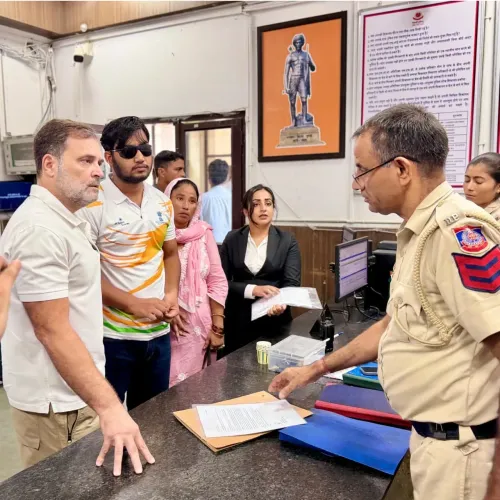
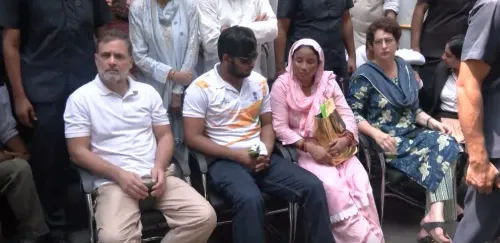
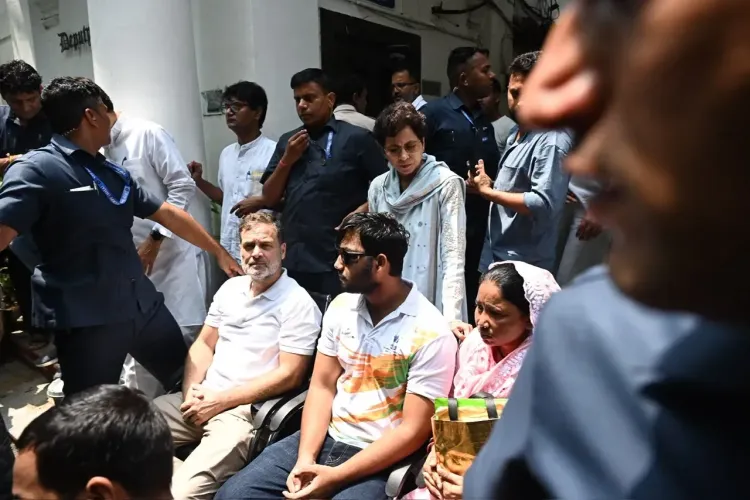
Leader of Opposition Rahul Gandhi visited the Parliament Street Police Station in New Delhi on Friday, 21 August, accompanied by the alleged pellet gun victim, to press for registration of a First Information Report (FIR) into the firing of pellet guns by Delhi Police on protesting students at Jantar Mantar on 20 July. The visit marks a sharp escalation in the political confrontation over the use of force against student demonstrators.
What Rahul Gandhi Did at the Police Station
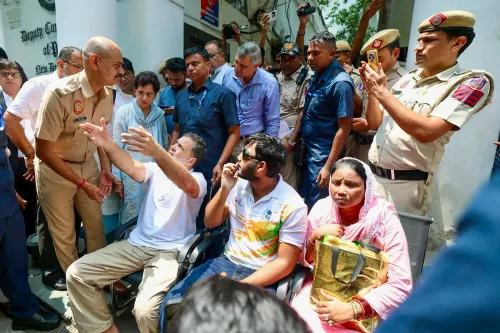
Gandhi first proceeded to the Mandir Marg Police Station to meet the Deputy Commissioner of Police (DCP), before moving to the Parliament Street Police Station, which holds jurisdiction over the Jantar Mantar area. According to reports, he directly questioned the DCP on why no police case had been registered over the pellet firing — a cognisable offence under Indian law — and demanded to know who authorised the lathi-charge and pellet gun deployment against the students.
Notably, the Congress party stated that the victim, identified as Sahil Lochav, had approached Delhi Police on 14 August with lawyers and submitted a written complaint, but was denied an Investigating Officer (I/O) number. Follow-up attempts on 17 August via email and phone also went unacknowledged, according to the party's statement.
Congress Alleges Deliberate Inaction by Delhi Police
'On 14th, Sahil Lochav went with his lawyers to Delhi Police and gave a written complaint. They refused to give a I/O number. It was again pursued on 17th with email, phone as well. Again, no I/O number given. No acknowledgement was also given. Now, LoP Rahul Gandhi ji went along with the victim to insist. The DCP is again not giving the case officer and I/O number. As it's a cognisable offence, a FIR also has to be registered, but Delhi Police not doing so,' the Indian National Congress (INC) said in a statement.
Delhi Police has not issued a public response to these allegations. The Congress has maintained that the refusal to register an FIR despite repeated attempts amounts to a dereliction of legal duty.
Background: Jantar Mantar Protests and the Pellet Controversy
The protests at Jantar Mantar on 20 July were held by students demonstrating against alleged paper leaks in competitive examinations, including the NEET controversy. The use of pellet guns — typically associated with crowd control in conflict zones — against student protesters drew immediate criticism from the Opposition. Gandhi had earlier publicly displayed the victim's pellet injuries to the media and demanded accountability from the Centre on who ordered the use of such force.
The Congress has also raised concerns about alleged harassment of women students by police personnel during the NEET protests in Delhi, broadening the campaign beyond the pellet gun incident.
Political Context: 'Chhatron ki Goonj' Campaign
Gandhi's visit to the police station comes a day before the third edition of his 'Chhatron ki Goonj' student outreach campaign, scheduled for 22 August in Pune. The Congress MP is set to address a student gathering there, where the issue of alleged police excesses against protesters is expected to feature prominently. The timing underscores the Congress party's strategy of sustaining pressure on the Centre over its handling of student unrest.
What Happens Next
As of Friday evening, no FIR had been registered, according to Congress. Legal experts note that under the Code of Criminal Procedure, police are obligated to register an FIR for cognisable offences. If Delhi Police continues to decline, the victim's legal team could approach a magistrate directly under Section 156(3) of the CrPC. The standoff is likely to remain a flashpoint in the ongoing political battle between the Opposition and the Centre over student protests.
Point of View
Delhi Police has no discretion to decline an FIR for a cognisable offence; the obligation is statutory. The fact that three documented attempts by the victim went unacknowledged points either to institutional defiance or deliberate stonewalling — both of which demand scrutiny beyond the political noise. Gandhi's visit is calibrated opposition strategy, but the underlying legal question stands independent of the politics: why has no FIR been filed? That question has not been answered by Delhi Police, and mainstream coverage has largely treated this as a Congress-versus-BJP story rather than a due-process story.
NationPress
5 Oct 2026
Frequently Asked Questions
Why did Rahul Gandhi visit Parliament Street Police Station on 21 August?
Rahul Gandhi visited Parliament Street Police Station to demand the registration of an FIR into the firing of pellet guns by Delhi Police on student protesters at Jantar Mantar on 20 July. He was accompanied by the alleged victim, Sahil Lochav, and questioned the DCP on why no case had been lodged despite it being a cognisable offence.
Who is Sahil Lochav and what happened to him?
Sahil Lochav is identified as the victim of pellet gun firing during the student protests at Jantar Mantar on 20 July. According to the Congress party, he approached Delhi Police at least twice — on 14 August and 17 August — to file a complaint, but was denied an Investigating Officer number and received no acknowledgement.
What is the legal basis for demanding an FIR in this case?
Under the Code of Criminal Procedure, police are legally obligated to register an FIR for cognisable offences without delay. The Congress argues that firing pellet guns on civilians constitutes a cognisable offence, making FIR registration mandatory rather than discretionary.
What is the 'Chhatron ki Goonj' campaign?
'Chhatron ki Goonj' is a student outreach initiative led by Rahul Gandhi. The third edition is scheduled for 22 August in Pune, where Gandhi is expected to address students and continue his criticism of the Centre's handling of student protests, including the alleged use of excessive force.
What were the Jantar Mantar protests about?
The protests at Jantar Mantar on 20 July were organised by students demonstrating against alleged paper leaks in competitive examinations, including irregularities linked to the NEET examination. Delhi Police's use of pellet guns and lathi-charges during these protests triggered the ongoing controversy.