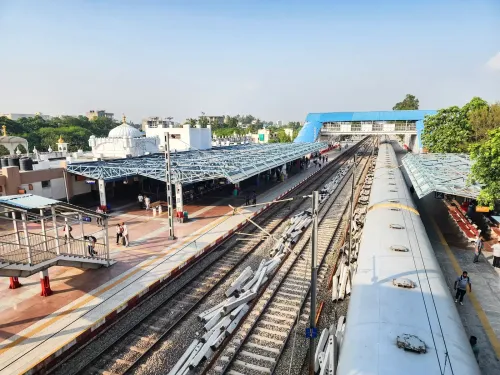
Indian Railways sanctions ₹447.58 crore to upgrade traction systems on two key corridors
Synopsis
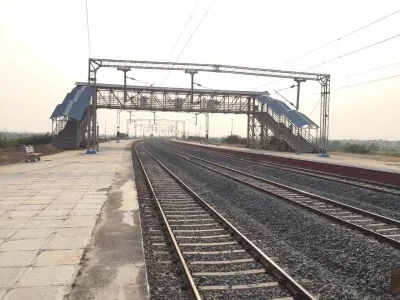
Indian Railways has cleared ₹447.58 crore to convert two high-traffic corridors — Bengaluru-Tumkur and Mahbubnagar-Secunderabad-Medchal — from the older 1x25 kV traction to the more powerful 2x25 kV system. The move signals a targeted push to raise freight and passenger capacity on some of southern India's busiest rail routes without laying new track.
Key Takeaways
Indian Railways sanctioned ₹447.58 crore on 8 June for two electric traction upgrade projects.
The Bengaluru-Tumkur section ( 120 km , South Western Railway) will cost ₹162.57 crore .
The Mahbubnagar-Secunderabad-Medchal section ( 141 km , South Central Railway) will cost ₹285.01 crore .
Both corridors will be upgraded from 1x25 kV to 2x25 kV electric traction systems.
The Bengaluru-Tumkur section is part of HUN Route-10 ; the Mahbubnagar-Secunderabad-Medchal section is on a designated High-Density Network (HDN) route.
Upgrades are expected to support heavier freight trains, longer passenger services, and improved traction reliability on both corridors.
Indian Railways has sanctioned two projects worth a combined ₹447.58 crore to upgrade the existing 1x25 kV electric traction system to the more advanced 2x25 kV electric traction system on busy rail corridors in Karnataka and Telangana, according to a statement issued by the Ministry of Railways on Monday, 8 June. The upgrades cover a total of 261 track kilometres across two zones and are part of the national rail network's broader infrastructure modernisation drive.
The Two Projects at a Glance
The first project covers the 120 km Bengaluru-Tumkur section under South Western Railway, sanctioned at ₹162.57 crore. The second covers the 141 km Mahbubnagar-Secunderabad-Medchal section under South Central Railway, sanctioned at ₹285.01 crore. Both involve converting the older single-supply traction architecture to a dual-supply system capable of handling greater power loads.
Why the Bengaluru-Tumkur Upgrade Matters
The Bengaluru-Tumkur corridor is described by the Ministry as part of the strategically important Highly Utilised Network (HUN) Route-10, which links major economic and industrial centres along the Pune-Hubballi-Chikjajur-Birur-Tumkur-Bengaluru-Salem-Kanniyakumari corridor — one of Karnataka's busiest rail arteries. The upgraded 2x25 kV system is expected to support heavier freight trains and longer passenger services while easing congestion in the Bengaluru metropolitan region and adjoining districts.
Significance of the Mahbubnagar-Secunderabad-Medchal Section
The Mahbubnagar-Secunderabad-Medchal section falls within a designated High-Density Network (HDN) route on the Dharmavaram-Dhone-Mahbubnagar-Secunderabad-Medchal-Mudkhed-Indore-Ajmer corridor, which carries substantial passenger and freight traffic across Telangana and beyond. The Ministry said the new traction system will deliver a more stable and efficient power supply, making rail services 'smoother, safer and more reliable.'
Operational and Economic Impact
The 2x25 kV architecture provides a more robust power supply by using autotransformers at intermediate points, reducing voltage drops and enabling trains to run at higher speeds with heavier loads. Upon completion of both projects, freight movement on the two corridors is expected to become faster and more capacity-efficient, supporting trade and industrial activity across southern India. This is consistent with Indian Railways' stated goal of increasing network throughput on high-density routes without adding new track.
Broader Context
The two sanctions are part of a wider push by Indian Railways to modernise electrical traction infrastructure across the country. The network has been progressively phasing out older traction configurations on its busiest corridors to accommodate the heavier axle loads required for freight growth targets and the higher power demands of semi-high-speed passenger services. Both projects are expected to deliver measurable gains in reliability once commissioned.
Point of View
But the choice of corridors is telling — both Bengaluru-Tumkur and Mahbubnagar-Secunderabad are capacity-constrained routes where traction limitations, not just track availability, throttle throughput. Upgrading to 2x25 kV is a relatively low-cost intervention that can meaningfully raise the ceiling for freight axle loads and semi-high-speed passenger services without the lead time of new-line construction. The real question is execution pace: Indian Railways has a long pipeline of sanctioned electrical projects, and commissioning timelines routinely slip. Whether these upgrades are prioritised alongside track-doubling and signalling work on the same corridors will determine whether the capacity gains are actually realised.
NationPress
24 Oct 2026
Frequently Asked Questions
What are the two railway traction upgrade projects sanctioned by Indian Railways?
Indian Railways has sanctioned the upgrade of the 120 km Bengaluru-Tumkur section under South Western Railway at ₹162.57 crore, and the 141 km Mahbubnagar-Secunderabad-Medchal section under South Central Railway at ₹285.01 crore. Both projects convert the existing 1x25 kV electric traction system to the more advanced 2x25 kV system.
What is the difference between 1x25 kV and 2x25 kV electric traction?
The 2x25 kV system uses autotransformers at intermediate points to supply power, which reduces voltage drops along the line compared to the older 1x25 kV single-supply setup. This allows trains to draw more power, supporting heavier freight loads and higher operational speeds with greater reliability.
Why is the Bengaluru-Tumkur rail section strategically important?
The Bengaluru-Tumkur section is part of HUN Route-10, a Highly Utilised Network corridor linking major economic and industrial centres along the Pune-Hubballi-Chikjajur-Birur-Tumkur-Bengaluru-Salem-Kanniyakumari axis. It is one of Karnataka's busiest rail routes, serving the Bengaluru metropolitan region and adjoining districts.
Which corridor does the Mahbubnagar-Secunderabad-Medchal section belong to?
It falls on the Dharmavaram-Dhone-Mahbubnagar-Secunderabad-Medchal-Mudkhed-Indore-Ajmer High-Density Network (HDN) corridor, which carries significant passenger and freight traffic across Telangana and central India.
What benefits are expected once the traction upgrades are completed?
Both sections are expected to handle heavier freight trains and longer passenger services with improved power stability and reliability. The upgrades are also projected to ease congestion, boost freight speed and capacity, and support broader economic and industrial activity across southern India.