CM Bhajanlal Sharma Approves Rajasthan Industrial Development Policy
Synopsis
Rajasthan's cabinet, chaired by Chief Minister Bhajanlal Sharma, approved the Rajasthan Industrial Development Policy on 23 May 2026, aiming to transform the state into a global industrial hub aligned with the Viksit Rajasthan @ 2047 vision and India's broader Viksit Bharat 2047 development roadmap.
Key Takeaways
The Rajasthan cabinet approved the Rajasthan Industrial Development Policy at a meeting chaired by CM Bhajanlal Sharma on 23 May 2026 .
The policy's stated objective is to make Rajasthan a global industrial hub .
The approval is aligned with the Viksit Rajasthan @ 2047 state vision document and the national Viksit Bharat 2047 framework.
The new policy succeeds the earlier Rajasthan Industrial Policy 2019 .
Key stakeholders include industrial investors , MSMEs , and the manufacturing workforce across the state.
Rollout notifications, investor summits, and potential PLI scheme linkages are expected to follow the cabinet approval.
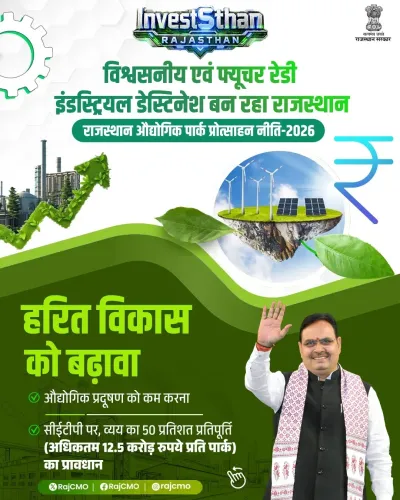
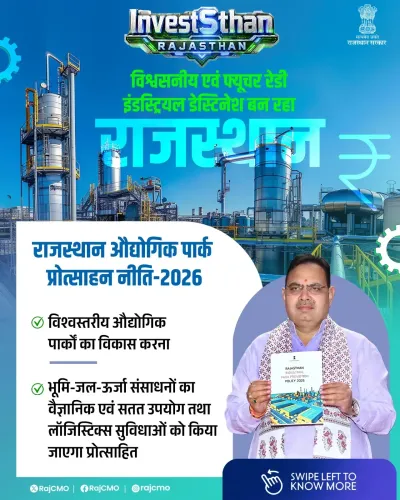
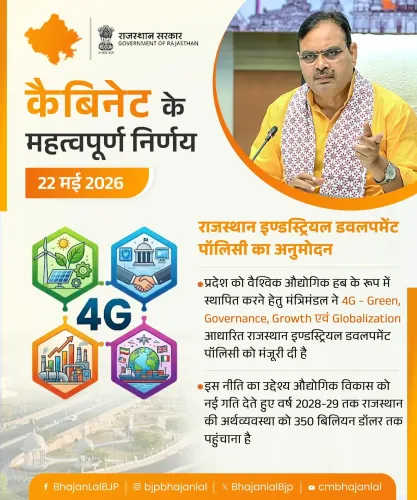
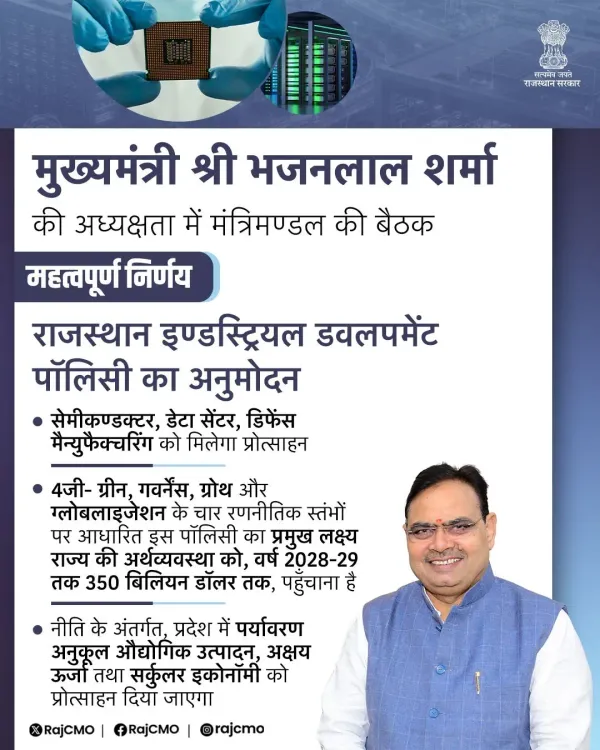
The Chief Minister's Office of Rajasthan announced on Saturday, 23 May 2026 that a cabinet meeting chaired by Chief Minister Bhajanlal Sharma approved the Rajasthan Industrial Development Policy, aimed at positioning the state as a global industrial hub in line with the Viksit Rajasthan @ 2047 vision.
The official post stated: 'mantrimandal ki baithak mein... Rajasthan Industrial Development Policy ka anumodan kiya gaya' — 'In the cabinet meeting... the Rajasthan Industrial Development Policy was approved' — with the explicit objective of making the state a global industrial hub consistent with the Viksit Rajasthan @ 2047 vision document.
Context
The approval came at a cabinet meeting held at the Chief Minister's Office in Jaipur, presided over by CM Bhajanlal Sharma. The decision signals the BJP-led Rajasthan government's intent to anchor its economic agenda around a long-term industrial transformation framework. The policy is framed around the hashtag #AapnoAgrani Rajasthan — 'Our Leading Rajasthan' — reflecting the administration's branding of the initiative.
Policy Backdrop
The Rajasthan Industrial Development Policy succeeds the earlier Rajasthan Industrial Policy 2019, which had targeted MSME growth and investment attraction across thrust sectors. The new policy is explicitly aligned with Viksit Bharat 2047, the national vision articulated by the Government of India for developed-country status by the centenary of independence. States across India have progressively updated their industrial frameworks to synchronise with national manufacturing and foreign direct investment targets under the Atmanirbhar Bharat initiative and the Make in India programme launched in 2014.
Rajasthan, with its strategic geography bordering Pakistan and proximity to Delhi-Mumbai Industrial Corridor nodes, has been a focus state for industrial decentralisation. The post-2023 BJP government under Sharma has consistently positioned industrial policy as a centrepiece of its governance agenda since taking office in December 2023.
Stakeholders and Impact
The policy is expected to affect a wide range of economic actors, including industrial investors, micro, small and medium enterprises (MSMEs), and the broader manufacturing workforce in Rajasthan. A globally oriented industrial policy typically carries provisions for land allocation, infrastructure development, fiscal incentives, and ease-of-doing-business reforms, though the specific provisions of this policy have not been made public in the cabinet announcement.
Rajasthan's large geography and relatively lower industrialisation compared to peer states such as Gujarat and Maharashtra make it a candidate for greenfield industrial investment, particularly in sectors such as renewable energy, defence manufacturing, and textiles — areas the state has previously identified as priorities.
What's Next
Following cabinet approval, the government is expected to issue rollout notifications detailing sector-specific incentives, eligibility criteria, and implementation timelines. Investor summits — a signature event format used by the Rajasthan government to attract commitments — may be convened to showcase the policy to domestic and international investors. Potential linkages with central Production-Linked Incentive (PLI) schemes could further amplify the policy's reach if formally integrated into the framework.
The approval of the Rajasthan Industrial Development Policy marks a formal legislative-executive step toward the state's 2047 industrial ambitions, but the measure of its success will ultimately rest on investment commitments, job creation, and effective on-ground implementation in the years ahead.
Point of View
Signalling that industrial transformation — not just welfare delivery — will define the BJP administration's economic identity in Rajasthan. Framing the policy around the 2047 horizon is a deliberate alignment with the Centre's Viksit Bharat narrative, a pattern seen across BJP-governed states seeking to demonstrate ideological and developmental coherence with New Delhi. The real test will come at the implementation stage: Rajasthan has historically struggled to convert policy ambition into sustained industrial growth, and investors will watch for concrete incentive structures and infrastructure commitments. If the government follows up with a high-profile investor summit and measurable FDI targets, this policy could become a defining economic plank ahead of the next state electoral cycle.
NationPress
6 Oct 2026
Frequently Asked Questions
What is the Rajasthan Industrial Development Policy?
The Rajasthan Industrial Development Policy is a state-level policy framework approved by the Rajasthan cabinet on 23 May 2026, aimed at making Rajasthan a global industrial hub in alignment with the Viksit Rajasthan @ 2047 vision.
Who approved the Rajasthan Industrial Development Policy?
The policy was approved by the Rajasthan cabinet at a meeting chaired by Chief Minister Bhajanlal Sharma at the Chief Minister's Office in Jaipur on 23 May 2026.
What is Viksit Rajasthan 2047?
Viksit Rajasthan @ 2047 is the Rajasthan government's long-term vision document aligned with the national Viksit Bharat 2047 goal of achieving developed-economy status by the centenary of India's independence.
How does the new Rajasthan industrial policy differ from the 2019 policy?
The Rajasthan Industrial Development Policy 2026 succeeds the Rajasthan Industrial Policy 2019 and is explicitly oriented toward a global industrial hub objective tied to the 2047 development vision, whereas the 2019 policy focused primarily on MSME growth and investment attraction in thrust sectors.
What happens after the Rajasthan Industrial Development Policy is approved?
Following cabinet approval, the government is expected to issue rollout notifications with detailed incentives and timelines, and may hold investor summits to attract domestic and international investment commitments.