Rajasthan CM Bhajan Lal Flags Western DFC as Economic Pillar
Synopsis
The Chief Minister's Office of Rajasthan has positioned the Western Dedicated Freight Corridor as a cornerstone of the state's economic progress, with CM Bhajan Lal Sharma cited in a post highlighting the corridor's role in boosting industrial connectivity and logistics across the state.
Key Takeaways
The Chief Minister's Office of Rajasthan on 22 June 2026 publicly described the Western Dedicated Freight Corridor as a critical foundation of the state's economic progress.
The post tagged Chief Minister Bhajan Lal Sharma and was shared under the campaign hashtag #आपणो_अग्रणी_राजस्थान ('Our Pioneering Rajasthan').
The Western DFC traces its origins to the Union Railway Budget of 2005-06 and received Cabinet approval in 2006 , with alignment running through Jodhpur and Jaipur divisions.
The corridor is built and operated by the Dedicated Freight Corridor Corporation of India (DFCCI) and forms part of the PM Gati Shakti multimodal infrastructure framework.
Key beneficiaries in Rajasthan include industries in textiles, cement, chemicals and agro-processing, as well as logistics operators and export-oriented SMEs.
Future focus will be on commissioning of remaining corridor sections and Rajasthan government announcements on linked industrial parks and investment incentives.
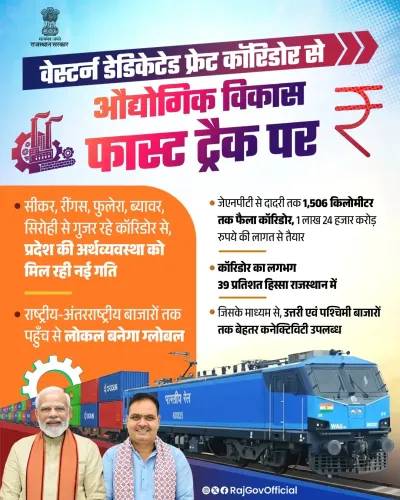
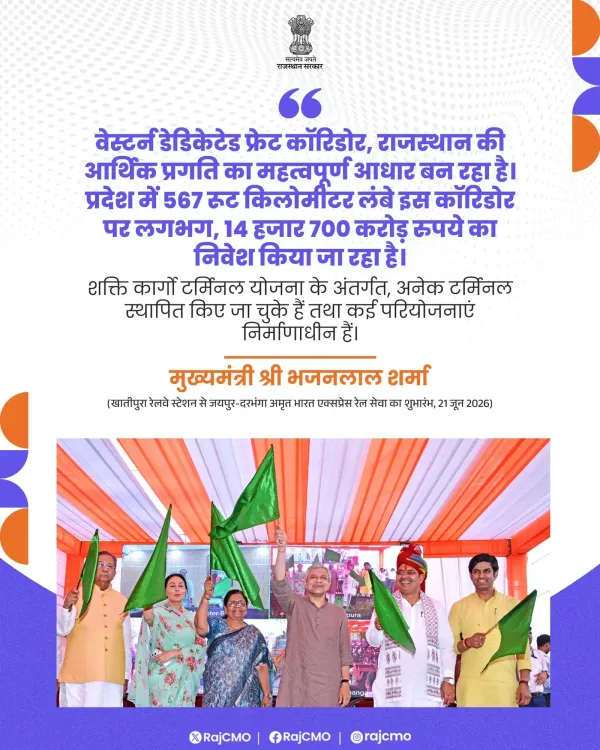
The Chief Minister's Office of Rajasthan on Monday, 22 June 2026, highlighted the Western Dedicated Freight Corridor (Western DFC) as a critical foundation of the state's economic progress, invoking Chief Minister Bhajan Lal Sharma in a post on X that carried the hashtag #आपणो_अग्रणी_राजस्थान ('Our Pioneering Rajasthan').
The post, shared from the official @RajCMO handle, stated in Hindi: 'वेस्टर्न डेडिकेटेड फ्रेट कॉरिडोर, राजस्थान की आर्थिक प्रगति का महत्वपूर्ण आधार बन रहा है' — 'The Western Dedicated Freight Corridor is becoming an important foundation of Rajasthan's economic progress.' The message positions the corridor as central to the ruling BJP government's vision for the state's development.
Context
The Western Dedicated Freight Corridor is a high-capacity rail freight artery designed to carry goods traffic separately from passenger trains, linking western ports to northern India. Rajasthan sits along a significant stretch of this corridor, with alignment passing through districts under the Jodhpur and Jaipur divisions. The state's position on the route gives it direct access to faster, cheaper freight movement — a factor increasingly cited by the government as a driver of industrial investment. The corridor is built and operated by the Dedicated Freight Corridor Corporation of India (DFCCI), a public sector undertaking under the Union Ministry of Railways. The project traces its origins to the Union Railway Budget of 2005-06, when dedicated freight lines were first proposed to decongest India's overburdened mixed-use rail network. Cabinet approval for the Western DFC followed in 2006, with phased construction and commissioning unfolding over the subsequent two decades.Policy Backdrop
The Western DFC is a constituent of the broader PM Gati Shakti National Master Plan, which seeks to integrate rail, road, port and logistics infrastructure across states to reduce the cost of doing business in India. Rajasthan's industrial zones and emerging logistics hubs are positioned to plug directly into this multimodal network, potentially cutting transit times and freight costs for manufacturers and exporters operating within the state. Chief Minister Bhajan Lal Sharma, who assumed office in December 2023, has consistently foregrounded infrastructure connectivity as a pillar of the state's economic agenda. The CMO's invocation of the Western DFC under the #आपणो_अग्रणी_राजस्थान campaign signals an effort to associate the corridor's national-level benefits with the state government's own development narrative.Stakeholders and Impact
The primary beneficiaries of an operationally mature Western DFC in Rajasthan include industries in sectors such as textiles, cement, chemicals and agro-processing, all of which depend heavily on rail freight. Logistics operators stand to gain from dedicated, time-tabled freight slots that reduce delays caused by passenger-train priority on conventional lines. Small and medium enterprises clustered around corridor-adjacent towns in Jodhpur and Jaipur divisions could see improved access to ports, enabling more competitive export pricing. State and central governments are also watching corridor-linked industrial park development as a measure of how effectively the infrastructure translates into jobs and investment on the ground.What's Next
Attention will now turn to the commissioning status of remaining Western DFC sections and any accompanying announcements from the Rajasthan government on industrial parks, logistics zones or investor incentives tied to corridor access. The CMO's public emphasis on the project suggests further policy communication — and potentially formal investment outreach — anchored around the corridor's expanding footprint in the state. How quickly freight volumes and industrial activity respond will be the real measure of the corridor's promise for Rajasthan's economic trajectory.Point of View
Associating a long-running central infrastructure project with the state BJP government's own development brand. By invoking the Western DFC under the 'Pioneering Rajasthan' campaign, the Bhajan Lal Sharma administration is staking a claim on the corridor's economic dividends ahead of any formal commissioning announcements. This fits a broader pattern across BJP-governed states of weaving national infrastructure programmes into state-level political narratives. The real test will be whether corridor-linked industrial and logistics activity in Rajasthan accelerates in a measurable way that validates the government's framing.
NationPress
22 Jun 2026
Frequently Asked Questions
What is the Western Dedicated Freight Corridor and how does it affect Rajasthan?
The Western Dedicated Freight Corridor is a high-capacity rail line built exclusively for freight, separate from passenger trains, linking western ports to northern India. Rajasthan sits along a key stretch of the corridor, with sections passing through Jodhpur and Jaipur divisions, giving the state improved access to faster and cheaper freight movement for its industries.
Who is Bhajan Lal Sharma and what is his role in Rajasthan's infrastructure push?
Bhajan Lal Sharma is the Chief Minister of Rajasthan, serving since December 2023. He has made infrastructure connectivity a central plank of his government's economic agenda, with the Western DFC featuring prominently in the CMO's public communications.
When was the Western Dedicated Freight Corridor project approved?
The Western Dedicated Freight Corridor was first proposed in the Union Railway Budget of 2005-06 and received formal Cabinet approval in 2006. Construction and commissioning have proceeded in phases over the subsequent two decades.
Which organisation is responsible for building the Western DFC?
The Dedicated Freight Corridor Corporation of India (DFCCI), a public sector undertaking under the Union Ministry of Railways, is responsible for constructing and operating India's dedicated freight corridors, including the Western DFC.
How does the Western DFC connect to PM Gati Shakti?
The Western Dedicated Freight Corridor is a component of the PM Gati Shakti National Master Plan, which integrates rail, road, port and logistics infrastructure across states. For Rajasthan, this means its industrial zones can link into a multimodal network designed to lower logistics costs and improve export competitiveness.