Rajasthan CMO highlights WDFC role in industrial growth
Synopsis
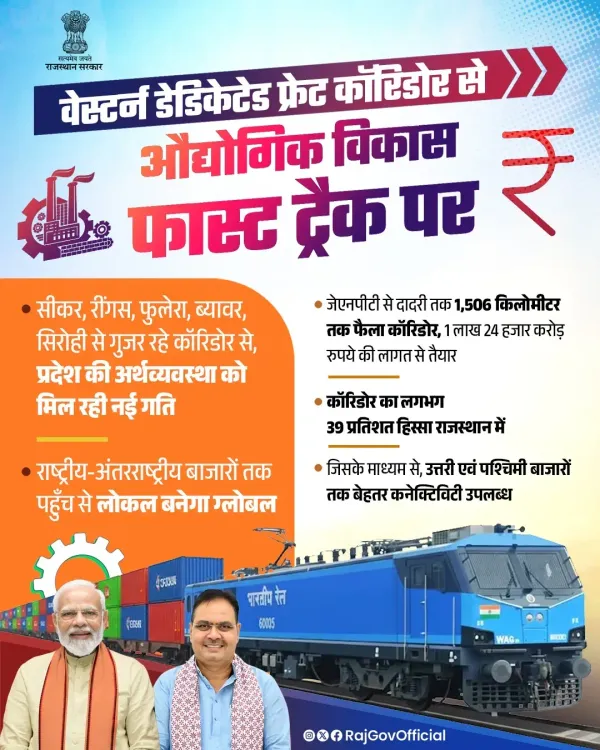
The Chief Minister's Office of Rajasthan on 11 June 2026 highlighted the Western Dedicated Freight Corridor's role in accelerating industrial growth, improving supply chains through rail-on-truck services, and driving employment and social change across urban and rural Rajasthan.
Key Takeaways
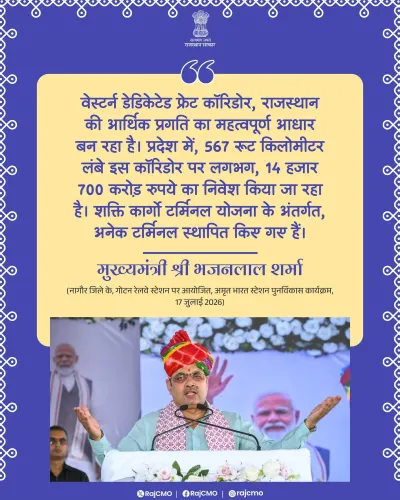
The Rajasthan CMO on 11 June 2026 highlighted the Western Dedicated Freight Corridor (WDFC) as a key driver of the state's industrial and economic development.
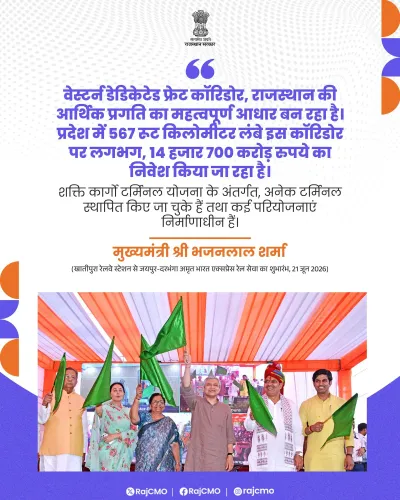
The WDFC spans approximately 1,504 km from JNPT Mumbai to Dadri, Uttar Pradesh , with roughly 600 km passing through Rajasthan.
The corridor's rail-on-truck service was specifically cited for making freight movement faster and more efficient.
The project was approved in 2006 and executed by DFCCIL ; its first commercial run occurred in 2020 .
The WDFC is expected to generate employment and drive social change in both urban and rural areas of Rajasthan.
The corridor is part of India's broader strategy to reduce logistics costs, estimated at 14 per cent of GDP .
The Chief Minister's Office of Rajasthan on Thursday, 11 June 2026, highlighted the transformative role of the Western Dedicated Freight Corridor (WDFC) in accelerating industrial development and strengthening logistics infrastructure across the state. The post underscored how the corridor is reshaping supply chains and creating new economic opportunities in both urban and rural Rajasthan.
Context
The Rajasthan CMO's post, shared under the hashtag #आपणो_अग्रणी_राजस्थान ('Our Leading Rajasthan'), stated that industrial development across the country and the state is 'moving fast on a fast track' through the WDFC. It specifically noted that the corridor's rail-on-truck service has made the movement of goods 'faster and smoother,' while also strengthening rail-based logistics infrastructure and improving supply chain reliability.
The post further stated that the corridor 'is ready to bring major social change in urban and rural areas' alongside driving economic growth and increasing employment in Rajasthan.
Policy Backdrop
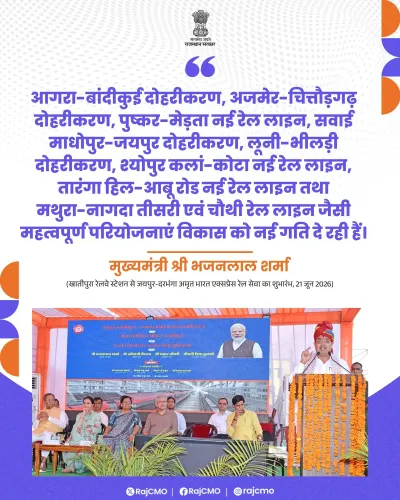
The Western Dedicated Freight Corridor spans approximately 1,504 km, connecting Jawaharlal Nehru Port (JNPT) in Navi Mumbai to Dadri in Uttar Pradesh, with roughly 600 km of its alignment passing through Rajasthan. The project was approved by the Union Cabinet in 2006, following its announcement in the 2005-06 Railway Budget, and is executed by the Dedicated Freight Corridor Corporation of India Ltd (DFCCIL), a wholly-owned public sector undertaking incorporated in October 2006.
The first commercial run on a completed section of the WDFC took place in 2020, with progressive commissioning of segments including the Rewari-Dadri stretch. The corridor is designed exclusively for freight trains, allowing them to operate at higher average speeds than on shared tracks, directly addressing India's logistics cost burden — estimated at around 14 per cent of GDP.
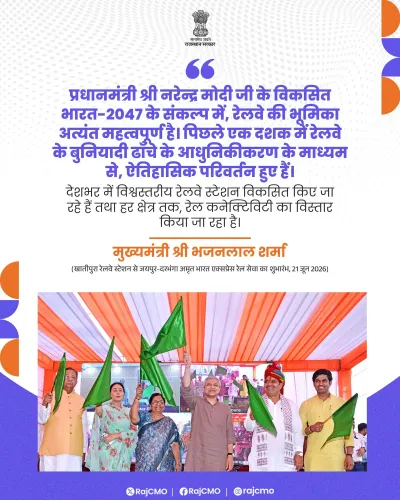
The WDFC is a core component of India's broader freight modernisation strategy, which also includes the Eastern Dedicated Freight Corridor and the PM Gati Shakti multimodal connectivity initiative launched in 2021. Rajasthan's sections are positioned to serve emerging industrial nodes and port-linked supply chains connecting the state's interior to maritime trade routes.
Stakeholders and Impact
The corridor's beneficiaries span a wide spectrum: industries based in Rajasthan gain faster and more reliable freight movement to ports and northern markets; logistics companies and truck operators benefit from the rail-on-truck model, which reduces road dependency and transit times. The rural workforce stands to gain through employment generated by new industrial activity along the corridor's alignment.
Key sections near Phulera and other Rajasthan junctions are expected to serve as critical nodes for goods originating in the state's textile, mining, and manufacturing sectors. Improved supply chain reliability is seen as a prerequisite for attracting fresh investment into the state's industrial zones.
What's Next
Full commissioning of the remaining WDFC sections and freight volume data from DFCCIL will be closely watched as indicators of the corridor's operational maturity. Integration with Rajasthan's state-level industrial and logistics policies will determine how effectively the infrastructure translates into measurable employment and investment outcomes. The CMO's communication signals that the state government intends to keep the WDFC's economic promise at the centre of its development narrative in the months ahead.
Point of View
Positioning Rajasthan as an active beneficiary and partner in national freight modernisation. By foregrounding rural employment and social change alongside logistics efficiency, the messaging broadens the corridor's political appeal beyond industry to ordinary voters. This fits a wider pattern among state governments of amplifying central infrastructure wins as local governance achievements ahead of electoral cycles. The emphasis on rail-on-truck services also signals awareness of last-mile connectivity as the critical gap in realising the corridor's full economic promise.
NationPress
25 Oct 2026
Frequently Asked Questions
What is the Western Dedicated Freight Corridor and how does it affect Rajasthan?
The Western Dedicated Freight Corridor is a 1,504 km rail line exclusively for freight trains, running from JNPT Mumbai to Dadri in Uttar Pradesh. Approximately 600 km of it passes through Rajasthan, making the state a key node for industrial and logistics activity along the route.
What is the rail-on-truck service mentioned by the Rajasthan CMO?
Rail-on-truck is a logistics model where trucks or trailers carrying goods are loaded onto flatbed rail wagons, combining road flexibility with rail efficiency. The Rajasthan CMO cited this service as making freight movement faster and smoother along the WDFC.
When was the Western Dedicated Freight Corridor project approved?
The project was approved by the Union Cabinet in 2006, following its announcement in the 2005-06 Railway Budget. The Dedicated Freight Corridor Corporation of India Ltd (DFCCIL) was incorporated in October 2006 to implement it, with the first commercial run on a completed section in 2020.
How does the WDFC help reduce India's logistics costs?
By separating freight from passenger traffic, the WDFC allows freight trains to run at higher speeds with fewer delays, directly cutting transit times and costs. India's logistics expenditure is estimated at around 14 per cent of GDP, and faster freight movement is central to bringing that figure down.
What employment benefits is the WDFC expected to bring to Rajasthan?
The Rajasthan CMO stated the corridor is positioned to increase employment and bring social change in urban and rural areas by attracting industrial investment to zones along its alignment, particularly benefiting the rural workforce through new economic activity near key junctions such as Phulera.