CM Himanta eyes ₹475 cr shipbuilding push on Assam's waterways
Synopsis
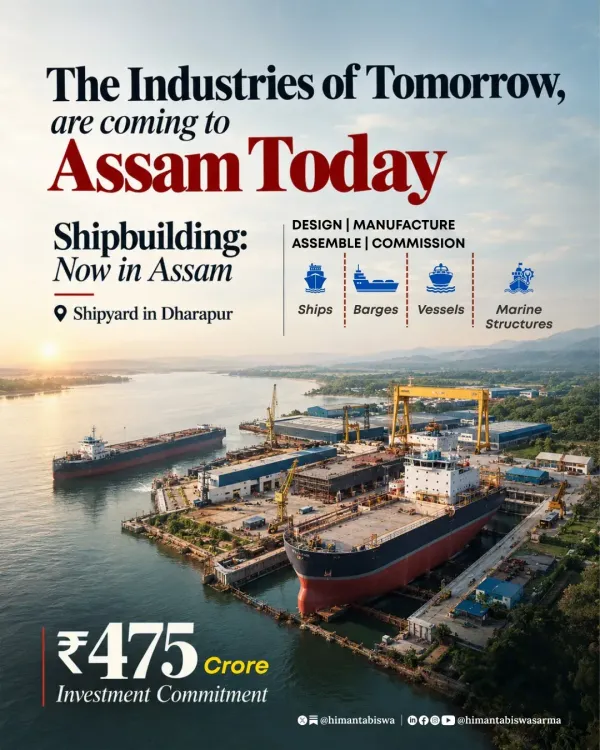
Assam CM Himanta Biswa Sarma has announced a proposed ₹475 crore investment in shipbuilding and vessel maintenance on the Brahmaputra, working with IWAI to turn National Waterway 2 into an inland industrial corridor generating jobs and growth.
Key Takeaways
Assam CM Himanta Biswa Sarma announced a proposed ₹475 crore investment in shipbuilding and vessel maintenance in Assam on 25 October 2026 .
The initiative targets National Waterway 2 , the Brahmaputra stretch declared under the National Waterways Act 2016 .
The Inland Waterways Authority of India (IWAI) has been tagged, indicating active state-centre coordination.
The push aligns with national programmes such as the Jal Marg Vikas Project and Sagarmala aimed at reducing logistics costs along river corridors.
Key next steps include detailed project reports, tendering for shipyard facilities, and formal funding agreements between state and centre.
Assam's rivers may soon carry more than cargo — they could carry an entire industrial ecosystem. Assam Chief Minister Himanta Biswa Sarma announced on Sunday, 25 October 2026 a proposed ₹475 crore investment aimed at establishing shipbuilding and vessel maintenance capacities in the state, tagging the Inland Waterways Authority of India (IWAI) in a post that signals active central coordination.
Brahmaputra as an industrial artery
The announcement is rooted in geography. Assam's Brahmaputra river forms National Waterway 2 (NW-2), one of India's most significant inland water corridors. Declared a national waterway under the National Waterways Act 2016, NW-2 runs through the heart of the Northeast and has long been identified as a logistics artery waiting to be unlocked. A domestic shipbuilding and maintenance hub on its banks would reduce dependence on vessels sourced or repaired outside the region — cutting costs and turnaround times.
Sarma framed the investment in terms of outcomes: 'Turning our waterways into engines of industrial growth, jobs and new opportunities.' The phrasing is deliberate — waterways policy in India has historically struggled to translate infrastructure intent into employment reality, and grounding the pitch in jobs signals the state's awareness of that gap.
IWAI's role and the national waterways framework
IWAI, the statutory body under the Ministry of Ports, Shipping and Waterways, has been the central instrument for developing inland water transport across India. Its involvement here suggests the ₹475 crore proposal is being positioned within a broader state-centre partnership rather than as a standalone state scheme. Successive central governments have advanced inland logistics through flagship programmes including the Jal Marg Vikas Project and the Sagarmala programme, both targeting logistics cost reduction along river and coastal corridors in eastern and northeastern India.
Assam plugging into that national architecture — with a specific shipbuilding angle — is a meaningful escalation. Building and maintaining vessels within the state rather than importing them addresses a real structural constraint for inland water transport in the Northeast.
What comes next: DPRs, tenders, and funding locks
The investment figure of ₹475 crore is proposed at this stage. The critical milestones that will determine whether it moves from announcement to ground-breaking include the release of detailed project reports, tendering for shipyard facilities, and any formal state-central funding agreements for vessel maintenance hubs. Stakeholders — shipbuilding firms and the Assam workforce — will be watching those signals closely.
For a state that has seen infrastructure promises cycle through decades with mixed delivery, the specificity of the number and the IWAI tag are meaningful. Whether the tendering calendar matches the ambition is the story that follows this one.
Point of View
A higher-value proposition. By looping in IWAI publicly, CM Sarma is signalling that this is a co-owned central-state project, which adds credibility and ties it to the broader Sagarmala-Jal Marg ecosystem. The Northeast has long been positioned as India's gateway to Southeast Asia under the Act East Policy, and a domestic vessel-building capacity on NW-2 would materially strengthen that corridor's self-sufficiency. The real test arrives when DPRs and tenders follow — that is when intent becomes infrastructure.
NationPress
25 Oct 2026
Frequently Asked Questions
What is the ₹475 crore Assam waterways investment about?
Assam CM Himanta Biswa Sarma has proposed a ₹475 crore investment to establish shipbuilding and vessel maintenance facilities in Assam, leveraging the Brahmaputra as National Waterway 2 for industrial growth and job creation.
What is National Waterway 2 in Assam?
National Waterway 2 (NW-2) is the Brahmaputra river stretch in Assam, declared a national waterway under the National Waterways Act 2016 to facilitate cargo and passenger inland water transport.
What is IWAI and why is it involved?
The Inland Waterways Authority of India (IWAI) is a statutory body under the Ministry of Ports, Shipping and Waterways responsible for developing national waterways. Its involvement suggests the Assam shipbuilding project will be structured as a state-centre partnership.
How does this project connect to Sagarmala or Jal Marg Vikas?
Both Sagarmala and the Jal Marg Vikas Project are central government programmes targeting logistics cost reduction along river and coastal corridors in eastern and northeastern India — frameworks within which Assam's shipbuilding push is expected to be positioned.
What are the next steps before the Assam shipbuilding project begins?
The critical milestones include release of detailed project reports (DPRs), tendering for shipyard and vessel maintenance facilities, and finalising formal funding agreements between the Assam government and the central government or IWAI.