Rajasthan CM Bhajan Lal Pushes Annual Unorganised Sector Survey
Synopsis
The Chief Minister's Office of Rajasthan announced on 22 June 2026 that CM Bhajanlal Sharma's government is seriously pursuing an annual survey of unorganised sector enterprises, a move aimed at generating granular data to support welfare targeting and formalisation policies for informal workers and micro-enterprises across the state.
Key Takeaways
The Chief Minister's Office of Rajasthan confirmed on 22 June 2026 that the state government is actively working on an annual survey of unorganised sector enterprises.
Chief Minister Bhajanlal Sharma (BJP) has been in office since December 2023 and publicly endorsed the survey initiative.
The exercise follows Rajasthan's participation in the national Sixth Economic Census (2013-14) and its 2021 alignment with the central e-Shram portal .
Similar localised surveys have been launched in Maharashtra and Tamil Nadu since 2022 to support formalisation and credit-linkage for micro-enterprises.
Survey findings are expected to inform welfare scheme eligibility and budget allocations in the next Rajasthan budget session.
Key beneficiaries include informal workers, street vendors, artisans, and micro-enterprises currently outside formal data systems.
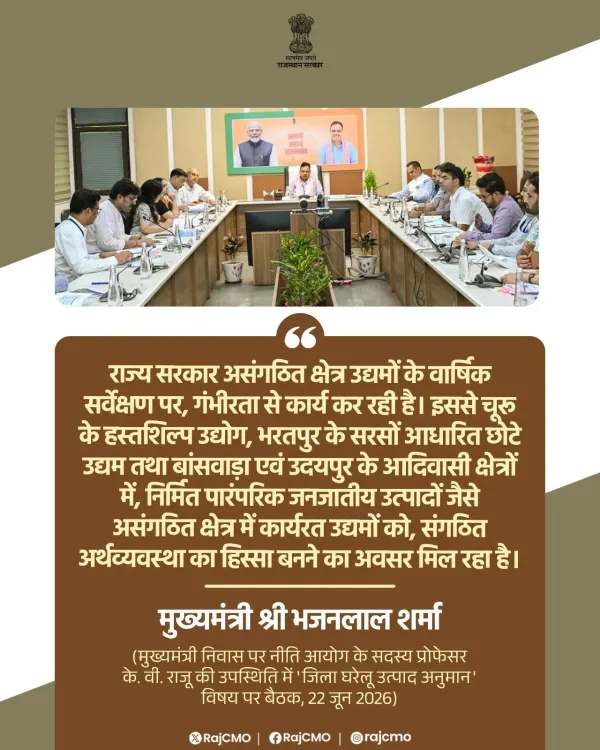
The Chief Minister's Office of Rajasthan announced on Monday, 22 June 2026 that the state government is actively working on an annual survey of unorganised sector enterprises, signalling a renewed push to map the informal economy across the state. The announcement, attributed to Chief Minister Bhajanlal Sharma, was shared under the hashtag #आपणो_अग्रणी_राजस्थान (meaning 'Our Leading Rajasthan').
Context
The post states: 'राज्य सरकार असंगठित क्षेत्र उद्यमों के वार्षिक सर्वेक्षण पर गंभीरता से कार्य कर रही है' — 'The state government is working seriously on the annual survey of unorganised sector enterprises.' The message is brief but pointed, indicating that the exercise is already under way rather than merely being proposed.
The unorganised or informal sector constitutes a dominant share of Rajasthan's workforce, encompassing street vendors, artisans, construction labour, and micro-enterprises that operate outside formal regulatory frameworks. Generating reliable data on these units is a prerequisite for targeted welfare delivery and credit-linkage programmes.
Policy Backdrop
Rajasthan previously participated in the national Sixth Economic Census (2013-14), which enumerated unorganised sector units across the country. In 2021, the state aligned with the central government's e-Shram portal, enabling registration of unorganised workers for social-security benefits.
The current annual survey initiative builds on that data infrastructure. Across India, several state governments — including Maharashtra and Tamil Nadu — have launched similar localised surveys since 2022, aiming to generate granular, district-level data to support formalisation drives and targeted credit schemes for micro-enterprises.
The broader impetus comes from the Periodic Labour Force Survey findings, which have consistently highlighted the scale and vulnerability of informal employment. State-level surveys help fill the gaps that national datasets leave at the sub-district level.
Stakeholders and Impact
Rajasthan is home to a large population of informal workers — from Jaipur's gem-cutting and textile units to agricultural labourers and rural micro-entrepreneurs in districts such as Barmer, Jodhpur, and Udaipur. An annual survey with updated enumeration could directly inform eligibility lists for state welfare schemes, housing benefits, and priority-sector lending targets set for banks operating in the state.
Micro-enterprises that are currently invisible to formal data systems stand to benefit most: survey registration can serve as a gateway to government credit guarantees, skill-development programmes, and social-security coverage. Labour unions and informal-sector advocacy groups have long demanded exactly this kind of systematic, periodic enumeration.
What's Next
The key deliverable to watch is the release of the survey findings and any linked policy announcements — particularly in the next Rajasthan budget session. If the survey data is published with district-level breakdowns, it could reshape how the state allocates welfare spending and frames its economic targets for the informal sector. CM Bhajanlal Sharma's public endorsement of the exercise adds political weight to its completion, making it a benchmark against which the government's delivery on informal-economy promises will be measured.
Point of View
The exercise carries political utility: robust data on informal workers can justify targeted welfare spending ahead of future electoral cycles. The hashtag 'Aapno Agrani Rajasthan' ('Our Leading Rajasthan') signals that the BJP government is framing data governance as part of its development narrative. Whether the survey translates into concrete policy action will depend on the speed of enumeration and the political will to act on findings that may reveal uncomfortable scale of informality.
NationPress
23 Jun 2026
Frequently Asked Questions
What is the Rajasthan unorganised sector survey about?
The Rajasthan government is conducting an annual survey to enumerate and map unorganised sector enterprises — including micro-businesses, street vendors, and artisans — to generate data for welfare targeting and formalisation programmes.
Who announced the Rajasthan unorganised sector enterprise survey?
The Chief Minister's Office of Rajasthan announced it on 22 June 2026, attributing the initiative to Chief Minister Bhajanlal Sharma.
What is the e-Shram portal and how is Rajasthan connected to it?
The e-Shram portal is a central government platform for registering unorganised workers to provide them social-security benefits. Rajasthan aligned with it in 2021, and the current survey builds on that registration infrastructure.
How will the survey benefit informal workers in Rajasthan?
Survey registration can make informal workers and micro-enterprises eligible for government welfare schemes, priority-sector bank credit, skill-development programmes, and social-security coverage that they currently cannot access due to lack of formal data.
Which other states have done similar unorganised sector surveys?
Maharashtra and Tamil Nadu have launched comparable localised surveys of informal enterprises since 2022, aiming to fill data gaps left by national economic censuses and support credit-linkage policies for micro-enterprises.