Rajasthan CM hails diaspora's water conservation push
Synopsis
The Rajasthan CMO praised migrant Rajasthanis for notable contributions to water conservation under the 'Karmabhoomi se Matrubhoomi' campaign. CM Bhajan Lal Sharma's government frames the initiative as participatory governance harnessing diaspora resources to tackle the arid state's chronic water challenges.
Key Takeaways
The Chief Minister's Office of Rajasthan on October 17, 2026 acknowledged migrant Rajasthanis' water conservation contributions under the Karmabhoomi se Matrubhoomi campaign.
The campaign channels the skills and resources of Rajasthan's large out-migrant population toward local development in their home regions.
Water conservation has been specifically highlighted as an area of 'noteworthy' diaspora participation under the drive.
Rajasthan launched the Mukhya Mantri Jal Swavalamban Abhiyan in 2016 , establishing community-led water conservation as a state priority well before this campaign.
CM Bhajan Lal Sharma , in power since December 2023 , has positioned diaspora engagement as a pillar of the BJP government's participatory governance model.
Verified data on specific projects, contribution volumes, and measurable outcomes under the campaign are yet to be officially published.
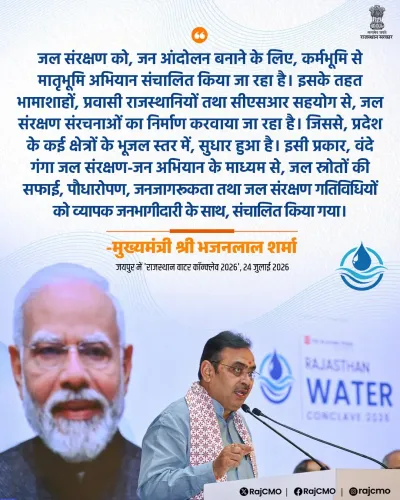
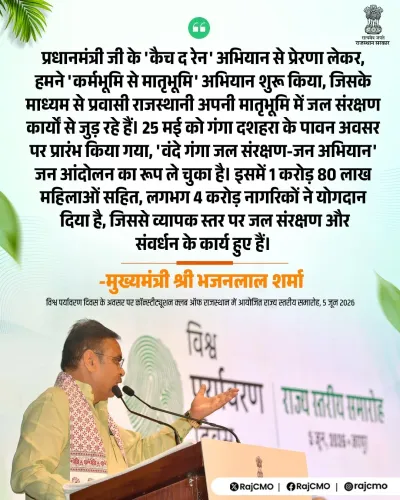
Rajasthan's vast out-migrant community is doing more than sending money home — they are helping save water in one of India's driest states. The Chief Minister's Office of Rajasthan on Saturday, October 17, 2026, highlighted the notable contribution of migrant Rajasthanis to water conservation work through the 'Karmabhoomi se Matrubhoomi' ('From the Land of Work to the Motherland') campaign, tagging Chief Minister Bhajan Lal Sharma in the post.
What the 'Karmabhoomi se Matrubhoomi' campaign asks of migrants
The campaign is a state-run initiative that channels the energy, resources, and civic pride of Rajasthan's large out-migrant population back into their native villages and towns. Rather than leaving local infrastructure to government budgets alone, it invites migrants — whether working in Mumbai, Surat, or abroad — to co-fund and co-build development projects in their home districts. Water conservation, given Rajasthan's chronic aridity, has emerged as a priority sector under the drive.
The Saturday post specifically flagged water conservation as an area where migrant contributions have been 'ullekhneey' — noteworthy or remarkable — signalling that the campaign is generating on-ground results beyond routine participation.
Rajasthan's long history of community water action
This is not the first time Rajasthan has bet on community participation to address its water crisis. The state launched the Mukhya Mantri Jal Swavalamban Abhiyan in 2016, a flagship programme aimed at making villages water self-sufficient through decentralised conservation structures — check dams, bunds, and recharge pits. That campaign drew on local labour and community funding alongside state resources, establishing a template that 'Karmabhoomi se Matrubhoomi' now extends to the diaspora dimension.
Successive Rajasthan governments have treated the state's enormous out-migrant workforce not as a demographic challenge but as a diaspora asset. Remittances flowing into the state are substantial; the harder task has always been directing those flows toward public goods like water infrastructure rather than private consumption alone.
CM Bhajan Lal Sharma and the BJP's participatory governance pitch
Bhajan Lal Sharma, who has led the state since December 2023, has framed such diaspora-engagement campaigns as part of a broader 'participatory governance' approach — the idea that citizens, not just the state, must co-own development outcomes. The hashtag #आपणो_अग्रणी_राजस्थान ('Our Leading Rajasthan') used in the post is a recurring slogan in the government's communications, signalling a pride-and-progress narrative built for both the home electorate and the diaspora audience.
Measuring the actual scale of migrant-led water conservation remains a work in progress. Official reports on verifiable outcomes — how many structures built, how many villages reached, how many litres conserved — will determine whether the campaign's ambition translates into durable impact.
In a state where water is existential, turning every migrant into a stakeholder in conservation is not just a political idea. It is an engineering bet on belonging.
Point of View
Water security, in a state where that need is both urgent and visceral. For the Bhajan Lal Sharma government, success here would validate a model that is part civic mobilisation, part fiscal ingenuity. The real test, however, is accountability: campaigns that lack transparent outcome reporting tend to fade into good-intention territory without structural change.
NationPress
17 Oct 2026
Frequently Asked Questions
What is the 'Karmabhoomi se Matrubhoomi' campaign in Rajasthan?
'Karmabhoomi se Matrubhoomi' is a Rajasthan government initiative that encourages migrants from the state — working in other Indian cities or abroad — to contribute resources and skills toward development projects in their native home areas, including water conservation.
Who is Rajasthan Chief Minister Bhajan Lal Sharma?
Bhajan Lal Sharma is the BJP Chief Minister of Rajasthan, in office since December 2023 . He has championed diaspora engagement and participatory governance as key themes of his administration.
What is the Mukhya Mantri Jal Swavalamban Abhiyan?
The Mukhya Mantri Jal Swavalamban Abhiyan was launched in 2016 to make Rajasthan villages water self-sufficient through community-built conservation structures such as check dams and recharge pits. It established the state's template for participatory water conservation.
Why does Rajasthan focus so much on water conservation?
Rajasthan is India's largest state by area and largely arid, making water scarcity a chronic and existential challenge. Successive governments have pursued community and diaspora-led conservation programmes to supplement state infrastructure investment.
What does #आपणो_अग्रणी_राजस्थान mean?
The hashtag translates to 'Our Leading Rajasthan' in English. It is a recurring slogan used by the current Rajasthan government in official communications to project a narrative of pride, progress, and development.