Rajasthan CMO highlights Jal Sanchay, Jan Bhagidari for water conservation
Synopsis
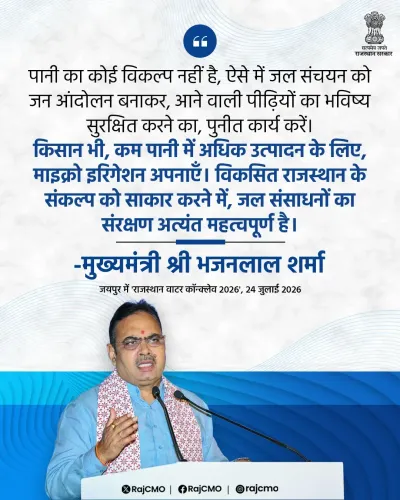
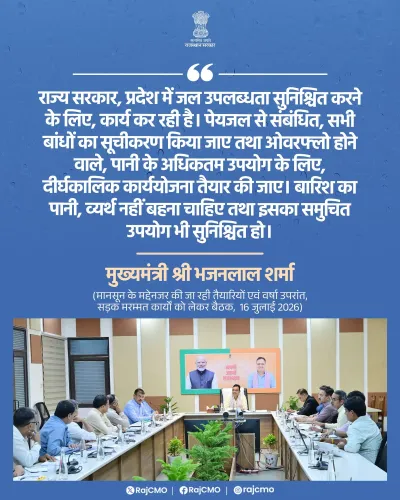
The Chief Minister's Office of Rajasthan on July 5, 2026 highlighted 'Jal Sanchay, Jan Bhagidari', a community-driven water conservation initiative, as a key driver in tackling the state's chronic water scarcity, linking the effort to PM Modi's national Viksit Bharat development vision.
Key Takeaways
The Chief Minister's Office of Rajasthan posted on July 5, 2026 spotlighting Jal Sanchay, Jan Bhagidari as a major water conservation driver in the state.
Rajasthan is India's largest state and one of its most water-stressed, with arid and semi-arid zones covering much of its territory.
The initiative focuses on community participation in rainwater harvesting and groundwater recharge, not just government-built infrastructure.
The post was tagged to PM Narendra Modi and linked to the #PMModi4ViksitRajasthan and Viksit Bharat narratives.
The programme builds on earlier schemes including Mukhya Mantri Jal Swavalamban Abhiyan (2016) and the central government's Jal Shakti Abhiyan (2019) .
Primary beneficiaries are farmers and rural households across Rajasthan's drought-prone districts.
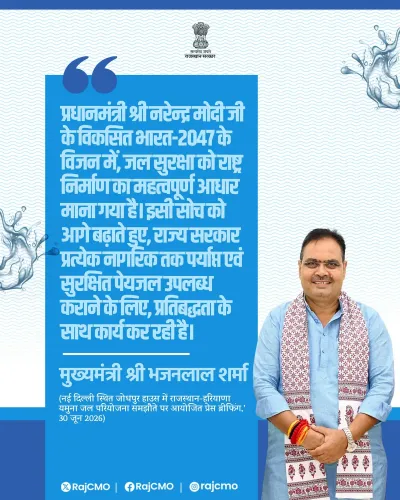
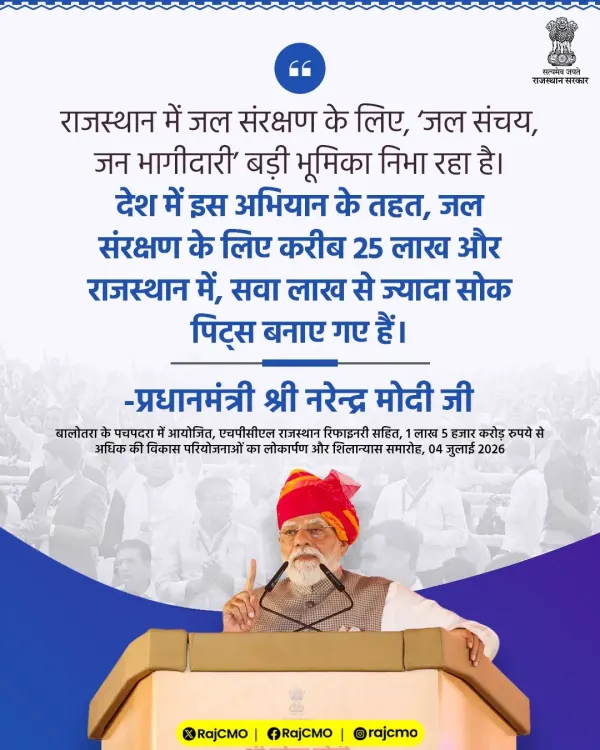
The Chief Minister's Office of Rajasthan on Sunday, July 5, 2026, spotlighted the state's community-driven water conservation initiative 'Jal Sanchay, Jan Bhagidari', crediting it with playing a major role in addressing Rajasthan's chronic water scarcity. The post also tagged Prime Minister Narendra Modi, framing the effort within the broader national development vision.
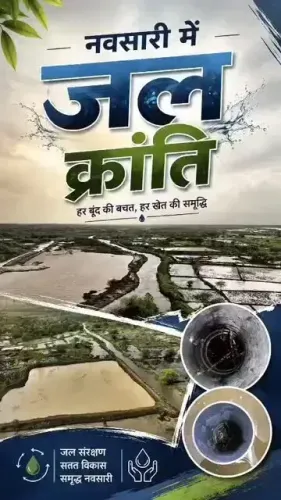
The official post stated, 'राजस्थान में जल संरक्षण के लिए, जल संचय, जन भागीदारी बड़ी भूमिका निभा रहा है' — ('For water conservation in Rajasthan, Jal Sanchay, Jan Bhagidari is playing a big role') — and was hashtagged under #PMModi4ViksitRajasthan and #आपणो_अग्रणी_राजस्थान (Our Leading Rajasthan), signalling alignment with the Viksit Bharat national development narrative.
Context
Rajasthan is India's largest state by area and one of its most water-stressed, with large swathes of its territory falling in arid and semi-arid zones. Erratic monsoons and depleting groundwater tables have long placed pressure on both agricultural communities and rural households that depend on seasonal water sources. The state has historically relied on traditional water harvesting structures — stepwells, johads, and check dams — alongside government-led programmes to manage this scarcity. The 'Jal Sanchay, Jan Bhagidari' initiative emphasises community participation in rainwater harvesting and groundwater recharge, positioning citizens as active stakeholders rather than passive recipients of infrastructure. By tagging PM Modi, the CMO post explicitly links the state programme to the central government's water conservation agenda.Policy Backdrop
The initiative builds on a layered policy lineage. In 2016, Rajasthan launched the Mukhya Mantri Jal Swavalamban Abhiyan, aimed at achieving village-level water self-reliance through the construction of check dams, tanks, and other harvesting structures. At the national level, the central government launched the Jal Shakti Abhiyan in 2019 to promote water conservation and public participation across states, with Rajasthan among the priority targets given its aridity. The Atal Bhujal Yojana, another central scheme, further reinforced the shift toward community-managed aquifer conservation. Together, these programmes reflect a deliberate national policy turn — away from reliance solely on large irrigation infrastructure and toward decentralised, people-led water management in drought-prone regions.Stakeholders and Impact
Farmers and rural households across Rajasthan's arid districts stand as the primary beneficiaries of water conservation programmes. For farming communities, improved groundwater recharge directly affects crop viability and reduces dependence on erratic rainfall. For rural households, especially women who bear the burden of water collection in many villages, local water availability has direct quality-of-life implications. The framing of the CMO post — invoking public participation ('Jan Bhagidari') alongside storage ('Jal Sanchay') — also signals a governance philosophy that seeks to build community ownership of natural resource management, a model that has shown results in comparable arid regions when sustained over multiple seasons.What's Next
The post's hashtag alignment with #PMModi4ViksitRajasthan suggests the state government intends to position its water conservation record as a pillar of its development credentials ahead of future political and budgetary cycles. Observers will watch the next Rajasthan budget session for announcements on expanded funding for water harvesting structures or measurable targets under Jal Sanchay, Jan Bhagidari. A formal impact assessment of the programme — covering the number of structures built, villages covered, and groundwater levels — would be a key indicator of whether community participation has translated into measurable hydrological outcomes.Point of View
The messaging pivots from a top-down infrastructure story to a people-led conservation model, which carries stronger electoral resonance in rural constituencies. The explicit tagging of PM Modi also signals the state's intent to claim credit within the broader Viksit Bharat framework, making water conservation a shared political asset. Whether the programme's on-ground impact matches the communication will be the test that follows.
NationPress
3 Oct 2026
Frequently Asked Questions
What is Jal Sanchay Jan Bhagidari in Rajasthan?
'Jal Sanchay, Jan Bhagidari' is a Rajasthan government initiative that emphasises community participation in rainwater harvesting and groundwater recharge to address the state's chronic water scarcity.
Why is water conservation important for Rajasthan?
Rajasthan is India's largest state and largely arid or semi-arid, making it one of the most water-stressed regions in the country. Erratic monsoons and depleting groundwater affect both farming and drinking water access for rural communities.
How does Jal Sanchay Jan Bhagidari relate to PM Modi's water schemes?
The Rajasthan CMO post linked the initiative to PM Narendra Modi's national water conservation agenda, including the centrally launched Jal Shakti Abhiyan of 2019, which promoted public participation in water management across states including Rajasthan.
What was the Mukhya Mantri Jal Swavalamban Abhiyan?
Launched in 2016, the Mukhya Mantri Jal Swavalamban Abhiyan was a Rajasthan state scheme aimed at achieving village-level water self-reliance through the construction of check dams, tanks, and other water harvesting structures.
Who benefits from water conservation programmes in Rajasthan?
The primary beneficiaries are farmers who depend on groundwater for irrigation and rural households — particularly women — who face the daily burden of water scarcity in drought-prone districts of Rajasthan.