Rajasthan CMO: 68% cases resolved within 60 days
Synopsis
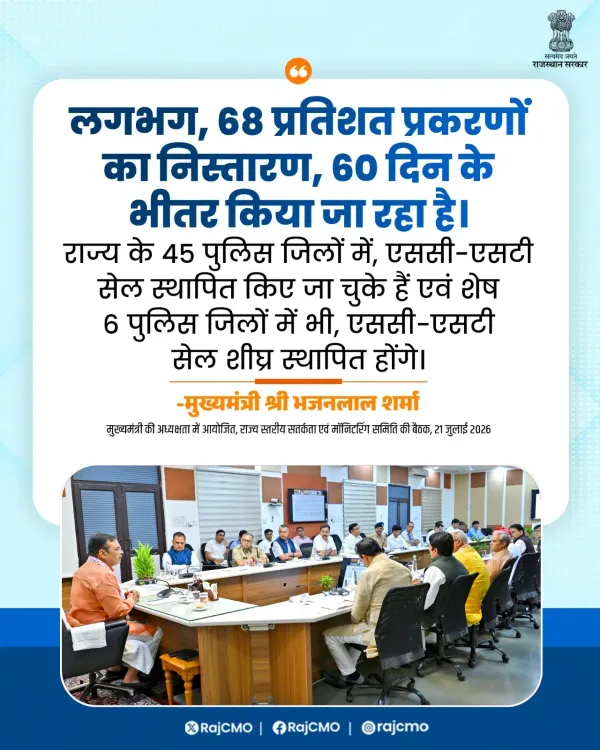
The Chief Minister's Office of Rajasthan announced on 22 July 2026 that approximately 68 per cent of cases are being resolved within 60 days, highlighting the Bhajanlal Sharma government's push for time-bound public service delivery under the 'Our Leading Rajasthan' banner.
Key Takeaways
The Chief Minister's Office of Rajasthan announced on 22 July 2026 that approximately 68 per cent of cases are being resolved within 60 days .
The post tagged Chief Minister Bhajanlal Sharma and was shared under the hashtag #आपणो_अग्रणी_राजस्थान ('Our Leading Rajasthan').
Rajasthan has had Right to Public Services legislation mandating time-bound delivery since the early 2010s.
The BJP government took office in December 2023 and has made administrative efficiency a key governance theme.
Roughly 32 per cent of cases are not being resolved within the 60-day window, a gap the announcement does not address.
Quarterly portal reports and possible Rajasthan Assembly updates to Right to Services timelines are the next milestones to watch.
The Chief Minister's Office of Rajasthan announced on Wednesday, 22 July 2026 that approximately 68 per cent of cases are being resolved within 60 days, tagging Chief Minister Bhajanlal Sharma in the post under the hashtag #आपणो_अग्रणी_राजस्थान ('Our Leading Rajasthan').
Context
The post, shared from the official @RajCMO handle, states: 'लगभग 68 प्रतिशत प्रकरणों का निस्तारण, 60 दिन के भीतर किया जा रहा है' — translated as 'approximately 68 per cent of cases are being disposed of within 60 days.' The reference to 'prakarana' (cases or matters) broadly covers public grievances and service applications routed through the state's administrative machinery. The hashtag #आपणो_अग्रणी_राजस्थान translates to 'Our Leading Rajasthan,' a phrase the Bhajanlal Sharma government has used to frame its administrative reform agenda.
Policy Backdrop
Rajasthan has maintained a legislative framework for time-bound public service delivery since the early 2010s, when the state enacted Right to Public Services legislation that mandated disposal timelines for notified government services. Successive administrations have built on this foundation through e-governance portals designed to track and escalate pending applications. The BJP government, which assumed office in December 2023 after winning the state assembly elections, has placed administrative efficiency and ease-of-living metrics at the centre of its governance communication. Publicising disposal rates is consistent with a broader pattern seen across BJP-ruled states, where digital dashboards and periodic performance data are used to demonstrate responsiveness to citizens.
Stakeholders and Impact
The primary beneficiaries of faster case resolution are Rajasthan's residents who submit applications for public services — ranging from certificates and land records to social welfare entitlements. A 60-day disposal benchmark, if sustained across departments, would reduce the backlog that has historically forced applicants to make repeated visits to government offices or rely on intermediaries. Civil society groups monitoring grievance redressal in the state have long called for shorter, enforceable timelines backed by penalty clauses for defaulting officials. The government's decision to highlight the 68 per cent figure publicly signals an intent to be held accountable against a measurable standard, even as the remaining roughly 32 per cent of cases that exceed the 60-day window remain unaddressed in the announcement.
What's Next
Observers will watch for quarterly grievance-disposal reports from state portals that can corroborate or contextualise the 68 per cent claim with department-wise and district-wise breakdowns. The Rajasthan Assembly may also see legislative proposals to revise or tighten the timelines under the Right to Services framework. If the government moves to publish granular data — including the categories of cases being resolved and those that are not — it would mark a meaningful step toward transparency in public service delivery. The metric, as it stands, sets a public benchmark that civil society and opposition legislators are likely to scrutinise in the coming months.
Point of View
Now past its two-year mark, shifting the narrative from electoral promises to measurable delivery metrics is politically necessary ahead of the next assessment cycle. The hashtag #आपणो_अग्रणी_राजस्थान frames this as part of a larger brand-building exercise, consistent with how BJP-ruled states have used digital governance data as a soft-power tool. The real test will come when opposition legislators and civil society demand a breakdown by district, department, and case type — because aggregate disposal rates can mask significant pockets of administrative failure.
NationPress
22 Jul 2026
Frequently Asked Questions
What does the Rajasthan CMO's 68 per cent case resolution announcement mean?
The Chief Minister's Office of Rajasthan stated on 22 July 2026 that approximately 68 per cent of cases — covering public grievances and service applications — are being resolved within 60 days, presenting it as a marker of administrative efficiency under CM Bhajanlal Sharma.
What is the 60-day case disposal rule in Rajasthan?
Rajasthan's Right to Public Services framework, in place since the early 2010s, mandates time-bound delivery of notified government services. The 60-day window referenced by the CMO appears to be the benchmark being tracked across departments.
Who is Bhajanlal Sharma and why is he tagged in the post?
Bhajanlal Sharma is the Chief Minister of Rajasthan, leading the BJP state government since December 2023. He was tagged in the CMO's post to associate the disposal metric directly with his administration's governance record.
What is the meaning of #AapnoAgraniRajasthan?
The hashtag #आपणो_अग्रणी_राजस्थान translates from Rajasthani and Hindi as 'Our Leading Rajasthan.' The Bhajanlal Sharma government uses it as a campaign tag for announcements highlighting the state's progress and administrative achievements.
What percentage of Rajasthan cases are NOT resolved within 60 days?
Based on the CMO's own figure of approximately 68 per cent being resolved within 60 days, roughly 32 per cent of cases are not meeting that timeline. The announcement does not provide details on the nature or volume of those pending cases.