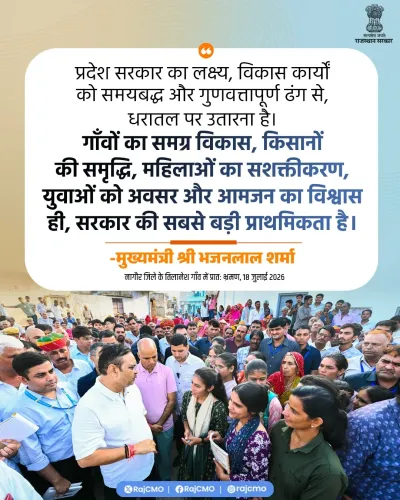
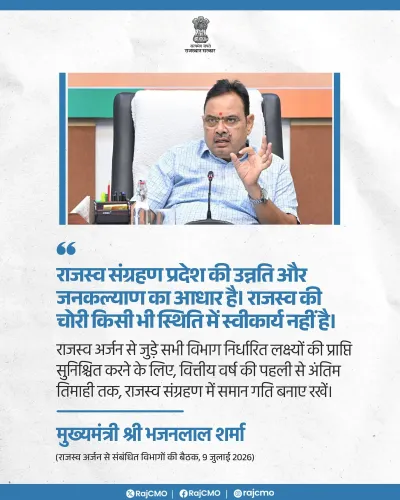
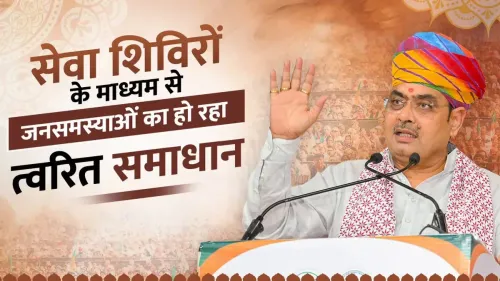
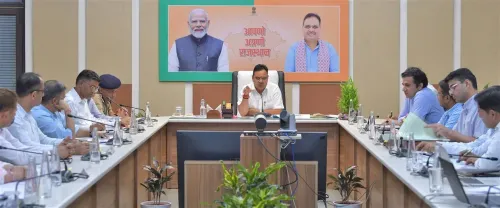
CM Bhajanlal flags grievance redressal as Rajasthan's top priority
Synopsis
The Chief Minister's Office of Rajasthan posted on 20 June 2026 that timely resolution of citizens' grievances is the state government's highest priority, reaffirming CM Bhajanlal Sharma's administration's focus on responsive governance under the hashtag 'Our Leading Rajasthan'.
Key Takeaways
The Chief Minister's Office of Rajasthan declared timely grievance redressal the state government's highest priority in a post dated 20 June 2026 .
Chief Minister Bhajanlal Sharma , in office since December 2023 , was directly tagged in the post, personalising accountability for the commitment.
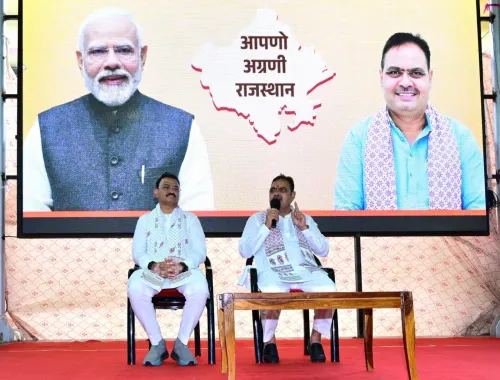
The message was shared under the hashtag #आपणो_अग्रणी_राजस्थान ('Our Leading Rajasthan'), linking governance to a broader state-branding campaign.
Rajasthan has long-standing grievance mechanisms including a CM helpline and Jan Sunwai public hearings that the current administration is expected to build upon.
The public reaffirmation sets a political benchmark that opposition legislators and civil society groups are likely to cite when evaluating the government's administrative record.
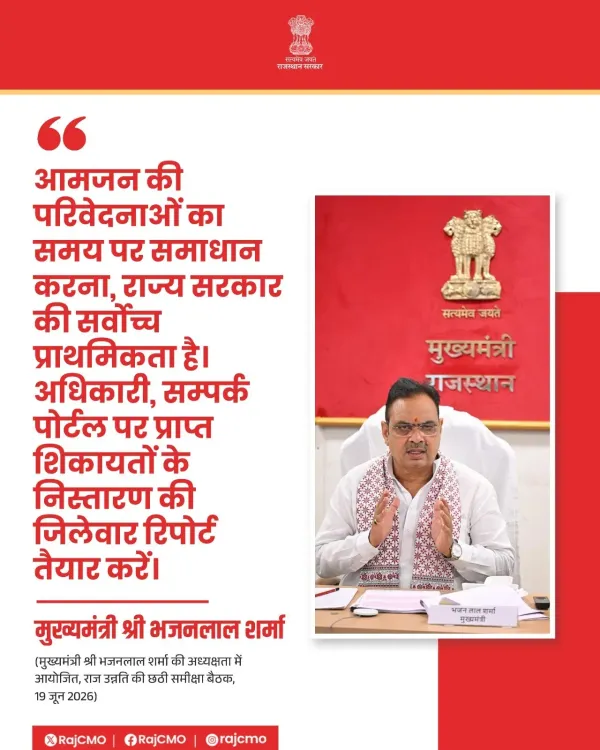
The Chief Minister's Office of Rajasthan reaffirmed on Saturday, 20 June 2026 that resolving the grievances of ordinary citizens in a timely manner is the state government's highest priority, posting the message on X under the hashtag #आपणो_अग्रणी_राजस्थान ('Our Leading Rajasthan').
Context
The post, attributed to Chief Minister Bhajanlal Sharma, states in Hindi: 'आमजन की परिवेदनाओं का समय पर समाधान करना, राज्य सरकार की सर्वोच्च प्राथमिकता है' — 'Resolving the grievances of the common people in a timely manner is the highest priority of the state government.' The statement signals a continued emphasis on citizen-facing administration under the BJP government that took office in December 2023.
Rajasthan has a long-standing institutional framework for public grievance redressal, including CM helplines and Jan Sunwai (public hearing) mechanisms that predate the current administration. The present government has positioned itself as building on and strengthening these channels.
Policy Backdrop
Across Indian states, grievance redressal systems have evolved from periodic physical camps to integrated digital portals that track complaint status and disposal timelines. The push to reduce pendency — the backlog of unresolved complaints — has become a standard administrative benchmark for state governments seeking to demonstrate responsiveness.
In Rajasthan, mechanisms such as the CM helpline and scheduled public hearings have historically served as the primary interface between citizens and the state machinery. Commitments to timely resolution are often followed by administrative circulars setting disposal deadlines for district and block-level officers.
Stakeholders and Impact
The direct beneficiaries of an effective grievance redressal system are common citizens — particularly those in rural and semi-urban areas who rely on government services for land records, pensions, utilities, and welfare entitlements. Delays in resolving such complaints can have material consequences for vulnerable households.
For district collectors, block-level officers, and departmental heads, a renewed emphasis from the Chief Minister's Office typically translates into stricter monitoring of complaint disposal rates and accountability for pendency. The hashtag #आपणो_अग्रणी_राजस्थान situates this governance message within a broader campaign framing Rajasthan as a leading, progressive state.
What's Next
Observers will watch for concrete follow-through: whether the government announces specific disposal timelines, new digital features on existing grievance portals, or assembly-floor disclosures on complaint pendency rates. Budget sessions and administrative reviews are the typical forums where such commitments are translated into measurable targets.
The reaffirmation of grievance redressal as the 'highest priority' sets a political benchmark that civil society groups and opposition legislators are likely to reference when scrutinising the government's administrative record in the months ahead.
Point of View
Using social media to publicly anchor the government's identity around administrative responsiveness — a theme that resonates strongly in a large, rural-heavy state like Rajasthan where citizen-state friction over service delivery is persistent. By tagging CM Bhajanlal Sharma directly, the office personalises accountability, a tactic that raises the political stakes for bureaucratic performance. This fits a broader pattern among BJP-governed states of using the Chief Minister's personal brand to drive administrative compliance, with grievance disposal rates increasingly treated as electoral optics rather than mere administrative metrics. The forward-looking question is whether this public commitment is backed by measurable targets and transparent reporting.
NationPress
19 Sept 2026
Frequently Asked Questions
What did the Rajasthan Chief Minister's Office say about public grievances?
The Chief Minister's Office of Rajasthan stated on 20 June 2026 that resolving the grievances of common citizens in a timely manner is the state government's highest priority.
Who is the Chief Minister of Rajasthan in 2026?
Bhajanlal Sharma of the BJP has been serving as Chief Minister of Rajasthan since December 2023.
What is the Rajasthan CM helpline and how does it work?
The Rajasthan CM helpline is a citizen grievance mechanism that allows residents to register complaints related to government services; complaints are routed to the relevant department for time-bound resolution and can be tracked by the complainant.
What does 'Aapno Agrni Rajasthan' mean?
'Aapno Agrni Rajasthan' is a Hindi phrase meaning 'Our Leading Rajasthan,' used as a campaign hashtag by the Rajasthan government to frame its governance and development initiatives.
How does Rajasthan handle public grievance redressal?
Rajasthan operates multiple grievance channels including a CM helpline, Jan Sunwai (public hearing) sessions, and digital portals where citizens can file and track complaints against government departments.